
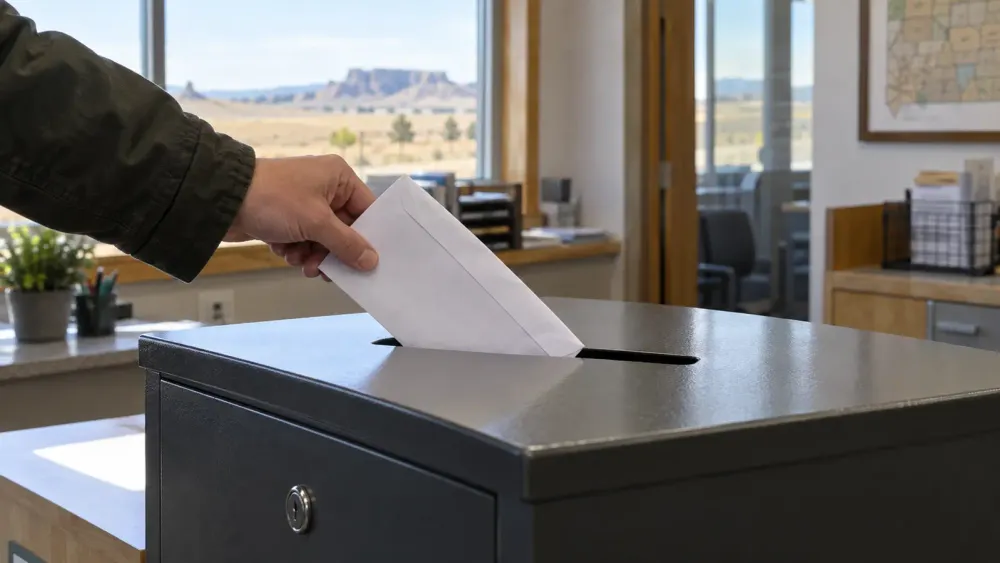
South Dakota voters can begin casting absentee ballots Friday, September 18, opening a 46-day voting window before the November 3 general election. The Secretary of State’s election schedule sets October 19 as the registration deadline and confirms the absentee start date.
Registered voters may vote early in person at their county auditor’s office once absentee voting begins. The state’s absentee-voting instructions say voters should bring valid photo identification; anyone without photo ID must be offered a personal-identification affidavit and allowed to cast a regular ballot. Office hours vary by county, so voters should confirm local hours and location before traveling.
Voting by mail requires an original, signed absentee-ballot application sent to the voter’s county election official. The Secretary of State provides a fillable application and county contact list online, but only voters covered by federal military and overseas-voting law may submit the application by fax or email. After approving a request, the county election official mails a paper ballot for the voter to complete and return.
The legal deadline for most absentee requests is 5 p.m. local time on Monday, November 2. That date is a statutory cutoff, not a recommended mailing date: the official election calendar also says no public official may mail an absentee ballot after that Monday. A completed ballot must reach the county election official early enough on Election Day to be delivered to the voter’s precinct before polls close at 7 p.m. local time.
Registration comes first
People who are not yet registered must submit a form bearing an original signature to their county auditor by 5 p.m. local time October 19. South Dakota does not accept voter-registration forms by email or fax, according to the state’s registration guidance. The form can also update a voter’s name, address or party affiliation.
New registrants should also review the state’s 2026 citizenship-document rules before filing. The Secretary of State says a new voter who does not provide documentary proof of citizenship at registration will be recorded as a federal-only voter. Listed proof includes certain state identification cards, tribal identification, a birth certificate, U.S. passport, consular birth report or naturalization certificate. Voters using a commercial mail-receiving address, forwarding service or post-office box must also describe the location where they live or may receive a federal-only designation.
The state’s Voter Information Portal lets residents verify registration, locate their county election official, view a sample ballot and track an absentee ballot. Voters confined by sickness or disability may use an authorized messenger; the state says those applications must arrive before 3 p.m. on Election Day. Military members and overseas citizens follow separate federal procedures linked from the absentee-voting page.
For Election Day itself, polls will operate from 7 a.m. to 7 p.m. local time on November 3. The practical advantage of acting when absentee voting opens is time: voters can correct registration issues, avoid last-minute postal delays and confirm through the state portal that election officials received their ballot.