
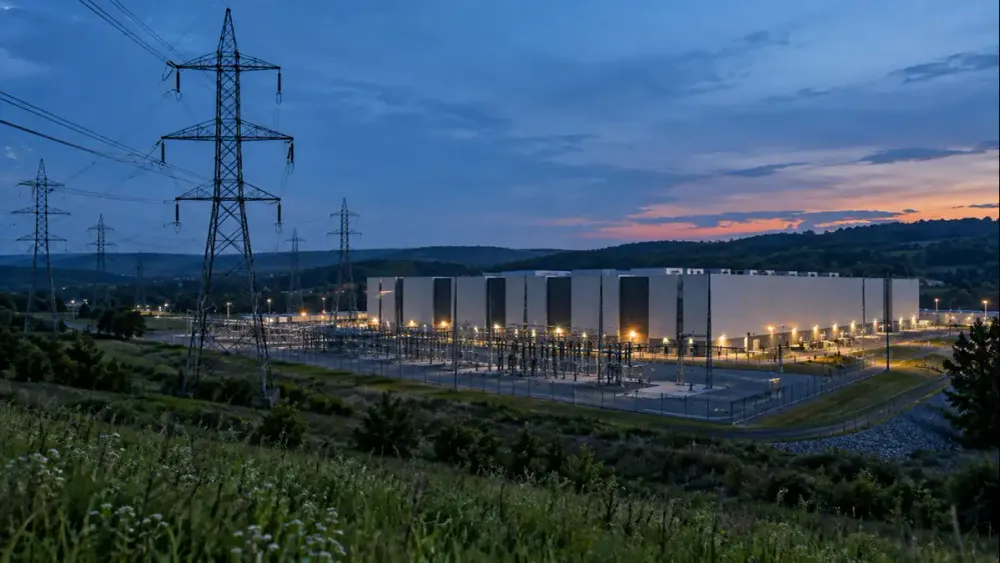
A Pennsylvania-commissioned analysis warns that the regional electric grid could fall short of its reliability planning standard from 2027 through 2030 if demand—driven largely by data centers—rises as forecast and no additional policy changes occur. In the study’s reference case, the modeled risk of insufficient supply in 2030 is nearly six times the standard used by PJM Interconnection.
The 50-page analysis, prepared for the Pennsylvania Public Utility Commission by Synapse Energy Economics with Mondre Energy and Aspen Technologies, does not predict six blackouts or any fixed number of customer outages. It models “loss-of-load expectation,” a planning measure used to estimate how frequently available generation may be insufficient for demand. PJM’s criterion is an expected one event in 10 years; the reference scenario reaches 0.59 events per year by 2030.
Data-center demand changes the forecast
The report modeled three futures. Both the reference case and a high-demand, constrained-supply case fail PJM’s reliability criterion from 2027 through 2030. A third scenario assuming no new data-center load beginning in 2027 remains within the standard. The authors identify large-load additions from data centers as the principal cause of the sharp deterioration projected for 2030, alongside retiring generators and delays in bringing replacement resources online.
The severe scenario reaches an expectation of 13.2 loss-of-load events per year in 2030, more than 100 times the planning criterion. That figure is a stress test, not the study’s most likely outcome. The report says the reference case is based on PJM’s 2026 load forecast, while the severe case combines higher demand with constrained development of new supply.
In releasing the study, the Public Utility Commission said the findings require urgent action by PJM and a broader Pennsylvania energy strategy. Chairman Steve DeFrank said data-center investment cannot come at the expense of reliable and affordable service for existing homes and businesses. The commission also emphasized that the model illustrates risk rather than forecasting a specific outage count.
Regulatory decisions are next
The commission has already begun a related rulemaking process. In a unanimous September 10 vote, it directed staff to draft clearer emergency load-control procedures and announced a technical conference on who should pay costs created by large computational loads. The proposal is intended to address when and in what order customers could be curtailed during stressed grid conditions.
Staff are scheduled to present a tentative order at the commission’s October 1 public meeting. If approved, the draft would go out for public comment, with final commission action targeted for January 28, 2027. The separate technical conference is expected to examine how utilities identify and allocate costs so households and businesses that are not creating the new demand are not automatically assigned those expenses.
For Pennsylvanians, the immediate significance is regulatory rather than an imminent outage warning. The study gives state officials a quantified basis for decisions about large-load tariffs, emergency curtailment and new generation. Those proceedings will determine how the projected risk is divided among data-center developers, utilities and existing customers—and whether planned supply can catch up before the model’s most acute pressure arrives in 2030.