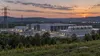

North Dakota Attorney General Drew Wrigley has concluded that only the school district containing Grand Sky’s leased property may impose a school tax on it, leaving local officials to determine whether the 216.65-acre technology park belongs within the Grand Forks Air Force Base district or the Larimore district.
The Sept. 15 legal opinion does not decide that boundary question. Instead, it says the answer depends on factual findings that the attorney general’s office is not authorized to make. Until those findings are completed, the opinion establishes the controlling rule: a school district’s taxing authority stops at its borders.
A dispute tied to federal land
Grand Sky was created in 2015 on 216.65 acres at the southeastern corner of Grand Forks Air Force Base. The Air Force owns the land and leases it to Grand Forks County, which subleases it to Grand Sky Development Company. Because the property is federally owned, it historically was exempt from local taxation, but federal law allows state and local governments to tax a private lessee’s interest in military property.
Grand Forks County has collected taxes on the leased property since 2015, including a school mill levy distributed to Larimore Public School District. The Base District is considering a levy of its own to support educational services that Grand Forks Public Schools provides for students living on the installation. Wrigley’s opinion says both districts cannot simply claim the same tax base; the lawful recipient turns on where the property is located.
North Dakota’s school-tax statutes require district levies to be based on the taxable valuation within the district. The attorney general therefore found that the Grand Sky lease may be taxed, but only by the district whose legal boundaries encompass it.
What local officials must decide
The key boundary test appears in the state’s military-school law. It defines a military installation school district as covering the lands over which the installation has exclusive, concurrent or proprietary jurisdiction. The Grand Sky lease says the United States exercises proprietary legislative jurisdiction over the property and that the installation must retain control because of the site’s strategic location near the runway and military facilities.
Those lease terms could support inclusion in the Base District, but the attorney general stopped short of making that factual determination. The opinion directs the local jurisdictions to establish whether the property satisfies the statutory test. If it does, the Base District would be the only school district authorized to levy the tax. If it does not, the existing Larimore levy could remain the relevant school tax.
The ruling has implications beyond one parcel because North Dakota law uses district boundaries to allocate taxing authority across school systems. For local officials, the immediate task is administrative and evidentiary: review the lease, jurisdictional records and district maps, then reach a defensible boundary finding before setting or redirecting a levy.
The opinion governs public officials unless a court later decides the issue differently. It does not set a tax rate, calculate revenue or order an immediate transfer of money. Its practical effect is to prevent overlapping school taxation while forcing the two districts and Grand Forks County to settle which district lawfully contains Grand Sky.