North Carolina has begun real-world flight testing for a proposed statewide network linking rural airports, hospitals and major aviation hubs. The first phase of eLIFT-NC included more than 16 medical and disaster-response missions by BETA Technologies, while Joby Aviation flew a remotely piloted aircraft from Dare County Regional Airport to Raleigh-Durham International Airport, according to the U.S. Transportation Department.
The September demonstrations are part of the Federal Aviation Administration’s Advanced Air Mobility Integration Pilot Program. North Carolina’s transportation department is using the project to test how next-generation aircraft could carry medical supplies, specialists and emergency cargo between the coast, the Research Triangle and other communities. State officials marked the flights at a September 23 showcase, calling them North Carolina’s first electric air-taxi operations under the federal program.
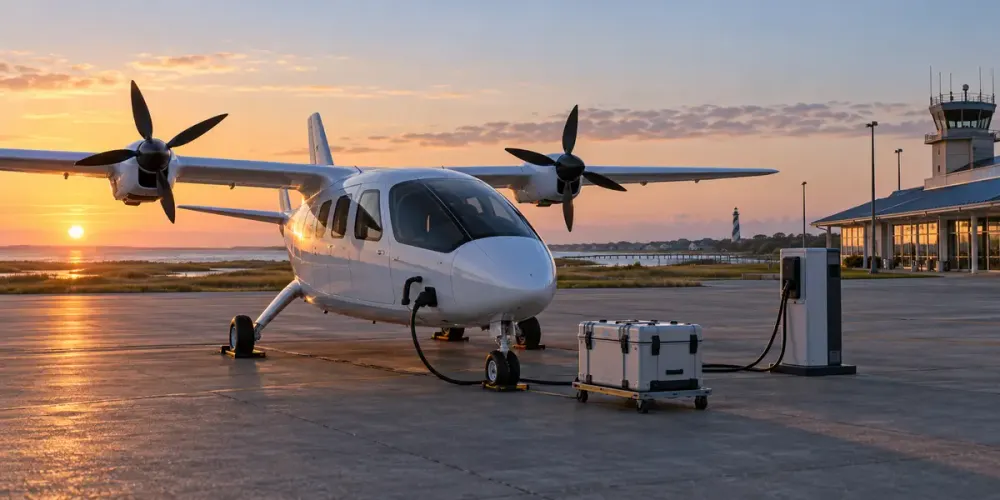
BETA’s electric ALIA aircraft completed multiple flights among Raleigh Executive Jetport, Pitt-Greenville Airport and Dare County Regional Airport. The company said the missions carried a field medical station and supplies. Joby’s autonomous J208, a converted Cessna Caravan, made the Outer Banks-to-RDU route after completing a 3,199-mile cross-country flight with no control inputs from its onboard safety pilot, according to the company’s flight report.
Testing before routine service
The flights do not establish a scheduled passenger service. They are tests intended to generate operational and safety data for the FAA, which is developing rules for electric vertical-takeoff aircraft, autonomous planes and related systems. The federal program notice says North Carolina is the fifth location to begin demonstrations and that additional state flights are planned through the rest of 2026.
Phase one will focus on establishing routes, expanding airport pairs, building safety cases, engaging local communities and collecting operating data, the governor’s office said. Earlier planning described a longer path from training and baseline operations to expanded routes and, eventually, hospital-to-hospital missions. It also identified needs beyond the aircraft themselves, including charging equipment, vertiports and digital systems, according to an EdNC overview.
The immediate public-service case is distance. Transporting supplies or personnel between the Triangle and eastern counties by road can take hours, while storms can close or damage surface routes. Aviation may shorten some trips, but any routine network would still depend on aircraft certification, reliable charging, suitable landing sites, weather limits and a sustainable operating model. The demonstrations measure those practical constraints rather than proving that a statewide service is ready.
The project also fits North Carolina’s larger aerospace strategy. More than 400 aerospace companies operate in the state, and the industry contributes an estimated $88 billion annually to the state economy, according to the state release. For now, eLIFT-NC’s consequence is narrower: federal regulators and state planners have moved from proposals to measured flights on actual North Carolina routes.