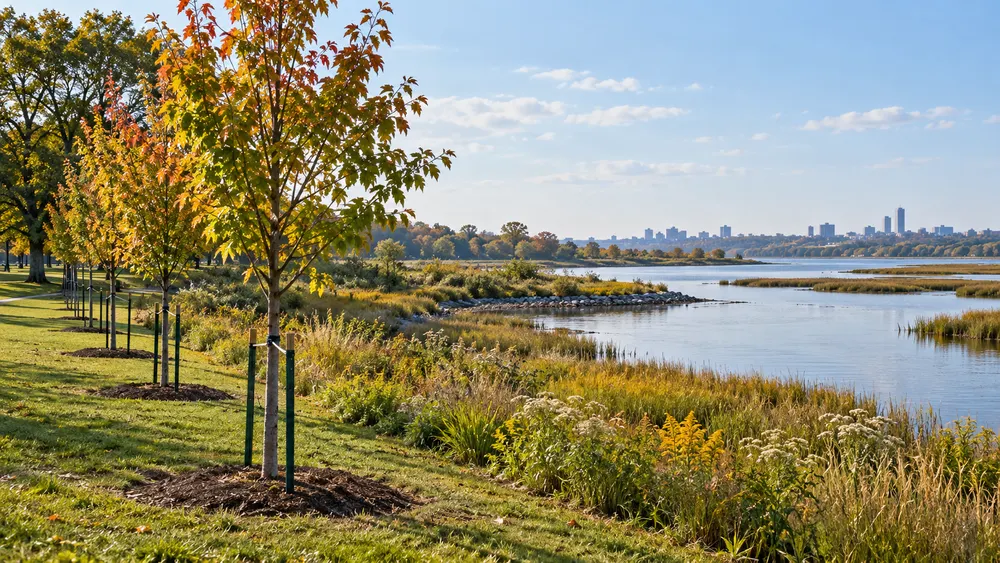
New Jersey has awarded $9.4 million for eight projects designed to store carbon, reduce flooding and improve local environments through trees, wetlands, forests and living shorelines. The Department of Environmental Protection announced the grants on September 22 as part of its Natural Climate Solutions program, pairing the new awards with a milestone in Trenton, where a state-backed project completed its 1,000th tree planting.
The largest single award, about $2.69 million, will go to Aberdeen Township for three acres of salt-marsh restoration, a half-mile living shoreline and three acres of coastal forest. Woodbridge Township received two awards: roughly $1.08 million to plant 380 trees at four schools and $1.30 million to restore a half-acre wetland at Captain Carlsen Park. Passaic County will use about $1.48 million to protect 49 acres and plant 12,200 trees in West Milford.
Four other recipients round out the package. Union Township was awarded approximately $898,000 for 581 trees; Morristown will receive about $759,000 for 500 trees; the Sussex County Municipal Utilities Authority was awarded roughly $672,000 to plant 5,000 trees across 20 acres along the Wallkill River; and the Tenafly Nature Center will receive about $566,000 for forest restoration. Together, the projects illustrate the range of work eligible under the state program, which supports projects that create, restore or enhance natural carbon sinks such as marshes, forests, urban parks and street-tree networks.
Trenton tree program reaches its target
The state announcement also marked the completion of the $1.3 million Trees for Trenton project. Its 1,000th tree, a London plane, was planted on South Clinton Avenue. The initiative’s public site says planting locations were chosen with an emphasis on low-canopy neighborhoods, suitable sidewalk space and the absence of overhead utility wires. The New Jersey Conservation Foundation, one of the project partners, describes the effort as a collaboration to put 1,000 shade trees along streets and in parks over several years.
The new grants are part of a broader funding cycle rather than isolated municipal awards. The state previously announced $14.8 million for three projects in April, and the current program page lists December 31, 2026, as the application deadline for remaining funds. A program overview from the New Jersey Business & Industry Association described the overall initiative as a $30 million opportunity for eligible public and nonprofit applicants.
The practical value of the eight awards will depend on implementation: trees must survive, restored wetlands must function, and protected acreage must remain intact to deliver lasting benefits. The project designs give the state measurable targets—numbers of trees, acres restored and shoreline distance—against which progress can be evaluated. For residents, the near-term effects are more local: shade at schools and along streets, added flood resilience in coastal communities and restored habitat in parks and river corridors.