The federal government has dropped its appeal in the legal fight over the $16 billion Gateway Hudson Tunnel Project, ending the latest attempt to withhold money from the rail expansion linking New Jersey and New York.
A filing in the U.S. Court of Appeals for the Second Circuit says the federal government, New Jersey and New York agreed to dismiss the appeal, according to the New Jersey Monitor. The move leaves intact a lower-court order requiring federal agencies to honor the project’s funding agreements.
The decision removes a major legal uncertainty from one of the country’s largest infrastructure projects. The Hudson Tunnel Project’s official plan calls for building a new two-track tunnel under the Hudson River and rehabilitating the existing North River Tunnel. Once complete, the corridor is intended to provide four tracks between New Jersey and New York, allowing the old tubes to be repaired without eliminating the current rail connection.
The existing tunnel opened in 1910 and was damaged by saltwater during Superstorm Sandy. Reuters reported that about 200,000 passengers and 425 trains use the corridor on a typical weekday, making an extended failure or shutdown a regional transportation risk as well as a New Jersey commuting problem.
The funding dispute began after federal payments were frozen. In June, a federal judge permanently barred the government from withholding the money, finding that the freeze violated binding grant commitments. The court ruling was described at the time as protection for contracts on which the states and Gateway Development Commission had already relied. The government appealed in August before abandoning that challenge in September.
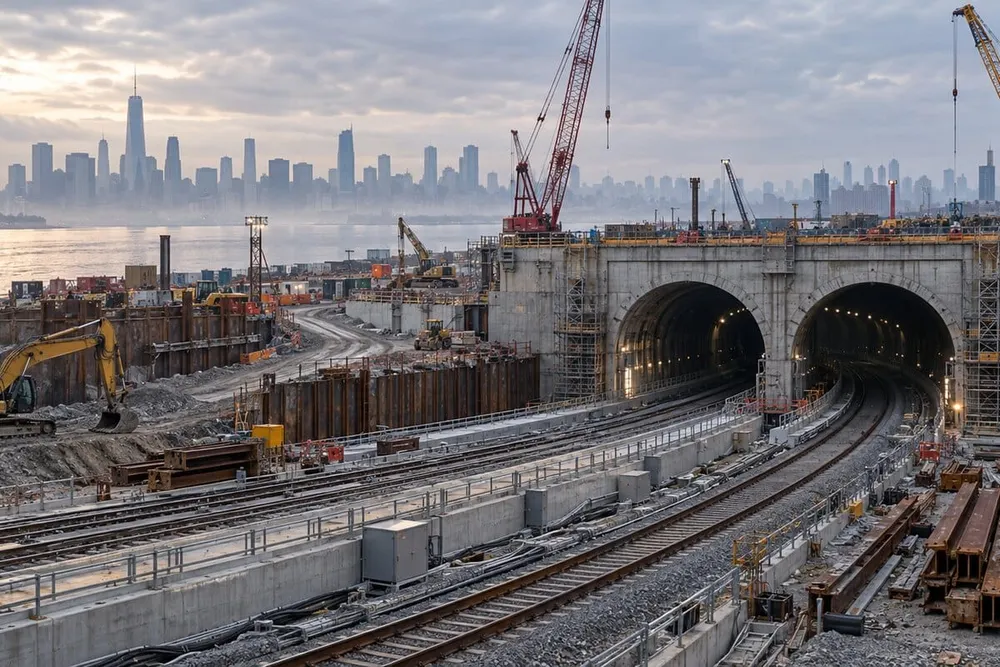
Construction did not fully stop during the litigation. The Gateway Development Commission says the project is divided into 10 construction packages, with seven in progress or completed. Those packages include work on both sides of the Hudson, tunnel approaches and supporting infrastructure needed before boring and rehabilitation can advance at full scale.
Visible progress does not eliminate the project’s dependence on steady federal reimbursements. Contractors must sequence utility relocation, excavation, river protection and rail work across multiple active sites. A renewed interruption could therefore affect more than a single invoice: it could force agencies to resequence connected packages and increase delay risk across the wider program.
For New Jersey, the dismissal stabilizes federal support for a project tied directly to NJ Transit’s busiest connection into Manhattan. Gov. Mikie Sherrill said the outcome protects nearly 100,000 jobs and the commutes of millions of riders. Those are projections rather than completed benefits, and the project still faces the ordinary risks of large public works, including schedule pressure, construction complexity and cost control.
The end of the appeal does not finish Gateway, but it narrows the remaining challenge to execution. The key questions now are whether the commission can keep the construction packages coordinated, preserve the funding schedule and deliver the new tunnel before the century-old tubes require a disruptive rehabilitation.