
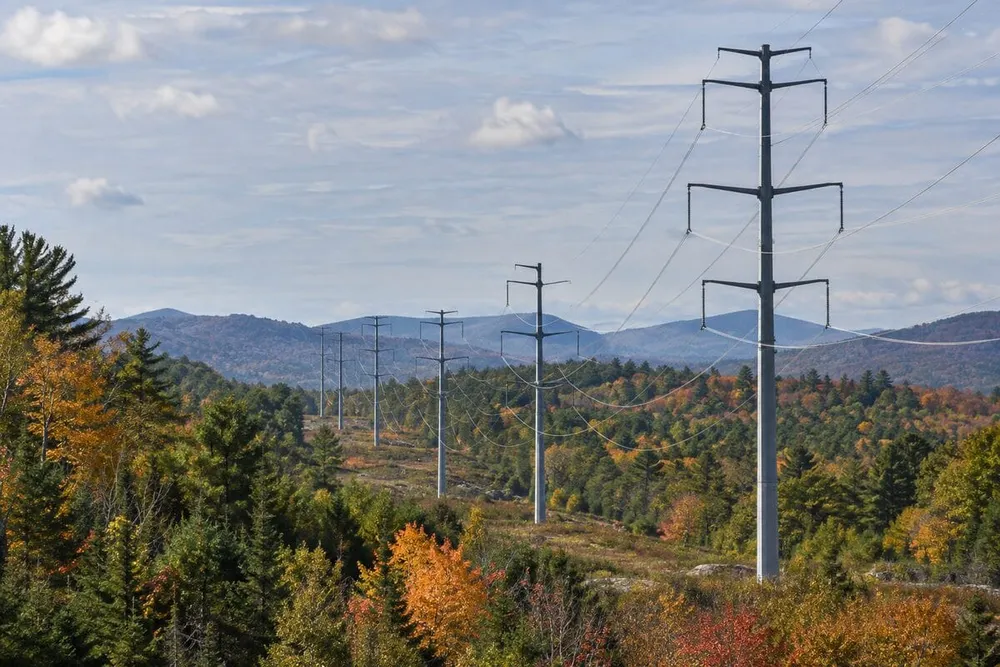
ISO New England has selected an Eversource and Avangrid transmission proposal as its preferred longer-term solution for moving more electricity across northern New England. The selection advances the Transmission Integration and Development project, or TIDE, into detailed engineering and review; it is not a construction permit. The companies say the project could accommodate as much as 1,200 megawatts of future onshore wind generation.
For New Hampshire, the plan is substantial. The proposed route includes a new 18-mile, 345-kilovolt line between Rochester and Deerfield, rebuilding an existing line with steel monopoles, reconductoring lines between Deerfield and the Scobie Pond area of Londonderry, and installing equipment intended to manage voltage and power quality. Eversource says the work would largely use existing transmission corridors, but the precise design and local effects will depend on the next phase of review.
The selection reflects a regional need rather than a final authorization. State and federal approvals would still be required, and the companies anticipate construction in 2029 only if those reviews are completed. Permitting, land-use conditions and the eventual allocation of costs among New England customers remain important unresolved questions. Residents along the Rochester-to-Deerfield corridor should expect formal opportunities to examine route details as regulatory filings develop.
The economic case presented for TIDE is based on modeled regional savings. ISO New England's analysis, as reported by InDepthNH, projects about $1.42 billion in production-cost and congestion savings, $1.30 billion in avoided capital costs and $694 million in avoided transmission investment. Those figures are forecasts used to compare alternatives, not guaranteed reductions on individual New Hampshire electric bills. The eventual customer impact will depend partly on how regulators assign the project's costs.
The proposal is designed to bring electricity from northern Maine toward population centers farther south and to ease constraints around existing high-voltage facilities, including the Seabrook area. The selected package combines new lines, rebuilt lines and substation work across Maine and New Hampshire rather than relying on a single new corridor. New Hampshire was not among the states participating in the associated multistate clean-energy procurement, but the physical route would make the state central to the transmission plan.
ISO New England made the choice through a competitive regional planning process focused on longer-term transmission needs. The developers say the selected plan has a benefit-to-cost ratio of about two to one. That comparison helps explain why the grid operator preferred TIDE, but it does not eliminate scrutiny of construction costs, environmental effects or who ultimately pays.
The practical takeaway is that no immediate service or construction change is expected. Eversource says extensive engineering, environmental, permitting and regulatory work comes next. The project will become more concrete when the developers file route, siting and cost details, giving communities and regulators a clearer basis for weighing regional reliability benefits against local impacts and customer expense.