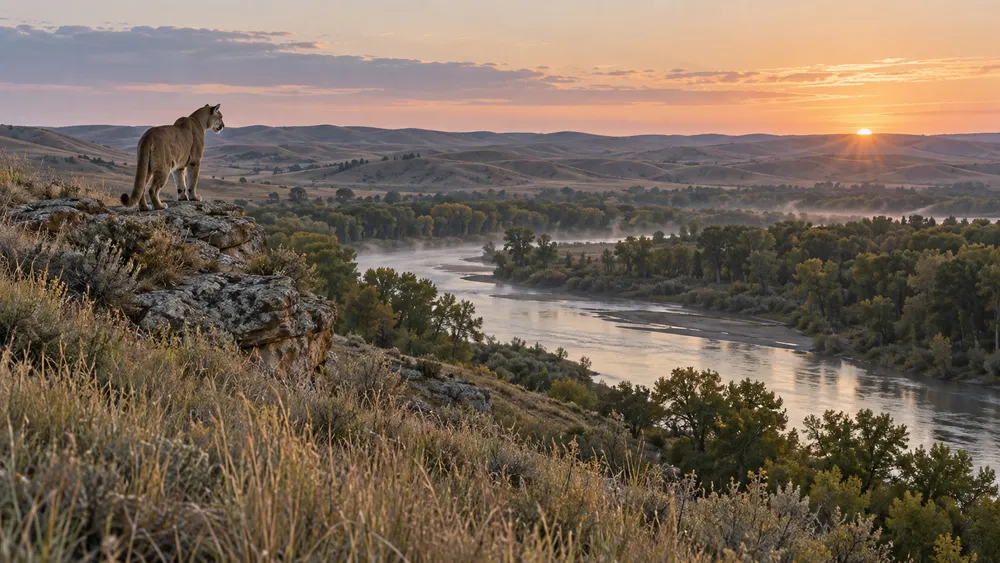
Nebraska wildlife commissioners have approved a wider 2027 mountain lion season in the Niobrara Valley while tightening harvest limits in the Pine Ridge and Wildcat Hills, shifting hunting opportunity toward the part of the state where officials say the population can sustain a larger take. The approved rules expand the Niobrara Unit east to Nebraska Highway 14 and raise its annual harvest limit to 10 lions, no more than five of them females.
The Nebraska Game and Parks Commission also reduced the Pine Ridge limit to three lions, with a one-female sublimit, and cut the Wildcat Hills limit to one. The agency’s 2026 hunt used limits of 12 in Pine Ridge, six in Niobrara and three in Wildcat Hills. That comparison shows the scale of the reset: Niobrara’s quota rises by four as its boundary grows, while the other two units together fall from 15 available lions to four.
For hunters, the framework remains tightly controlled. Season 1 will run from Jan. 2 through Feb. 28, 2027, but each unit closes as soon as its overall limit or female sublimit is reached. Thirty general permits and 20 limited-landowner permits will be issued for every lion authorized in a unit, and applicants must be Nebraska residents. Applications are scheduled from the first Monday in November through the first Friday in December. If the Niobrara quota is not filled, an auxiliary season using dogs may run from March 13 through March 31; the auxiliary option will not apply in the other two units.
The geographic shift follows the commission’s population work. Nebraska’s management program identifies breeding populations in the Pine Ridge, Niobrara Valley and Wildcat Hills and uses genetic sampling, trail cameras and other monitoring to set unit-level limits. The agency says mountain lions naturally recolonized the state after being eliminated in the late 1800s. Regulated hunting began in the Pine Ridge in 2014, expanded to Niobrara in 2024 and reached Wildcat Hills in 2025.
Those differences matter because a statewide quota would obscure the fact that the three populations are managed separately. Game and Parks says it considers population estimates, sex ratios, mortality and habitat when establishing harvest limits. Female sublimits are especially consequential because they constrain the portion of the harvest most directly tied to future reproduction. The 2027 package therefore does not simply increase or reduce hunting statewide; it reallocates pressure among units.
Hunters will still need to monitor closures closely. Nebraska requires harvested lions to be checked in and makes it unlawful to hunt after a unit reaches either cap. The agency posts harvest updates during the season, and permit holders remain responsible for knowing whether their unit is open before hunting. The practical effect is a larger but still capped Niobrara opportunity, paired with sharply narrower access in the Pine Ridge and Wildcat Hills.