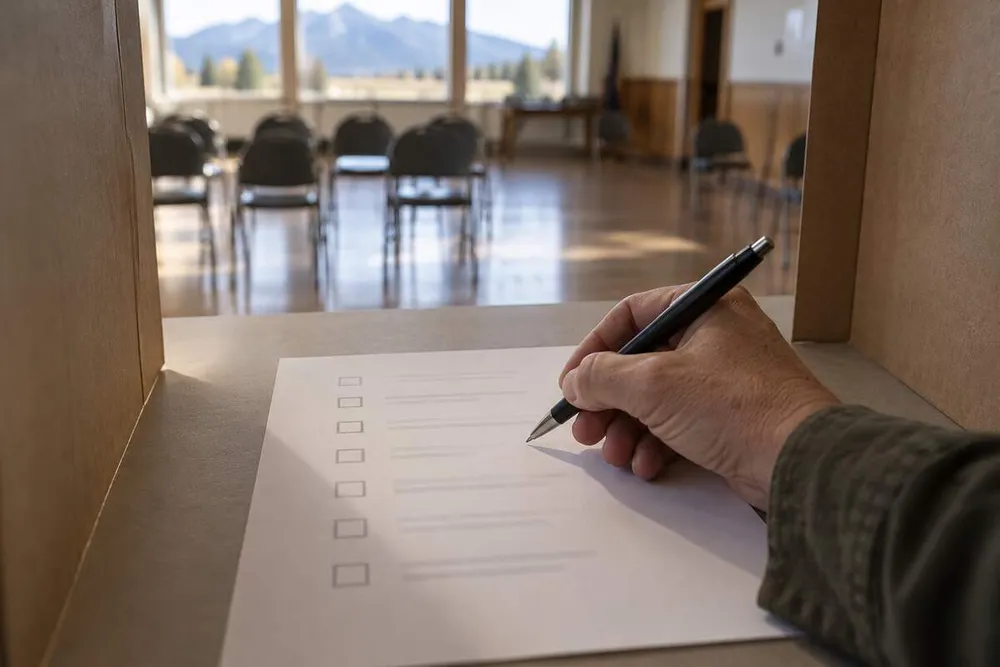
Montana voters will decide on November 3 whether corporations, unions, nonprofits and other legally created entities should be barred from spending money to influence elections in the state. Initiative 194, often called the Montana Plan, would make Montana the first state to attempt that restriction through a corporate-powers framework rather than by directly challenging the First Amendment rule established in Citizens United.
The proposal’s full text defines an “artificial person” broadly to include corporations, limited-liability companies, partnerships, trusts, associations and labor organizations. It would prohibit those entities from making contributions or expenditures for candidates, political parties and ballot measures. The measure says those restrictions would become conditions on the legal privileges that entities receive from the state.
Individuals would remain able to spend their own money on political speech, subject to existing disclosure and campaign-finance rules. That distinction is central to the proposal: I-194 targets the authority of an organization to use its treasury for political activity, not the ability of owners, employees or members to participate as people.
A consequential vote with an unsettled legal future
The initiative is on the general-election ballot after surviving an effort by business groups to stop it before voters could act. Reuters reported September 16 that supporters see Montana as a national test case and that similar proposals are active or under consideration in more than 30 states. The article also noted there has been no independent public polling on I-194.
Supporters argue that states have long possessed authority to define the powers granted to corporations and other entities they create. Opponents answer that the measure would suppress protected political speech and invite expensive litigation. The Montana Chamber of Commerce, which joined an unsuccessful pre-election challenge, says the prohibition would reach businesses and nonprofits that provide money or anything of value to influence ballot questions as well as candidate contests.
The legal uncertainty is real. The U.S. Supreme Court’s 2010 decision in Citizens United v. Federal Election Commission held that independent political spending by corporations and unions is protected speech. I-194 is designed to approach the issue from another direction by conditioning state-conferred entity powers, but courts have not yet accepted that theory as a way around the constitutional holding. Ballotpedia’s measure summary describes the scope of the proposed prohibition and the arguments submitted by each side.
For voters, the immediate choice is narrower than the national debate it could trigger: whether Montana law should deny artificial persons the power to spend in state elections. A “yes” vote enacts the prohibition; a “no” vote leaves current campaign-finance law in place. If approved, litigation is likely to determine how much of the measure can actually be enforced. That court fight could extend well beyond Election Day.