
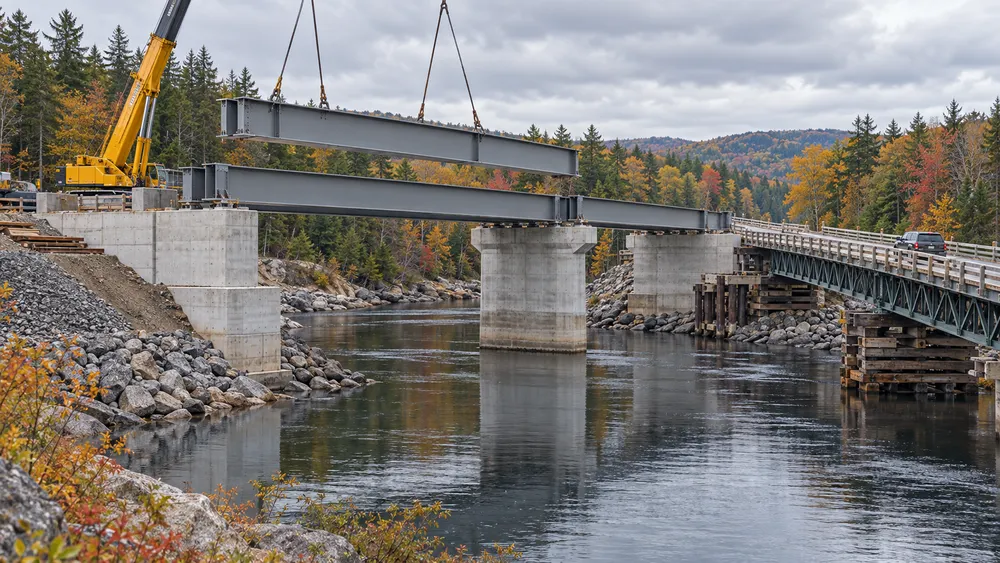
Maine transportation officials will replace the composite girders planned for both Llewellyn Estes bridges in Old Town with conventional steel, a consequential redesign ordered after one span failed during a concrete deck pour in August.
The September 24 decision covers the two bridges that carry Stillwater Avenue over the Stillwater River. MaineDOT Commissioner Dale Doughty approved steel after an internal assessment team concluded it was the most practical way to complete the project using foundations and other substructure work already in place. The department has not yet set a revised cost or completion date.
MaineDOT emphasized that changing materials is a construction decision, not a finding about why the span failed or who may be responsible. Its project FAQ says the outer upstream girder appears to have buckled first at about 1:43 p.m. on August 13, triggering a cascading failure as concrete was being placed. The bridge was not open to traffic. One worker sustained a broken ankle and two others had minor injuries.
The failed span was part of the first bridge. MaineDOT says an adjacent span was damaged and will also be removed. The second bridge used shorter girders, but they shared the same design, fabrication process and materials. The agency concluded it would be imprudent to continue with those girders before the cause is understood and the system is fully tested.
What remains unresolved
Investigators are conducting forensic analysis that includes inspections, testing and computer modeling. A September 8 update said removal of the failed debris was being coordinated with engineers so evidence could be preserved. MaineDOT, contractor Reed & Reed, Basalt International, the University of Maine’s Advanced Structures and Composites Center and the Federal Highway Administration’s Turner-Fairbank center are involved.
The composite technology had been selected in part because it is resistant to corrosion and lighter than steel. MaineDOT says similar composite tub girders have been used on two other Maine bridges. The department has not attributed the failure to the material itself, and its switch to steel does not settle questions about design, fabrication, erection or deck placement.
The project has already undergone a procurement reset. MaineDOT’s project overview says bids received in early 2022 were nearly twice the available construction budget and were rejected. The state then used a construction-manager/general-contractor approach with Reed & Reed; the first phase was valued at about $10 million, with separate highway work estimated at $10.9 million.
For drivers, the immediate route remains the temporary bridge installed beside the work zone. MaineDOT says that structure is safe and will stay in service while the failed spans are removed and steel replacements are designed and installed. The next practical milestones are approval of a demolition plan, completion of the cause assessment and publication of a revised construction schedule.