
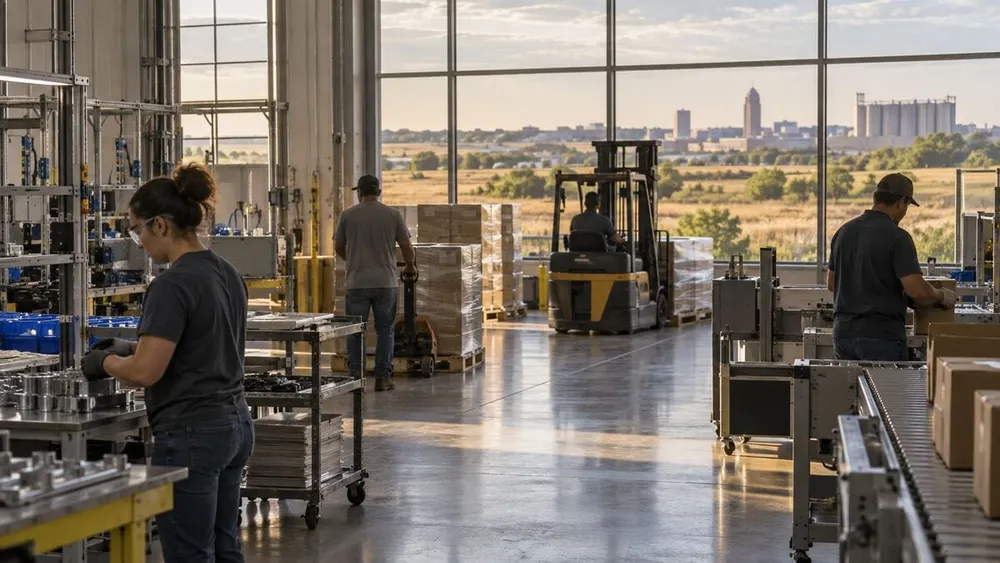
Kansas employers added an estimated 1,900 nonfarm payroll jobs in August, but the state’s civilian labor force fell for a third consecutive month and its unemployment rate held at 3.8 percent. The mixed movement means workplaces reported more jobs even as fewer residents were working or actively seeking work, according to federal labor-force estimates released Friday.
Seasonally adjusted payroll employment reached 1,472,300, up from 1,470,400 in July and 1,465,000 in August 2025. The monthly increase was 0.1 percent, while the year-over-year gain was 7,300 jobs, or 0.5 percent. Those figures come from the Bureau of Labor Statistics’ survey of establishments and count jobs by workplace location rather than individual workers.
The industry-level payroll table showed uneven hiring. Trade, transportation and utilities added 900 positions during August, professional and business services gained 700, and education and health services added 600. Construction increased by 300 jobs, while manufacturing was unchanged. Leisure and hospitality lost 1,000 jobs, and financial activities declined by 400.
Over the year, education and health services and leisure and hospitality each gained 3,100 jobs, while construction added 4,100. Government payrolls fell by 3,500 from August 2025, partially offsetting private-sector increases. The distribution matters because the overall 7,300-job gain was not concentrated in a single industry, but neither was it broad enough to produce a statistically significant statewide increase.
The household-based measure presented a weaker picture. Kansas’ civilian labor force declined by about 2,700 people in August to 1,553,281. The number of unemployed residents increased slightly to 58,912, while the number counted as employed fell by roughly 2,900 to about 1.49 million. Compared with a year earlier, the labor force was smaller by more than 23,000 people, even though the unemployment rate changed only from 3.7 percent to 3.8 percent.
The distinction helps explain why payrolls can rise while resident employment falls. The establishment survey counts jobs located in Kansas and can count one person more than once if that worker holds multiple jobs. The household program counts residents and includes groups, such as the self-employed, who generally are not included in nonfarm payroll totals. Commuting across state lines can also separate where a job is counted from where a worker lives.
Statistical caution is warranted. The BLS September 18 state summary classified payroll employment as essentially unchanged in 46 states and the District of Columbia; Kansas was not among the four states with a statistically significant monthly increase. Its unemployment rate also was not identified as having a significant monthly change.
For state policymakers and employers, the August report therefore carries two signals: modest payroll expansion and continuing pressure on labor supply. The figures are preliminary and subject to revision as more employer and household information becomes available. A durable improvement would require both job growth and stabilization of the resident labor force over subsequent months.