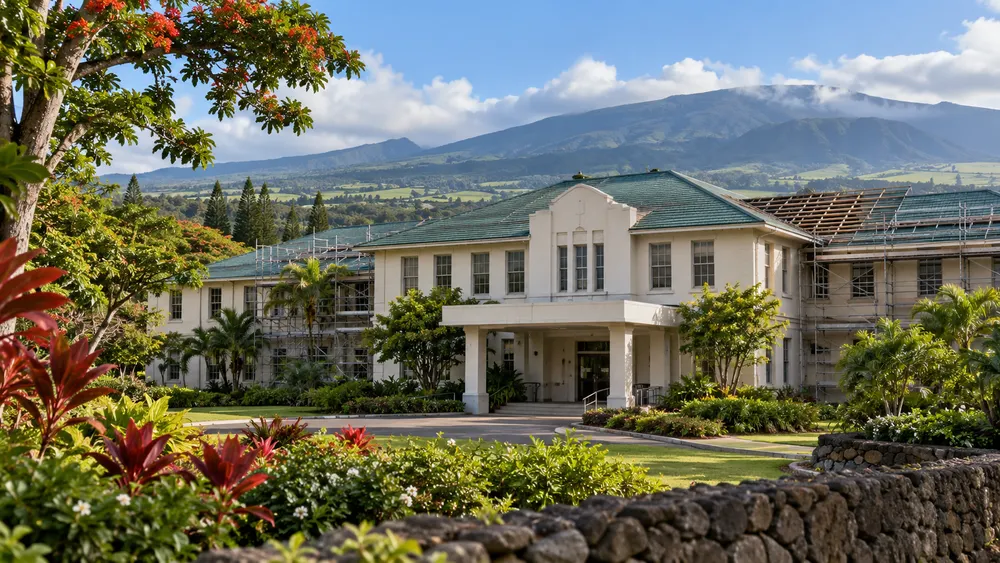
Hawaii will commit $42 million and Kaiser Permanente will invest another $23 million to restore and reopen Kula Hospital, giving Upcountry Maui its first firm path toward recovering emergency, inpatient and long-term-care services lost after severe storms closed the historic facility in March.
Gov. Josh Green announced the $65 million package Tuesday with Maui Health and Kaiser Permanente. The work will repair and modernize interior spaces and essential building systems, install custom windows that meet historic-preservation requirements and strengthen the hospital against future severe weather, according to the governor’s release. Officials did not announce a reopening date or a schedule for returning individual services.
The March Kona Low storms forced the closure of Kula Hospital, its emergency department and Hale Makamae, a nine-bed facility for residents with intellectual disabilities. Before the disaster, the campus also provided 105 long-term-care beds, rehabilitation, diagnostic services and limited acute care. More than 100 patients and residents were relocated to sites on Maui and Oahu after water penetrated much of the five-story building.
The closure removed roughly one-quarter of Maui’s rehabilitation and long-term-care capacity, according to an early assessment reported by Maui Now. It also lengthened some ambulance trips from Upcountry communities, although state monitoring found emergency medical services continued meeting response needs while Maui Memorial Medical Center absorbed additional demand.
Until this week, the hospital’s future remained uncertain. Maui Health said in a September update that damage assessments were complete and remediation was underway, but no final restoration plan had been selected. Kula Clinic, which escaped the major damage, has continued providing weekday outpatient care. Some Hale Makamae residents transferred off-island have begun returning to a temporary home on the Maui Memorial campus.
The new commitment resolves the central funding question but leaves major operational details ahead. Project leaders still must publish a construction schedule, determine whether services can reopen in phases and coordinate the return of patients and staff. Historic-preservation requirements add complexity because Kula Hospital dates to 1910 and grew from a tuberculosis sanitarium into a critical-access hospital serving a geographically isolated community.
Restoration also carries statewide implications. Maui already has limited institutional-care capacity, and moving medically fragile residents between islands separated families and placed pressure on other facilities. In May, Maui Health estimated that roughly 65 percent of the building had suffered water damage, while families told HPR that the uncertainty complicated visits and long-term planning.
The $65 million announcement therefore marks a policy decision to preserve the Upcountry campus rather than permanently redistribute its services. It also gives displaced staff and families a clearer destination after months without certainty. The practical measure of success will be how quickly the partners convert that commitment into a public timeline, resilient repairs and the safe return of emergency care and long-term residents to Kula.