
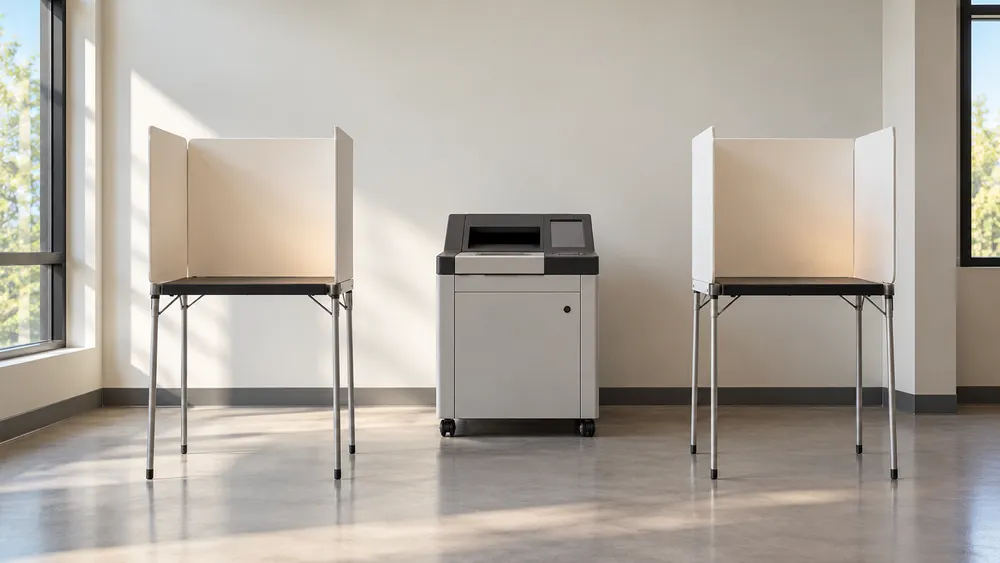
Georgia’s State Election Board stopped short of imposing a new ballot-shuffling procedure after an emergency meeting examined a privacy flaw that can help reconstruct the order in which in-person ballots were cast. The board did not vote on the proposed process but approved a resolution urging the secretary of state to address the vulnerability, according to Associated Press reporting.
The issue concerns ballot secrecy, not vote tabulation. Officials and researchers have said the vulnerability does not change votes or call election outcomes into question. It instead creates a risk that public election records could be combined to connect individual voters with their selections—a separate problem involving privacy, coercion and public confidence.
A test by Princeton researcher Max Springer showed how quickly that risk can scale. Using a commercial artificial-intelligence coding tool and records from Georgia’s May primary, he reconstructed the voting order for 1.52 million in-person ballots, or 98.9% of the ballots examined across 114 of 139 counties. Princeton’s research center said the assistant reversed the electronic-record shuffle and identified what additional records would be needed to match names to ballots.
How the privacy risk works
When a voter feeds a paper ballot into a scanner, the system creates a cast-vote record and assigns it an identifier. Researchers found that the apparent shuffling of those records could be reversed. Combining the recovered sequence with early-voting lists, scanner logs or other timing information can narrow which ballot belongs to which voter. The Guardian reported that the method produced exact or near-exact matches in some smaller jurisdictions.
Georgia’s legal standard is direct. Article II of the state Constitution says elections by the people “shall be by secret ballot.” That guarantee makes the ability to infer voter choices consequential even when ballots are counted accurately.
The proposed last-minute response would have required poll workers to hold and shuffle printed ballots before scanning them. Board members raised operational concerns, including retraining workers shortly before voting, maintaining chain of custody and preventing ballots from being misplaced. The secretary of state’s office has pursued a different mitigation: redacting identifying numbers from public cast-vote records and working on software changes.
A longstanding problem meets an election deadline
This is not the first time the board has considered ballot-secrecy rules. Its official meeting archive shows that proposed Rule 183-1-11-.01 on ballot secrecy was scheduled for possible adoption in August. The new urgency comes from evidence that widely available AI tools can automate a technically complex reconstruction.
Early in-person voting begins Oct. 13, leaving limited time for changes that affect county election workers. The board’s decision avoids an immediate statewide shuffling mandate, but it does not eliminate the underlying privacy risk. State and county officials must still decide which records to redact, what software safeguards can be applied and how to preserve public auditability without exposing voter choices.
For voters, the key distinction is between secrecy and counting accuracy. The reported flaw concerns whether a ballot can be traced back to a person, not whether the recorded choices are tallied correctly. The next practical test will be whether Georgia’s administrative safeguards protect both constitutional privacy and transparent election review during the November cycle.