
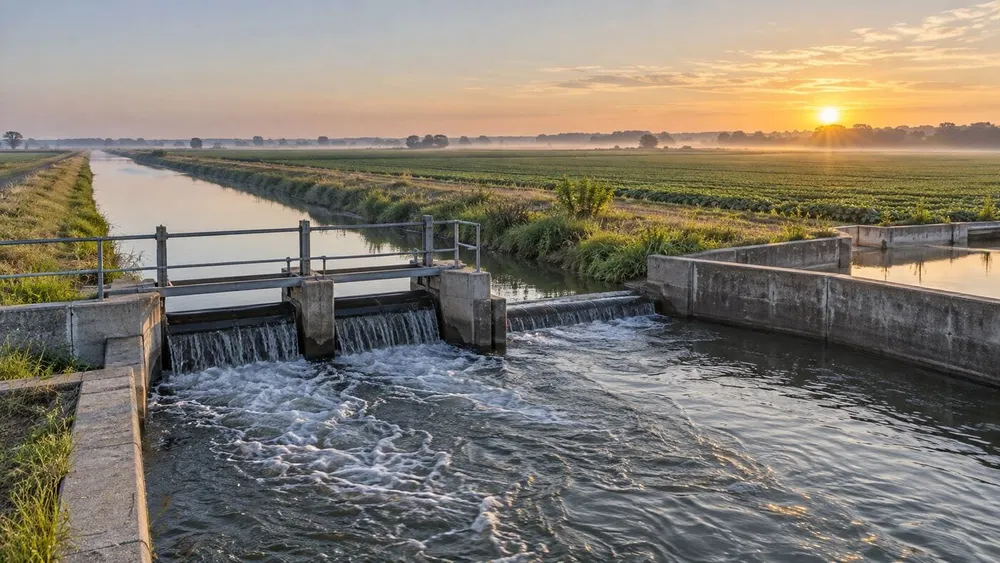
Arkansas approved $8.2 million in financing for three water and wastewater projects on September 16, directing nearly all of the money to a major irrigation system while providing two small cities with emergency wastewater loans.
The package announced by Gov. Sarah Huckabee Sanders includes an $8 million loan to the White River Regional Irrigation Distribution District in Prairie County. The money will continue construction of the Grand Prairie Demonstration Project, an unfinished system intended to move surface water to farms that have long relied on the declining Mississippi River Valley alluvial aquifer.
The state says the completed system is designed to provide irrigation water to 362,000 acres. That makes the financing more than a local construction decision: agriculture is one of Arkansas' largest industries, and eastern Arkansas groundwater depletion has been a long-running state planning problem. The loan comes through the General Obligation Bond Program, the financing mechanism state rules describe as supporting water, wastewater, pollution-control, drainage, irrigation and flood-control projects.
Two $100,000 emergency loans from the Water Development Fund make up the rest of the package. Black Rock, in Lawrence County, will use its loan for sewer lift-station improvements. Stamps, in Lafayette County, will use its loan to repair its wastewater treatment plant. Together, the two systems directly serve more than 1,848 residents, according to the governor's announcement.
The projects were approved after the Arkansas Natural Resources Commission held a September meeting and a special September 15 session focused on the White River district's funding request. The commission administers state water-development financing through the Arkansas Department of Agriculture.
The state’s broader funding rules put public-health compliance and household need at the center of project ranking. A newly effective Arkansas Natural Resources Commission rule says maximum priority should go to projects needed for compliance with the federal Clean Water Act or Safe Drinking Water Act, those providing the greatest public-health protection and systems most in need on a per-household basis.
The financing is also small compared with the state’s long-term capital gap. Agriculture Secretary Wes Ward said Arkansas faces more than $20 billion in water-infrastructure needs over the next two decades because of aging systems and insufficient capacity. Separately, voters will consider a November ballot proposal authorizing up to $500 million in additional water-related general-obligation bonds; under the proposal, no more than $165 million could finance irrigation facilities.
For Black Rock and Stamps, the practical question is how quickly the emergency work moves from financing approval to construction. For the Grand Prairie project, the $8 million loan advances a much larger, multi-year system rather than completing it by itself. The Natural Resources Division publishes priority lists and financing plans that residents and local utilities can use to track the state’s broader water-funding pipeline.