
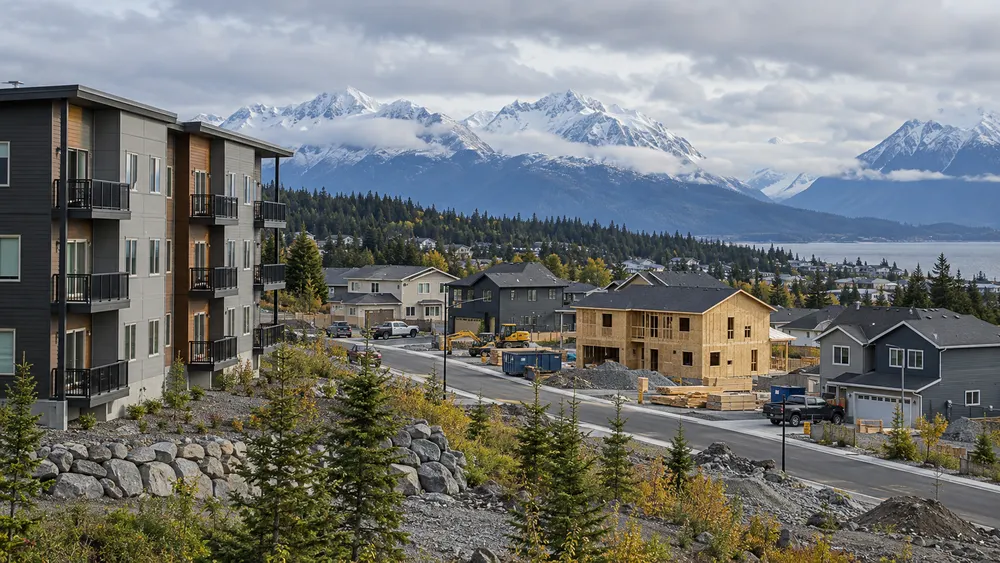
Alaska apartment rents rose 2.1% over the past year, the smallest statewide increase in five years, while new-home construction reached a decade high. The combination offers limited relief in a market where mortgage payments remain dramatically above pre-pandemic levels, according to the state Department of Labor and Workforce Development’s September housing report.
The statewide figure masks large regional differences. The department’s March survey found that a two-bedroom apartment had a median monthly rent of $1,288 in the Wrangell-Petersburg area, the lowest among 11 markets studied. Bethel was highest at $2,030. Kodiak, Anchorage, the Fairbanks North Star Borough and Juneau were all above $1,700, according to a detailed data review by the Alaska Beacon.
The Matanuska-Susitna Borough recorded the largest annual increase, 12.8%, even though its median two-bedroom rent of $1,567 remained below several urban markets. State labor economist Gunnar Schultz attributed some of that pressure to Mat-Su’s population growth and its close economic connection to Anchorage. The survey does not cover every part of Alaska; the North Slope Borough and Bering Strait region were among the places excluded, so the statewide results should not be read as a complete census of rural housing costs.
For buyers, the state calculated that a 30-year fixed mortgage on a $415,000 home—the 2025 median value—produced a monthly payment of about $2,050. That was 84% more than the estimated payment for a median home in 2019. Home values rose from roughly $300,000 in 2019 to $415,000 six years later, while mortgage rates moved from below 3% in 2020 to about 6.5% in 2023.
Wage growth and a slight easing in interest rates made Alaska homes marginally more affordable in 2025 than during the previous two years. The state’s affordability measure fell to 1.37 from 1.39 a year earlier and 1.4 in 2024. The concept follows the broader practice of comparing household income, home prices and mortgage costs; the National Association of Realtors explains its national index as a test of whether a typical family can qualify for a mortgage on a typical home.
Supply also improved. Alaska added 2,261 single-family and multifamily units in 2025, the highest total in 10 years and well above the 1,747 units built in 2020. More construction can moderate competition, but it does not immediately erase regional shortages, high financing costs or the logistical expense of building in remote communities.
National Census data provide context: median gross rent increased across many U.S. counties between the 2015–2019 and 2020–2024 survey periods. Alaska’s newest figures indicate slower rent growth, not falling rents. For households, the practical picture remains mixed—more units and slightly improved buyer affordability alongside historically elevated monthly costs and sharp local disparities. Those differences make local market data more useful than statewide averages alone.