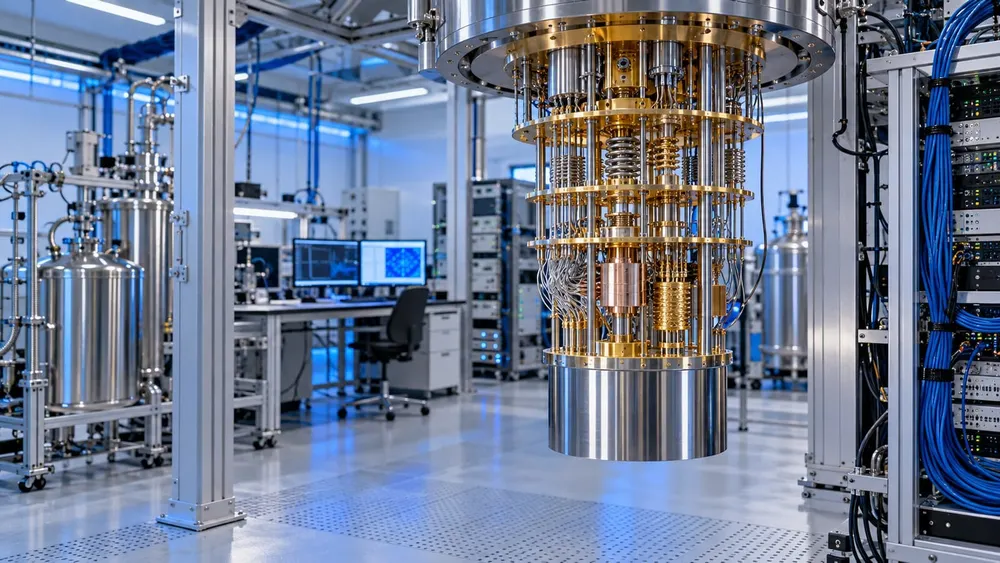
Microsoft has opened a quantum research center in the University of Maryland’s Discovery District, converting a partnership announced last year into a physical laboratory intended to connect corporate research, university talent and Maryland’s growing quantum-computing industry.
Gov. Wes Moore joined the ribbon-cutting Tuesday in Riverdale Park. The governor’s announcement describes the Discovery Center as a development hub for next-generation quantum technologies and says the state and university have attracted more than $500 million in pledged public, federal and private investment through the Capital of Quantum initiative.
The center gives Maryland’s campaign a tangible operating site, but the opening is a milestone rather than proof that the technology has reached broad commercial use. Quantum systems remain technically difficult to build and operate, and many proposed applications are still in research or early testing. The practical state-level question is whether the new cluster produces durable companies, jobs and research results over time.
A second company joins the district
Microsoft’s opening coincided with Boston-based QuEra Computing’s decision to establish an office in the same Discovery District. QuEra’s agreement with the University of Maryland’s QLab will give researchers cloud access to the company’s neutral-atom system. The company says its Aquila platform supports experiments using as many as 256 qubits.
That addition broadens the hardware approaches available to Maryland researchers rather than tying the initiative to a single company or technical method. Local reporting by College Park Here said QuEra announced its office hours before Microsoft’s ribbon-cutting and that the center opened as the Quantum World Congress began its annual gathering in College Park.
State leaders have framed the district as an economic-development strategy built around the University of Maryland, nearby federal research agencies and private firms. Maryland Matters reported Moore’s argument that the cluster can create career opportunities for students with relevant skills while drawing companies to Prince George’s County.
What remains unreported
The announcements do not provide a full project budget, a count of permanent jobs at the Microsoft center, expected payroll, lease terms or a schedule for specific products. They also do not identify how much of the cited $500 million has been spent, as distinct from pledged. Those omissions limit any immediate assessment of the project’s return to taxpayers or its near-term effect on the regional economy.
The broader initiative is intended to catalyze more than $1 billion in investment. Reaching that target will require more than laboratory openings: companies must hire, universities must train workers, and research must move into products or services that customers use.
For now, the measurable development is narrower but significant. A major technology company has opened the promised Maryland lab, a second quantum firm is adding a local presence, and university researchers are gaining access to another computing platform. Future disclosures on employment, public support and research output will show whether that concentration becomes a lasting business cluster.