
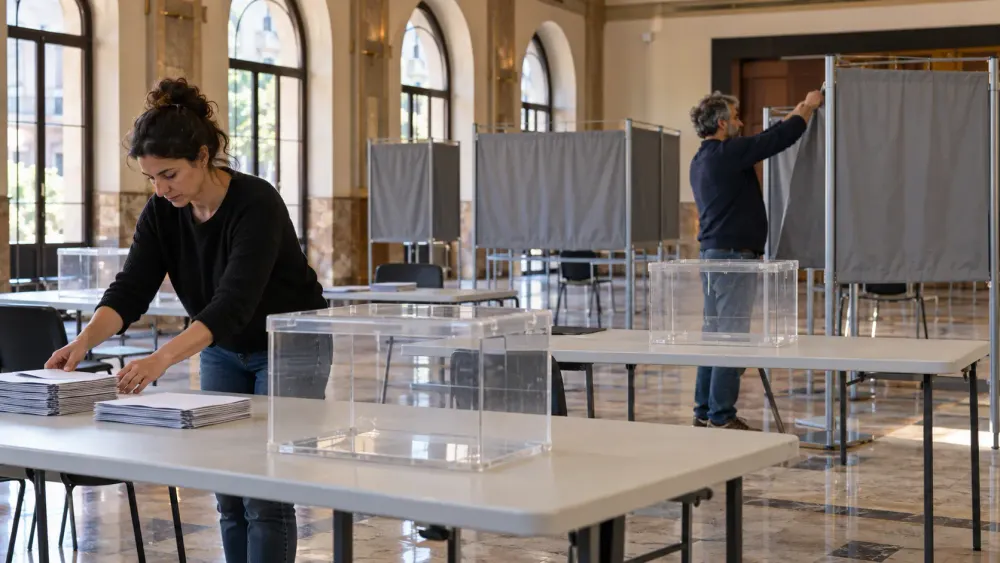
Spain will hold an early general election on November 29, nine months before the legislature was due to end, after Prime Minister Pedro Sánchez concluded that his minority government could no longer reliably pass major legislation. The decision follows Parliament’s rejection Friday of two emergency housing decrees and turns a mounting affordability crisis into the central test of the country’s political direction.
Sánchez announced the date in a televised statement Monday, arguing that voters should decide whether to give his governing alliance a broader mandate. The opposition Popular Party welcomed the election, while current polling places a conservative-led government within reach. The campaign therefore begins as both a judgment on Sánchez’s eight years in office and a contest over whether housing anger can revive the left before a fragmented Parliament is dissolved.
A housing defeat became the breaking point
The immediate trigger was Friday’s vote on two decrees approved by the Cabinet on September 29. One sought to expand affordable housing and strengthen the social function of the housing stock; the other aimed to reinforce the stability of primary-residence leases. An official parliamentary notice confirms that both measures came before the full Congress of Deputies for validation, a constitutional requirement for emergency decrees.
The measures failed after the conservative Popular Party, the far-right Vox and the Catalan separatist Junts withheld support, according to AP reporting. That defeat exposed the government’s central vulnerability: Sánchez’s Socialist Party and its Sumar coalition partner depend on smaller regional and separatist parties whose support has become increasingly conditional. The government has also failed to pass a new budget since 2023, leaving it with fewer tools to turn its agenda into law.
Sánchez is choosing the timing, not the conditions
Calling an election now allows Sánchez to campaign while national attention is fixed on housing, rather than waiting for further legislative defeats or a deteriorating coalition. Nationwide demonstrations have intensified the pressure, particularly after the eviction of an 87-year-old Madrid tenant became a symbol of rising rents and insecure leases. Reuters reported that the rejected decrees were broadly welcomed by protesters even as the parties needed to enact them voted them down.
But the decision remains a gamble. A recent poll average compiled by El País placed the Popular Party near 33%, the Socialists around 26% and Vox at roughly 18%. The model gave the right a majority in most simulations, though Spain’s province-based seat allocation and the performance of regional parties make national vote shares an imperfect guide to the final parliamentary arithmetic.
The right has an opening, but no simple path
Popular Party leader Alberto Núñez Feijóo has long demanded an early vote and cast the announcement as an opportunity for political change. Yet the polls suggest he may need Vox to govern. Such an agreement would bring the far right into Spain’s national government for the first time since democracy was restored after Francisco Franco’s death in 1975, even though Vox already participates in several regional administrations.
Sánchez’s route is equally complicated. He has assembled governing coalitions spanning the left and regional nationalists, but the relationship with Junts has deteriorated and the parties to the left of the Socialists remain divided. His case rests on mobilizing progressive voters around housing, social protections and resistance to the far right, while persuading former allies that a renewed coalition is preferable to a PP-Vox government. Reuters’ account notes that Sánchez has repeatedly survived elections and coalition negotiations in which he began as the apparent underdog.
The constitutional timetable is already moving
Spain’s prime minister cannot dissolve Parliament by announcement alone. Article 115 of the Constitution allows the prime minister, after Cabinet deliberation, to propose dissolving one or both chambers; the king then issues the decree and the decree fixes the election date. The government said the formal order would appear in the Official State Gazette on Tuesday.
The country’s election law requires an early-election decree to be published the day after it is issued. November 29 falls 54 days after the expected October 6 publication, matching the statutory campaign calendar used for an early dissolution. Once Parliament is dissolved, its permanent deputations retain limited powers, but ordinary lawmaking stops and the housing conflict moves from the chamber to the campaign.
What the election will decide
The vote will determine more than who becomes prime minister. A PP-Vox majority could shift Spain’s positions on immigration, regional autonomy, climate policy and relations with European partners. Another Sánchez-led coalition would still need a workable agreement among parties whose disputes over housing, budgets and Catalonia have already slowed the current government. A hung Parliament could reproduce the same arithmetic and lead to another prolonged negotiation.
Polling at the start of a campaign is not a result, and the competing surveys in Spain have produced materially different estimates. What is established is that the housing defeat ended Sánchez’s attempt to govern through the remainder of the term without a stable majority. The next seven weeks will show whether he has converted that institutional weakness into a mobilizing issue—or handed the opposition the election it has been requesting.