Six people remained hospitalized Sunday evening after a shooting near Florida A&M University’s Bragg Memorial Stadium injured 12 people, including six minors, during the final weekend of the university’s homecoming celebration. Eleven of the victims sustained gunshot wounds, and one remained in critical condition, according to a Sunday evening local update. No deaths had been reported.
The Tallahassee Police Department said the gunfire began around 8 p.m. Saturday near Perry and Manatee streets, a short distance from the stadium. A preliminary police account said a physical altercation preceded the shooting, but investigators had not announced an arrest, identified a suspect or established a motive. Those omissions matter: the incident occurred as crowds were leaving a football-centered celebration, but authorities have not established that the dispute was connected to Florida A&M, the game or an official university event.
The shooting’s scale and timing make it a higher-education safety issue even though police and the university described the scene as near, rather than on, the campus. Homecoming brings students, alumni, families, vendors and children into spaces where university property, city streets and private gatherings meet. The case therefore tests not only the criminal investigation but also how colleges and municipalities communicate responsibility and risk when a major campus event spills into the surrounding neighborhood.
What Police Know So Far
Police said six adults and six juveniles were injured. Five victims had been released from hospitals by Sunday morning, while six remained hospitalized and one was in critical condition through Sunday evening. The youngest person shot was 11, and one victim was believed to be a Florida A&M student, according to the Washington Post. A twelfth person, identified by police as a victim’s grandmother, was injured while fleeing rather than by gunfire.
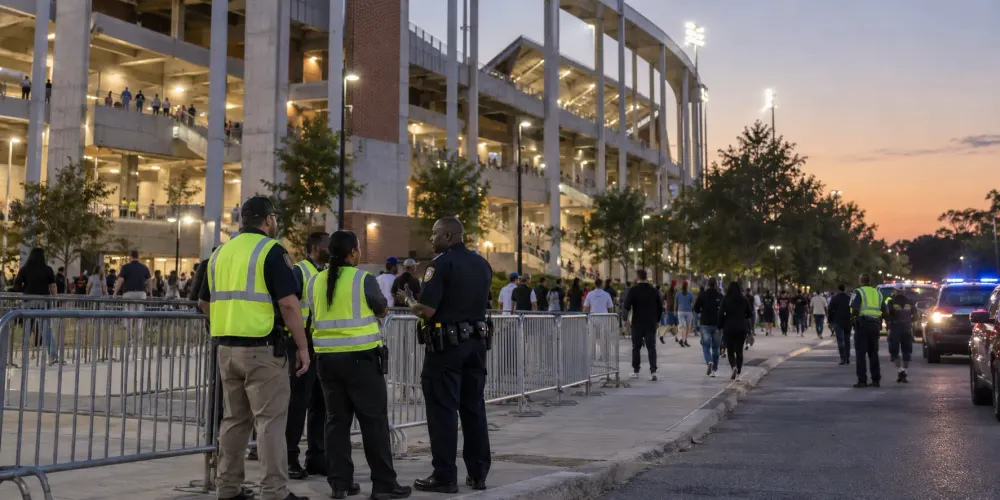
About two dozen officers were already in the area before the shooting, Police Chief Lawrence Revell said. Officers responded immediately, carried victims to safety and helped transport them for treatment. Detectives then worked overnight reviewing digital evidence, canvassing the neighborhood and collecting physical evidence. The department created a dedicated hotline and an upload portal for photographs and video, an unusually important step in a crowded public setting where many witnesses may have recorded fragments of the event.
The Link to Homecoming Remains Limited
Florida A&M’s homecoming ran from Oct. 18 through Oct. 25 and included a Saturday parade, football game and other gatherings intended to bring students, alumni and community members together. The university’s official schedule described homecoming as a multigenerational celebration. Saturday’s football game ended roughly two hours before the shooting, according to local reporting, and the intersection where gunfire erupted sits just steps from Bragg Memorial Stadium.
Proximity is not proof of causation. The Associated Press reported that the area was crowded with people leaving the celebration, while the university confirmed the incident occurred near campus on Perry Street. Florida A&M said the campus remained safe and asked people to avoid the area while police worked. At publication, authorities had not said whether the altercation began at an official event, involved attendees or reflected a broader threat to the university.
Why the Boundary Matters for Safety
Universities generally control safety planning most directly on their own property, while city police and emergency services lead responses on adjacent public streets. During homecoming, those operational boundaries can be almost invisible to visitors. Florida A&M’s emergency system says its police, emergency-management and communications teams coordinate alerts to students, employees, families, alumni and visitors, with university email, text messages, the FAMU app, sirens and social channels providing overlapping notification routes.
The university’s published alert policy also says officials first confirm whether a dangerous situation significantly affects the campus community before issuing emergency messages. That framework explains why an incident just outside university property can still require campus communication, even when city police control the investigation. It does not establish whether any existing plan succeeded or failed Saturday; a meaningful assessment would require a timeline of alerts, calls, crowd movement, staffing assignments and coordination among Florida A&M, Tallahassee police and emergency medical services.
The Educator's Takeaway
For university leaders, the immediate lesson is about operational clarity rather than premature blame. Large events extend a campus’s practical safety footprint beyond its legal boundary, especially when alumni, families, vendors and minors gather on adjoining streets. Administrators will need to distinguish verified facts from social-media claims, explain which agency controls each part of the response and preserve evidence for an after-action review. Any review should examine crowd-dispersal plans, communications with visitors who are not enrolled in campus alerts, medical access and the handoff between campus and municipal authorities. None of those questions can be answered from the injury count alone, and the available evidence does not show that a different plan would have prevented a dispute from becoming gunfire.
The investigation remains active. Police are seeking witnesses and digital evidence, while the university’s next decisions will turn on facts that have not yet been released: who was involved, where the altercation began, how quickly warnings reached the surrounding community and whether the shooting exposed a correctable gap in planning or response.