

The bottom line: A Mississippi grand jury found no credible evidence that anyone committed a crime in connection with the death of 18-year-old Nolan Xavier Wells. That unanimous no-bill is a consequential legal finding. It is not, however, a medical determination of how Wells died. Mississippi’s state medical examiner and the independent forensic pathologist retained by his family both classified his cause and manner of death as undetermined.
Those two conclusions can coexist. Prosecutors may lack probable cause to charge anyone even when medicine cannot establish a cause of death. The result is an unusual and painful public record: no person has been charged, no evidence released by authorities establishes a racially motivated attack, and no forensic expert has certified that Wells accidentally drowned. What happened between his final known hours on Horn Island and the discovery of his body two days later remains incompletely explained.
Editor’s note: This article distinguishes documented facts, attributed claims, corrected rumors and unanswered questions. Questions are not accusations. Several young people drawn into public speculation have not been charged with any crime, and the grand jury expressly found no credible evidence of criminal conduct by people traveling to or from Horn Island that day.
Feature photo: Nolan Wells in a family photograph published by his mother, Christine Wonsley, through the family’s memorial fund. Source: Christine Wonsley/Wells family via GoFundMe.
This is a national follow-up to The American Quorum’s prior article on the Jackson County grand jury’s decision. Since that report, the public record has expanded to include the state’s full postmortem report, the family pathologist’s final report, a digital-forensics presentation about Wells’s phone and a sharply worded response from the district attorney. Together, those materials answer several disputed points while exposing the limits of what the public can presently know.
What is established — and what is not
- Established: Wells went to Horn Island on July 4, 2026, for an Independence Day gathering and did not return to the mainland with the boat that carried him there.
- Established: His phone remained with the boat, returned to the mainland and was later recovered by his family. Publicly described forensic data place his last phone use at about 2:17 or 2:18 p.m.
- Established: A witness told the grand jury that Wells slipped awkwardly from the side of a boat at about 3:30 p.m., got back up, continued socializing and did not appear injured.
- Established: A National Park Service ranger found his body near the northwestern end of Horn Island on the morning of July 6. He was face down and wearing swim trunks.
- Established: The state autopsy documented two approximately two-inch contusions beneath the scalp at the back of his head, but no skull fracture, brain hemorrhage, other reported internal injury, fatal trauma or disease explaining death.
- Established: Both forensic pathologists classified the cause and manner of death as undetermined. Both left accidental drowning possible; neither certified it.
- Established: A 23-member grand jury reviewed a substantial record, issued 132 subpoenas and considered information from 43 witnesses. It unanimously declined to indict anyone.
- Not established: The public evidence does not establish when Wells entered the water, how he entered it, whether anyone saw him enter it, whether he was conscious or impaired, or the precise mechanism that caused his death.
Who Nolan Wells was
Wells was born Aug. 19, 2007, and grew up in Ocean Springs, Mississippi. He played football at Ocean Springs High School and continued as a college athlete at Southwest Mississippi Community College. His family’s obituary described a young man known for faith, humility, kindness and an ability to make other people feel welcome. His parents described him as protective, steady and close to his family.
On Friday, July 3, his mother said he cooked dinner for his parents, hugged and kissed her, said he loved her and left to stay with a friend. It was the last time she saw him alive, according to the detailed WLOX timeline.
July 4: The known timeline
9:56 a.m. to 11:14 a.m.: The trip out
Marine GPS records show the boat carrying Wells left a private Ocean Springs-area dock at about 9:56 a.m. and reached Horn Island at about 11:14 a.m. The undeveloped barrier island is part of Gulf Islands National Seashore and is accessible primarily by private boat. It has no regular staff, drinking water, shelter or communications facilities, according to the NPR report.
Numerous groups converged on the island for the holiday. The grand jury later found that people frequently arrived and departed on different boats and that Wells was not the only person whose phone returned to the mainland without its owner.
About 2:17 p.m.: The last described phone use
Digital examiner Andrew Garrett said phone records show Wells used Face ID and interacted with his phone at approximately 2:17 or 2:18 p.m. while the device was on the boat. Garrett said the phone then remained locked, continued receiving synced material and traveled with the boat to the mainland. No evidence presented publicly shows that someone physically unlocked the handset between Wells’s last use and the family’s recovery of it, the AP update reported.
The phone’s route is therefore evidence about the device, not proof of Wells’s location after he separated from it.
About 3 p.m. to 3:30 p.m.: Last sightings and a fall
Early public statements described Wells as last seen at approximately 3 p.m. The grand jury report later added a more specific event: a witness testified under oath that Wells slipped awkwardly off the side of a boat at about 3:30 p.m. The witness could not say whether Wells struck his head, but said he immediately resumed socializing and did not appear injured.
That testimony matters because the autopsies documented recent bruising at the back of Wells’s head. It offers a possible mechanism. It does not prove the fall caused the bruises, and the grand jury expressly said it could not make that connection with certainty.
Friends told investigators that Wells chose to remain on the island to socialize and planned to return with other people. His parents have consistently said that voluntarily separating from his group — particularly without his phone and keys — would have been out of character. The jury report accepted the voluntary-stay account, noting that other people also remained and later changed boats. The public report says investigators identified and interviewed the people known to have been with Wells after his original companions departed, but their names and full testimony remain redacted.
About 4 p.m.: A genuine boat emergency
A teen aboard the troubled boat called Sea Tow at about 4 p.m. and reported that its bilge pump had stopped and the vessel was taking on water. When asked whether everyone aboard was in good health, the caller said yes and estimated that about seven people were on board. That phrase refers naturally to the vessel’s occupants at the time of the call; it does not establish that Wells was among them.
Sea Tow ultimately did not provide the tow because the boat’s owner said other help had been secured. Marine records show another boat towed the vessel for approximately 2.75 miles at low speed before normal operation resumed and it accelerated to about 34 knots. That sequence reconciles two facts sometimes presented as suspicious: the boat had a documented emergency, and it later moved under its own power.
4:31 p.m. to 7:19 p.m.: The boat and phone return
The vessel left Horn Island at 4:31 p.m., entered Fort Bayou at about 5:52 p.m. and returned to the original dock at about 6:06 p.m. It later went to the Fort Bayou launch at 7:19 p.m., was removed from the water and traveled over land to its owner’s home. The boat GPS and the phone reconstruction broadly follow the same path, according to the GPS report.
Wells did not follow that route. The public record does not identify a confirmed sighting of him after the island gathering or a confirmed boat on which he intended to return.
About 11 p.m. onward: Recognition that Wells was missing
The Coast Guard said one of Wells’s friends contacted it at about 11 p.m., though the agency said the call did not require Coast Guard assistance and did not publicly disclose the full exchange. At about 11:07 p.m., Wells’s mother received a call from a friend asking whether he had returned. She checked location services: Life360 placed his phone on the mainland, while Snapchat reportedly displayed different information.
At 11:49 p.m., she called the Mississippi Department of Marine Resources and was redirected to the Jackson County Sheriff’s Office. She described jurisdictional back-and-forth before a report was opened. Family members retrieved Wells’s belongings that night. At about 1:38 a.m. on July 5, marine officials were told the sheriff’s office did not yet perceive a water emergency because witnesses said Wells had stayed voluntarily and was expected to return on another boat.
That judgment explains the initial response. It also makes the six-plus-hour interval between the group’s 4:31 p.m. departure and the first missing-person calls an important part of the unresolved timeline.
July 5 and 6: Search and recovery
Wells’s father and a football coach went to the island on July 5. Marine officers launched at about 8 a.m., and multiple public agencies and private volunteers joined. Three drone efforts were disrupted — one by software trouble and another when heat caused a swollen battery to separate. The Coast Guard received a formal request for assistance at 12:26 p.m. and deployed a helicopter. A command post was established at 5:54 p.m. Sonar searches later ended because of adverse weather.
On July 6, a National Park Service ranger found Wells’s body near the island’s northwestern tip at about 8:45 a.m. The state’s autopsy report records that he was found face down in the water. He was wearing swim trunks and underwear. Dental records confirmed his identity.
The date and time of death remain unknown.
Reading the geography — and one coordinate that needs correction
The released geographic record points consistently to the northwestern end of Horn Island, but it does not provide the public with one unambiguous, certified recovery coordinate. Marine officials supplied the Coast Guard with 30-14.626N / 088-46.629W — decimal coordinates 30.243767, -88.777150 — for search-and-rescue analysis based on the originating vessel’s GPS. That is a vessel/search coordinate near the island’s northwestern tip, not a formally identified body-recovery coordinate.
The family’s independent autopsy separately prints the scene location as 30.240817N, 80.778600W. The longitude as written would place the location hundreds of miles east of Horn Island in the Atlantic. Replacing the apparent missing digit with 88.778600W places the point just offshore from Horn Island’s northwestern end, consistent with the reported recovery area and this coordinate map. That correction is a strong geographic inference, not a substitute for an amended medical report or an official release of the ranger’s precise recovery coordinates.
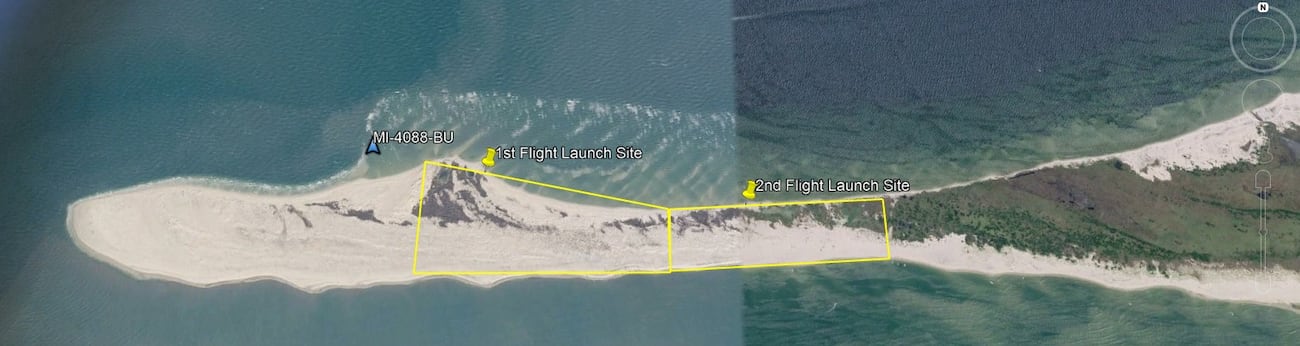
Fort Bayou was the later haul-out point, not the departure dock
The distinction matters. GPS reporting says the boat carrying Wells left from an unidentified private dock in the Ocean Springs area at about 9:56 a.m., returned to that original dock at about 6:06 p.m., and then reached the public Fort Bayou Boat Launch at 7:19 p.m., where it was removed from the water. Because the private departure dock has not been publicly identified, an exact outbound starting point cannot responsibly be plotted from the released record.
What the two autopsies actually say
The first examination occurred July 7, one day after recovery. State Medical Examiner Staci Turner signed the report Aug. 17. The family’s second examination occurred July 10 and was led by Dr. Roger A. Mitchell Jr., a board-certified forensic pathologist and former chief medical examiner in Washington, D.C. Mitchell later reviewed retained tissue, the state report, photographs, radiology, approximately 750 pages of investigative material and the Horn Island scene before issuing his final second autopsy on Sept. 14.
| Issue | State examination | Independent examination |
|---|---|---|
| Cause of death | Undetermined | Undetermined |
| Manner of death | Undetermined | Undetermined |
| Head injury | Two roughly two-inch subcutaneous scalp contusions at the posterior skull | Confirmed blood in a larger 12-by-8-inch area of deep soft tissue at the back of the head, corresponding to the state-documented contusions |
| Fracture or brain bleeding | No skull fracture or described brain hemorrhage | No fracture or deep-tissue injury found |
| Other bruising | No other external or internal injury reported | Pathologist interpreted original photographs as showing two probable lower-back contusions and one near the left shoulder blade; the state examiner did not report them |
| Airway and stomach | No fluid or debris within the airways; stomach empty | Relied on the state findings after initially lacking the retained structures |
| Neck structures | No hemorrhage or fracture of the larynx or hyoid | Later examined retained structures; no acute fracture or injury |
| Toxicology | Ethanol measured at 270 mg/dL in chest decomposition fluid; several presumptive findings, with cannabinoids negative on confirmation | Concluded decomposition fluid could not reliably establish an antemortem blood-alcohol level or functional impairment |
The head and back injuries
Both pathologists agree that Wells had recent blunt-force injury at the back of his head. The state report describes two localized contusions and found no fracture, brain hemorrhage or fatal injury. Mitchell’s microscopic review confirmed blood in the soft tissue and concluded the injury probably occurred shortly before death. He also interpreted three areas visible in the state photographs as additional bruises on the back and shoulder. The grand jury said the pathologists disagreed about whether those additional areas were bruising or decomposition-related changes.
“Not fatal” is important: neither examination found trauma sufficient by itself to explain death. But “not fatal” does not identify how the injury occurred, whether it affected Wells’s condition before he entered the water or whether it was related to his death. The witnessed fall is a plausible explanation; the record released publicly does not establish it as the explanation.
The airway finding does not settle drowning
The state report says, precisely, “No fluid or debris is within the airways,” and that the stomach was empty. A family attorney publicly paraphrased that as no water in Wells’s lungs, stomach or throat. Those statements are not medically identical: the report describes the contents of the airways, not a categorical laboratory finding that the lung tissue contained no water.
More important, the absence of one classic finding does not by itself exclude drowning, particularly after immersion and decomposition. A peer-reviewed forensic review explains that drowning is diagnosed through the complete scene, investigative and autopsy context after competing causes are excluded; no single autopsy sign is conclusive. That is why both pathologists could note the empty airways and still decline to rule out drowning.
The scientifically careful conclusion is therefore narrower than either side’s rhetoric: the released findings do not prove drowning, and they do not disprove it.
The alcohol number cannot be read as a blood-alcohol level
The state laboratory measured 270 mg/dL of ethanol in chest decomposition fluid. Some records and witnesses described heavy alcohol consumption during the gathering. But the tested material was not blood, urine or vitreous fluid. Both the grand jury and Mitchell cautioned that decomposition, microbial alcohol production, dilution and redistribution make it unreliable to translate the number into Wells’s blood-alcohol concentration while alive.
The public record therefore supports that alcohol was available and reportedly consumed. It does not support the numerical claim that Wells had a 0.27% blood-alcohol level or that intoxication necessarily made him unable to swim.
What the grand jury reviewed and decided
The Jackson County grand jury reconvened Sept. 14 and adjourned Sept. 18. Its 23 members ranged from 27 to 68 years old and included 13 men and 10 women; the district attorney described a racially diverse panel. According to the nine-page report, the investigation produced 132 subpoenas and information from 43 witnesses through live testimony, sworn statements and recorded interviews.
Jurors had the sheriff’s full investigative file and supplemental material from assisting agencies. The evidence included photographs, videos, surveillance, GPS data, laboratory reports, phone downloads, a 14-page preliminary phone report, a 21-page final phone report, a 261-page Snapchat report, both autopsy opinions and materials from the family’s independent investigation.
The panel found no credible evidence that anyone traveling on the three identified boats engaged in criminal conduct related to Wells’s death. It found no evidence of a fight involving Wells, no evidence that his death was racially motivated and no evidence that he had cocaine in his system. It concluded that the location, position, condition and timing of the body’s recovery were consistent with drowning, while acknowledging that both medical experts had classified the death as undetermined and that drowning is a diagnosis of exclusion.
A no-bill is not a trial verdict. A grand jury determines whether probable cause exists to issue an indictment, not whether someone is guilty beyond a reasonable doubt. The no-bill means the panel concluded that the evidence presented did not justify charging an identifiable person with a crime. It does not supply a missing cause of death.
The report says seven people swept into public suspicion were invited to testify and that the panel also obtained sworn statements and interviews. Names are redacted and grand-jury testimony is secret. The report says investigators interviewed every identified person who had contact with Wells after his original group left. The public cannot independently test those accounts because the transcripts, underlying exhibits and most identities have not been released.
The phone dispute: A contradiction that may not be one
Wells’s family believed material was missing from his Snapchat account when the phone was returned. In a Sept. 24 presentation, Garrett said “things were deleted” between Wells’s last interaction and his parents’ recovery of the device. The district attorney responded that no one physically accessed Wells’s phone during that interval and that the user actions originated with other Snapchat users.
Both statements can be true. A sender can delete or unsend a message from another device, causing the conversation record visible to a recipient to change without anyone unlocking the recipient’s handset. Garrett did not publicly identify who removed material, what each deleted item contained or any intent behind the actions. The AP reported that the presentation did not show anyone unlocking Wells’s phone after it left the island.
A second dispute concerns completeness. Garrett said his team’s extraction took roughly 30 hours and generated more than one million digital artifacts. District Attorney Angel Myers McIlrath said the raw download was not delivered to the state and that prosecutors received two emails containing roughly 300 pages of selected findings. The grand jury report confirms that jurors received the 14-page, 21-page and 261-page reports, but the complete forensic image, native logs and full artifact export are not public.
That leaves a narrower but legitimate question: not whether the public evidence proves phone tampering — it does not — but whether the reports supplied to the grand jury captured every relevant artifact, timestamp, sender action and location event in a form that could be independently reproduced.
Five prominent claims the record has corrected
- The alleged argument video: Early claims said Wells could be heard demanding his phone. A friend later identified himself, not Wells, as the person yelling. The grand jury found no evidence of an altercation involving Wells.
- The pool-party image: A widely circulated image was presented as potentially relevant to July 4. People shown in it said the party occurred June 27. Reposting material was not authentication.
- “Fully clothed” at recovery: Conflicting public descriptions were resolved by the state report and recovery accounts: Wells was wearing swim trunks and underwear, not a shirt or street clothes.
- Cocaine: The grand jury expressly rejected an online claim that cocaine was found. The released toxicology report lists no cocaine.
- Physical phone access: Publicly presented forensics do not show that Wells’s handset was unlocked by another person after his last use. Sender-side Snapchat deletions are a different technical event and do not establish evidence tampering.
Correcting those claims is not incidental. Unsupported allegations have led to harassment and threats against uncharged people. An evidence-based inquiry must protect the Wells family’s right to ask hard questions while also refusing to convert suspicion into guilt.
20 questions the public record still cannot answer
- What was Wells’s final independently verified sighting? Public accounts first said about 3 p.m.; the grand jury report describes a witnessed fall at about 3:30 p.m. The difference may be simple rounding or separate observations, but the precise sequence has not been published.
- Who was with him after his original group left? Authorities say they identified and interviewed everyone known to have contact with him. The redacted report does not disclose their identities, full accounts or the last person who saw him alive.
- What return transportation had Wells actually arranged? The grand jury accepted that he planned to return on another boat. The public report does not identify a particular vessel, operator, departure time or confirmed conversation establishing that plan.
- Why did he remain without his phone and keys? Evidence shows other people left phones on boats, and family members say Wells would not normally separate from his group. Neither fact alone resolves his personal decision that afternoon.
- When did people on the mainland first realize he had not returned? The boat reached the dock shortly after 6 p.m., but the first publicly documented calls reporting concern came near 11 p.m. The intervening communications and assumptions have not been released in full.
- When did Wells enter the water? Neither autopsy could determine a time of death, and no public witness account identifies the moment he entered the water.
- How did he enter the water? An accidental step, a swim, a fall, impairment, a medical event and forced entry are materially different scenarios. The released evidence does not establish one.
- Was anyone present at the decisive moment? A crowded island produced many photographs, videos and interviews, yet the public record contains no identified eyewitness to Wells becoming distressed or entering the water for the final time.
- Did the 3:30 p.m. fall cause the head contusions? The witness could not say whether Wells hit his head, and the grand jury could not make the link with certainty.
- If the fall did not cause them, what did? The two posterior scalp contusions are medically documented and recent. No other mechanism is established publicly.
- Were the three additional back and shoulder marks true bruises? Mitchell interpreted them as contusions visible in the original photographs; the state examiner did not report them, and the grand jury described a professional disagreement that could include decomposition changes.
- Did any nonfatal injury affect his ability to protect himself? No injury was independently fatal, and a witness said Wells appeared fine after the fall. The evidence does not establish whether a later effect, impairment or unrelated event changed his condition.
- If he drowned, why could he not leave the water? Being a capable swimmer does not make drowning impossible. Currents, fatigue, alcohol, disorientation, sudden depth changes or injury could matter. No specific combination has been medically or factually demonstrated in this case.
- What do currents and drift modeling show? The body’s location was considered consistent with drowning near the northwestern tip, but the public report provides no detailed current analysis, estimated entry point, drift interval or range of possible paths. Mitchell’s final report also prints the longitude as 80.778600W, while the marine search coordinate and Horn Island are near 88.78W. That appears to be a one-digit transcription error, but it should be corrected in any record used for spatial reconstruction.
- What weight should be given to the empty airways and stomach? Those are documented findings, but they neither prove nor exclude drowning. A complete explanation would require the state pathologist’s case-specific reasoning, including the effect of decomposition.
- What was Wells’s functional alcohol level? A high ethanol value was measured in decomposition fluid, not blood. Science does not permit a reliable conversion to his level of intoxication while alive.
- Exactly which Snapchat items were removed, by whom and when? The family examiner described sender-side deletions or unsent messages but did not publish the complete artifact-level record. Deletion alone does not establish sinister intent, but timing and content would determine relevance.
- Did the grand jury receive the complete phone evidence? It received nearly 300 pages of reports; the district attorney says it did not receive the raw 30-hour extraction. The public cannot compare the selected reports with the underlying forensic image.
- What changed between the family team’s August communication and its September concerns? The grand jury quoted an August statement that the private investigation had no witness or evidence warranting a criminal referral. The final autopsy and final phone work came later. A clear chronology of what was learned when would sharpen the dispute.
- What review remains possible? The family has requested federal scrutiny and broader disclosure. No public record reviewed for this article confirms a separate Justice Department death investigation. Mississippi’s report states that credible new evidence can be presented to a future grand jury and that homicide has no limitations period.
What the evidence does not justify
It does not justify declaring that Wells was murdered. The grand jury found no credible evidence of a crime, an altercation or racial motivation. The family’s pathologist did not certify homicide; he said nonaccidental factors could not be excluded.
It also does not justify declaring accidental drowning medically proven. Both pathologists selected “undetermined,” and the state examiner wrote that the surrounding circumstances were unknown. “Consistent with drowning” means the evidence can fit that scenario, not that every competing scenario has been eliminated.
It does not justify treating unanswered questions as proof against Wells’s friends. The panel reviewed sworn and digital evidence and expressly rejected the public allegations. Nor does it justify treating the family’s questions as irrational. Their son died without a certified medical explanation, and multiple parts of his final timeline remain unavailable to them and the public in a complete, independently reviewable form.
What happens next
The state postmortem report and Mitchell’s final report are now public. The complete sheriff’s file, grand-jury testimony, native phone extraction and full digital artifact record are not. The no-bill ended the present charging review, but it did not legally bar reconsideration if credible new evidence emerges.
The most productive next steps are evidentiary, not rhetorical: preserve every native digital artifact; document each sender-side deletion and timestamp; retain the complete boat and phone GPS exports; release legally disclosable scene, current and search analyses; explain the pathology disagreements in technical terms; and create a dated inventory showing what each investigative team received and when.
Nolan Wells’s case now carries two official truths. The legal process found no basis to charge anyone. The medical process could not determine why he died. A responsible account must hold both truths at once — clearing unproven accusations without pretending the final hours of his life have been fully reconstructed.
Primary record: jury report · state autopsy · second autopsy · phone briefing · case timeline.