Saudi air defenses intercepted two ballistic missiles aimed at the southern city of Khamis Mushait and two drones headed toward Riyadh early Saturday, according to the Saudi-led coalition fighting Yemen’s Houthi movement. The four reported interceptions mark another expansion of the cross-border air campaign, but the coalition disclosed no launch locations, debris damage or casualties. The episode underscores how quickly the renewed fighting in Yemen is reaching Saudi population centers and placing pressure on a regional defense pact whose operational commitments remain largely undefined.
Four threats reported in one morning
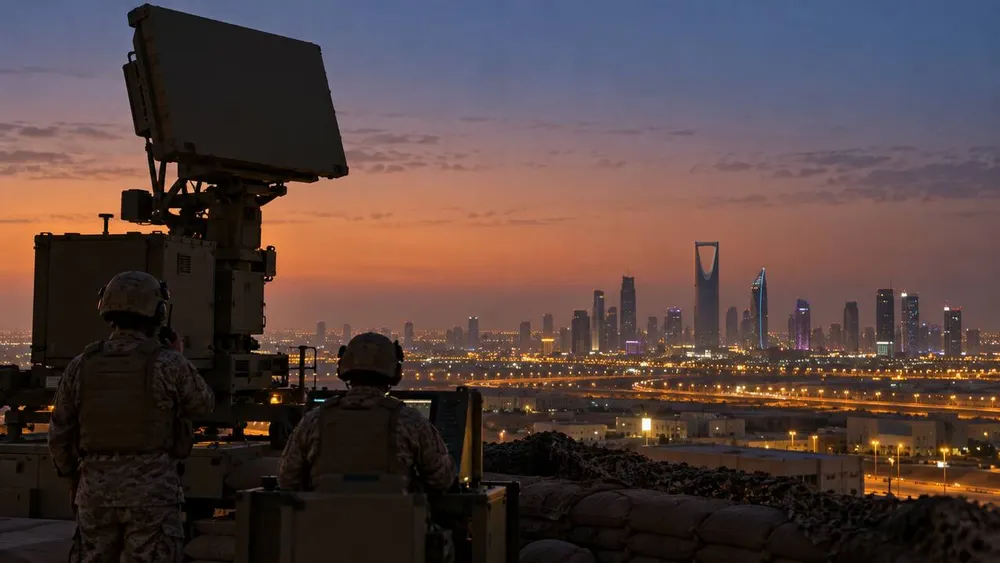
Coalition spokesperson Maj. Gen. Turki al-Maliki said air defenses first destroyed two drones approaching the Riyadh area, then intercepted two ballistic missiles bound for Khamis Mushait. The sequence was reported by Qatar’s state news agency, which carried the coalition’s statements, and independently summarized by Reuters. Saudi authorities did not identify the interceptor systems used or disclose whether falling fragments caused damage.
The limited public record requires caution. An interception claim does not by itself establish every feature of an incoming weapon, its intended target or the success rate of the defensive network. No independent imagery or wreckage assessment was available Saturday. The most firmly supported facts are the coalition’s report of four inbound weapons and the destinations it assigned to them.
Why the two cities matter
Riyadh is the kingdom’s political and commercial center, far from Yemen’s northern launch areas. Reaching it demonstrates the range needed to threaten strategic sites as well as civilians. Khamis Mushait, in southwestern Saudi Arabia, is much closer to the border and hosts King Khalid Air Base, making it a recurring focus of Houthi missile and drone operations.
That geographic split complicates defense. Saudi forces must protect a large capital region while sustaining dense coverage near southern military facilities and cities. Even when interceptions succeed, repeated launches consume expensive interceptors, require continuous radar coverage and create danger from falling debris. The Euronews account noted that the coalition was still monitoring additional missile and drone threats, signaling that officials treated the event as an active air-defense operation rather than a closed incident.
Drones and ballistic missiles also create different detection and engagement problems. Ballistic missiles travel quickly on a high arc, while drones can fly lower and more slowly, complicating radar tracking and allowing attacks to approach from different directions. Launching both in a short period can force commanders to allocate sensors and interceptors across several threat profiles. The coalition has not said whether Saturday’s weapons arrived together or in separate waves, so it is not possible to determine whether the operation was designed as a coordinated saturation attack.
A renewed cross-border campaign
Saturday’s launches followed a series of attacks this month, including missiles and drones directed at Riyadh, Yanbu, Taif and areas near Mecca. On Sept. 19, Reuters documented smoke near Riyadh’s main airport after the Houthis said they had targeted sensitive sites and the coalition said it destroyed a missile aimed at the capital. The available evidence did not establish precisely what caused the fire near the airport.
The escalation is part of a larger struggle inside Yemen. Houthi forces have pressed against territory held by the internationally recognized government and its Saudi-backed partners, while Saudi aircraft have conducted strikes in Yemen. A Reuters review of the battlefield described Houthi efforts to seize high ground that could cut the Red Sea coast from government-held areas. That context makes the launches more than isolated long-range attacks: they accompany a contest over territory, supply routes and regional leverage.
Allied commitments face a practical test
Saudi Arabia, Pakistan and Turkey signed the Makkah Joint Defense Agreement last month, pledging to treat an armed attack on one as an attack on all. Their military chiefs met in Riyadh on Friday to review threats and discuss coordination. Yet neither the public text summarized by the parties nor subsequent statements specify whether the pact automatically requires combat deployments, intelligence support, air-defense equipment or consultations.
Regional governments have offered political backing. The Saudi Press Agency reported that the Arab Interior Ministers Council condemned Saturday’s attacks on Riyadh and Khamis Mushait, while Gulf officials reiterated support for the kingdom’s right to defend itself. Such statements reinforce diplomatic solidarity but do not reveal whether partners will supply interceptors, sensors or personnel.
What to watch next
The immediate operational questions are whether launches continue at the current pace, whether Saudi defenses can sustain their interception rate and whether the coalition answers with a broader air campaign in Yemen. Civilian protection also depends on rapid warnings, transparent damage reporting and safe debris recovery in populated areas.
Independent verification will remain difficult while access to launch areas and impact sites is restricted. Claims from belligerents should therefore be treated as claims until physical evidence, satellite imagery or multiple on-the-ground accounts support them. That standard is especially important when officials attribute intended targets or describe interception performance, both of which can serve military messaging as well as public safety.
The strategic question is whether the attacks remain a Saudi-Houthi confrontation or pull allied states into a more integrated defense effort. Saturday’s reported success prevented an immediate mass-casualty event, but it did not resolve the underlying vulnerability. Long-range weapons can force costly defensive responses even when they do not reach their targets, and every new launch raises the chance that interception, warning or diplomacy will fail.