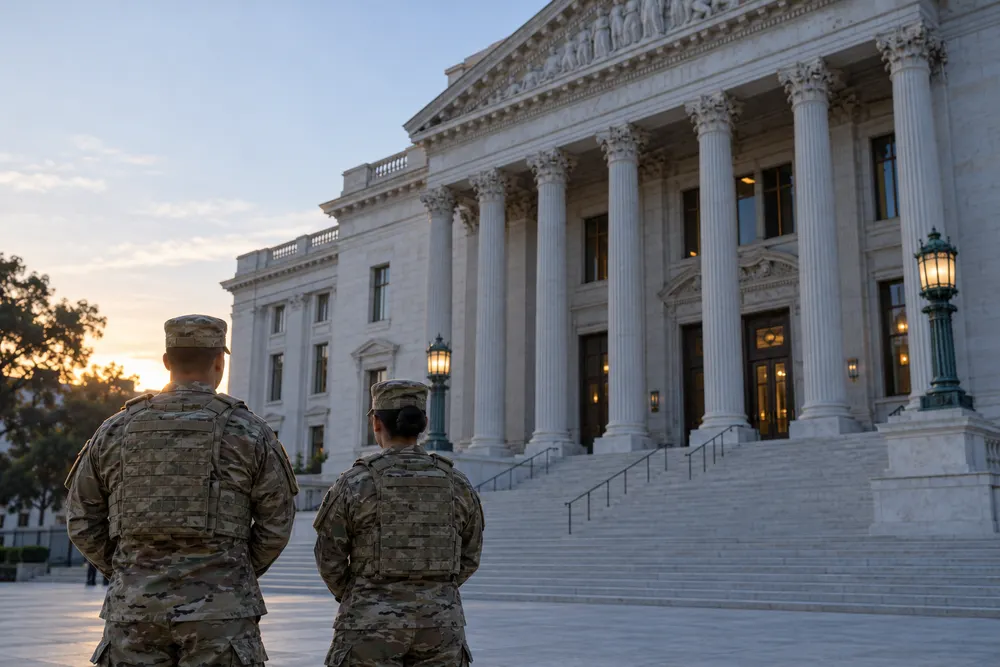
A divided federal appeals court has upheld an order blocking President Donald Trump’s 2025 federalization and deployment of California National Guard troops in Los Angeles, establishing a new constraint on when a president may take control of a state’s Guard over the governor’s objection.
The U.S. Court of Appeals for the Ninth Circuit ruled Friday that the initial federalization order exceeded the authority Congress supplied in federal law and intruded on Congress’s constitutional power to call forth the militia. The published opinion affirmed a lower-court injunction and rejected the administration’s reliance on two emergency provisions of 10 U.S.C. § 12406.
The dispute began in June 2025, after protests followed federal immigration enforcement activity in Los Angeles. Trump ordered 4,000 California Guard members into federal service for 60 days to protect federal personnel and property. California Gov. Gavin Newsom and the state sued Trump, the defense secretary and the Defense Department, arguing that the order lacked a valid statutory basis. The court’s official case summary traces the litigation through separate injunctions addressing the initial order, the use of troops for civilian law enforcement and later extensions.
A deferential review with enforceable limits
The majority said presidential determinations about the conditions for federalizing Guard units receive substantial deference, but they remain reviewable. At minimum, judges must determine whether the president made a legally plausible assessment of the facts within a range of honest judgment. That standard matters because the administration had argued courts should largely stay out of the decision.
Under one provision, Section 12406(3), the president may call Guard units into federal service when unable to execute federal law with regular forces. The Ninth Circuit applied the Supreme Court’s 2025 decision in Trump v. Illinois, which required the government first to identify authority for using regular military forces to execute the law and then show those forces could not perform the task. The panel found the government had made neither showing.
The administration also relied on Section 12406(2), which applies when there is a rebellion or danger of rebellion against federal authority. The majority acknowledged that some people committed serious violence during the protests. It nevertheless concluded that the evidence did not show the organized, armed resistance against government authority needed to sustain the rebellion theory. Independent legal reporting described the ruling as an important precedent even though the deployment itself ended last year.
The conflict reflects the Guard’s dual state-federal structure. A National Guard Bureau fact sheet explains that members serving under Title 10 are federally funded and controlled, while many Title 32 missions remain under a governor’s command. The governing statute lists invasion, rebellion and inability to execute federal law with regular forces as the three circumstances permitting a presidential call into federal service. The case focused on whether the Los Angeles conditions fit the latter two.
Why the ruling still matters
The case carried limited immediate operational effect because the administration had already ended the federalization and returned control of the Guard to California after related court action. But the majority declined to let the government erase the initial appeal after full briefing and argument. It found that resolving the merits could protect California from a similar federalization under comparable circumstances and prevent strategic dismissal from manipulating the creation of precedent.
The opinion does not eliminate federal authority over state Guard units. It requires the executive branch to meet the conditions Congress placed on that authority. That distinction could shape future disputes when a president cites unrest, interference with federal operations or threats to personnel as grounds to assume command without a governor’s consent.
The ruling was issued by a three-judge panel. Judge Jennifer Sung wrote the majority opinion, joined by Judge Eric Miller. Judge Mark Bennett dissented from the merits and argued that Congress had authorized the president to take Guard members into federal service. Court coverage noted that Miller and Bennett were both appointed by Trump, underscoring that the division did not track a simple appointing-party line.
California’s response and what comes next
California Attorney General Rob Bonta and Newsom welcomed the result. The state’s account describes a broader series of cases over the Los Angeles deployment, alleged Posse Comitatus Act violations and attempts to send Guard members to Oregon. Newsom called the decision a precedent protecting states and the public, according to his official statement.
The White House had not issued an immediate public response reported with the decision. The administration may seek rehearing before a larger Ninth Circuit panel or ask the Supreme Court to review the case. Any further appeal would confront the Supreme Court’s earlier Illinois framework, which the Ninth Circuit treated as controlling.
The decision therefore draws a practical line: isolated violence and disruption do not automatically create statutory authority for a president to federalize a state’s Guard. The ruling leaves room for federal action during a genuine rebellion or when regular forces cannot execute federal law, but it requires evidence and a legal basis that courts can examine.