
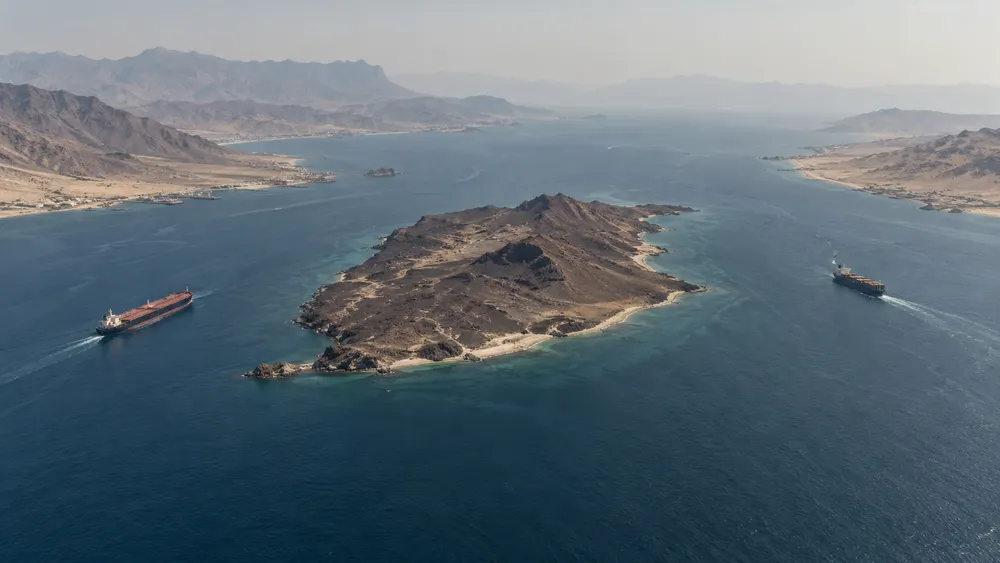
Houthi forces seized Perim Island and the facing coastal town of Dhubab at the southern entrance to the Red Sea on Friday, extending a rapid west-coast offensive to the Bab el-Mandeb chokepoint one day after taking Mocha. The advance gives the Iran-aligned movement new positions beside a channel used by Europe-Asia shipping and increasingly important to Saudi oil exports as the Strait of Hormuz remains severely disrupted. It does not establish that the Houthis control the strait, but it materially raises the risk around a second major energy corridor while Saudi crude supply has already fallen to its lowest level in more than three decades.
The island’s capture was confirmed to the Associated Press by a senior official in Yemen’s internationally recognized government and a Houthi official. Separately, four Yemeni government sources told Reuters that Houthi forces had reached Perim, also known as Mayun. Two of those sources said government forces withdrew and that the Houthis also took Dhubab on the mainland opposite the island. The convergence of those accounts marks the capture as a confirmed territorial development, even though neither side has published a detailed, independently verifiable battlefield map.
A second gain at the strait
Perim is a barren volcanic island near the Bab el-Mandeb’s narrowest point, dividing the waterway into two channels. Dhubab sits on Yemen’s Red Sea coast across from it. Their loss follows the Houthis’ Thursday capture of Mocha, a port roughly 50 miles north of the strait, which TAQ reported as the movement’s most consequential west-coast advance in years. Reuters said government forces also lost the Hanish Islands this week. Together, the gains move Houthi positions closer to the passage itself; they do not, on the public evidence available Friday morning, show that commercial traffic has been stopped or that both navigation channels are under Houthi enforcement.
The distinction matters. The Bab el-Mandeb is about 17 miles wide at its narrowest and connects the Gulf of Aden with the Red Sea and the Suez Canal. The EIA treats it as one of the world’s principal oil-transit chokepoints because ships unable or unwilling to pass through it must take the much longer route around Africa. Cargo volumes had already been heavily reduced: the AP, citing Lloyd’s List Intelligence, reported that shipping through the strait fell about 60 percent after Houthi attacks began in late 2023. Traffic had started to increase again this year as Saudi Arabia sought alternatives to Hormuz, only to be curtailed by renewed threats.
The immediate military picture remains fluid. Saudi Arabia struck the airport at Mocha on Friday, according to Houthi-run media cited by the AP, while the Yemeni government’s forces said they planned a counteroffensive. Government military spokesman Col. Majed al-Nazili warned civilians away from the Taiz-Mocha road and Houthi equipment, Reuters reported. There were no confirmed casualties from the reported Saudi strike, and no authoritative account Friday morning established that a counterattack on Perim or Dhubab had begun.
Saudi exports under pressure
The territorial change comes as Saudi Arabia’s available export routes are under unusual strain. The International Energy Agency said Saudi crude supply dropped by 2.3 million barrels a day in August to 6 million barrels a day, the lowest level in more than 30 years, according to a separate Reuters report. The agency cited attacks on Saudi energy facilities and ships near the Bab el-Mandeb, as well as strikes on the Jazan refinery, shipping near Yanbu and the Abqaiq processing site.
Saudi Arabia reported different figures to OPEC, telling the group it supplied 7.122 million barrels a day and produced 6.238 million in August. The discrepancy reflects different measures, not necessarily contradictory physical counts: the IEA’s supply estimate includes exports, domestic refinery and power-plant use, and changes in storage. The agency’s September oil report is the official monthly source for OECD petroleum statistics and selected non-OECD estimates. It revised its 2026 forecast for Saudi crude supply down by 885,000 barrels a day to 7.6 million.
Saudi Aramco has been sending more crude through the East-West pipeline from fields near the Persian Gulf to Red Sea terminals because Iranian action has sharply reduced traffic through Hormuz. Satellite imagery verified by Reuters showed smoke Thursday near the pipeline, but Saudi authorities had not confirmed an incident and Aramco had not responded. That image is therefore evidence of smoke, not proof that the line was attacked, damaged or disrupted. No confirmed pipeline outage was included in the supply figures released Friday.
Oil was on course to finish the week above $100 a barrel for the first time since mid-May, Reuters reported, although prices eased Friday amid reports of diplomatic work on a temporary Hormuz shipping arrangement. The market response reflects an accumulation of risks rather than a measured supply loss from the Perim capture alone. Still, the new Houthi positions matter because the Red Sea route is the principal large-scale alternative to the Gulf exit for Saudi exports; simultaneous constraints at both ends of the Arabian Peninsula would be harder and more expensive to bypass.
A promise that cannot remove the risk
Houthi political bureau member Hazam al-Assad told the AP that non-Saudi shipping would face “no threat,” while saying the movement had significant targets available if Riyadh continued its strikes. That is a public assurance from the party controlling the advancing forces, not a binding navigation guarantee. Previous Houthi attacks misidentified or struck commercial vessels with disputed connections, and the movement’s capacity to launch missiles and drones has forced shipowners and insurers to make their own risk judgments.
The Guardian reported that roughly 12 percent of world goods normally move through the strait and that Saudi Arabia launched air raids on Houthi positions in Mocha on Friday. Those figures explain the international consequence without establishing that the channel is closed. For now, the verified development is territorial: the Houthis hold an island inside the strait and a coastal town facing it. Whether they can sustain those positions, deploy surveillance or antiship systems there, or enforce a blockade remains unknown.
A humanitarian crisis worsens
The renewed fighting is also ending a period of relative calm inside Yemen. A fragile truce had largely suppressed major fronts since 2022, even though no comprehensive settlement ended the civil war. The AP said more than 46,000 people fled during the past week, citing the United Nations migration agency, with large numbers leaving Mocha overnight. That displacement began before Friday’s full consequences could be counted and may rise if fighting moves toward Aden or government forces attempt to retake the coast.
Yemen has little capacity to absorb another nationwide campaign. A June U.N. report said more than 21 million of the country’s roughly 40 million people were projected to need assistance in 2026, 18.3 million faced acute food insecurity and only about 59 percent of health facilities were fully functional. Those are pre-escalation estimates. They do not measure losses from the current offensive, but they show why even a geographically concentrated battle around Taiz, Mocha and the strait can produce consequences far beyond the front line.
What happens next
The first question is whether Saudi-backed Yemeni forces can prevent the Houthis from consolidating Perim and Dhubab. A successful counteroffensive would require coordination among government units and allied militias that one senior Yemeni officer told the AP had been lacking during the Mocha retreat. Continued Saudi airstrikes could slow the advance, but they also risk civilian casualties and further displacement. Any claim that the island has changed hands again will require fresh official or independently corroborated confirmation.
The second question is how commercial shipping responds. Insurers, shipowners and naval authorities will evaluate actual incidents, threats and deployments rather than political statements alone. A sharp fall in transits, a verified attack on a non-Saudi vessel or confirmed deployment of antiship weapons to the newly captured positions would represent another material escalation. Conversely, uninterrupted passage would limit the immediate economic effect without removing the strategic risk.
Finally, the advance increases the stakes in diplomacy involving Saudi Arabia, Iran and the United States. Iran called Friday for renewed Saudi-Houthi talks and an end to restrictions on Houthi-held territory, while Saudi officials have maintained that the kingdom may defend itself against attacks. Reporting that Washington declined a Saudi request for direct strikes had not been confirmed by the White House as of Friday morning. The confirmed fact is narrower but consequential: the Houthis have moved from Mocha to positions at the Bab el-Mandeb itself, placing another vital trade route inside the expanding regional war.