Houthi forces seized Yemen’s Red Sea port of Mocha on September 10, moving to within roughly 50 miles of the Bab el-Mandeb Strait, a passage used for about 12% of global goods trade. The takeover, confirmed to the Associated Press by officials from both the Houthi movement and forces aligned with Yemen’s internationally recognized government, is the group’s largest territorial gain since a United Nations-brokered truce sharply reduced fighting in 2022.
The immediate fact is a battlefield reversal inside Yemen, not proof that the Houthis control the strait or can close it. But Mocha sits on the coastal approach to Bab el-Mandeb, and the same offensive has pushed government-aligned forces south toward Dhubab while Houthi units reached the Hanish islands, according to Reuters. Control of those positions would improve the group’s ability to observe, threaten or attack vessels entering the southern Red Sea.
The advance matters far beyond Yemen because it comes as traffic through the Strait of Hormuz, on the other side of the Arabian Peninsula, is already impaired by the expanding war involving Iran, the United States and Israel. Saudi Arabia has relied more heavily on its east-west pipeline and the Red Sea export terminal at Yanbu to bypass Hormuz. A credible threat at Bab el-Mandeb therefore raises the possibility that the region’s two main maritime exits could be disrupted at the same time.
Why Mocha Changes the Military Map
Mocha itself does not command the narrowest channel of Bab el-Mandeb. The decisive terrain lies farther south around Dhubab and Perim Island, where shipping lanes pass between Yemen and the Horn of Africa. The port nevertheless gives the Houthis a logistics point and a continuous coastal foothold closer to those positions. It also deprives government-aligned forces of a base that had anchored their presence south of Hodeidah.
The capture followed several days of fighting across western Yemen. Residents told AP that markets in Mocha were closed, Houthi vehicles were visible in the streets and civilians were fleeing south toward Aden. Doctors said they left a local hospital after Houthi forces entered it. Those accounts indicate effective control of the city, while the longer-term stability of that control remains untested.
Government commander Tareq Saleh said his forces had made a strategic withdrawal to regroup. Reporting by The Guardian said the government camp’s fragmented command and the withdrawal of earlier Emirati support from southern allies had weakened its ability to hold the coast. Saudi air power can strike advancing units, but airstrikes alone do not restore lost ground or unify rival anti-Houthi formations.
A Shipping Route Already Under Strain
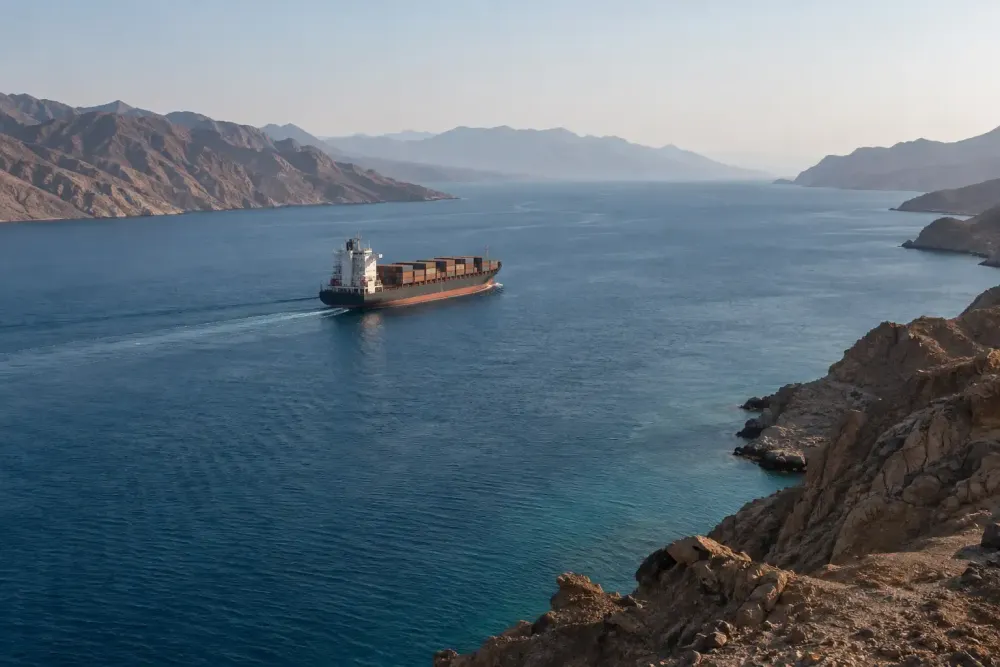
The commercial consequences depend less on formal territorial control than on insurers’ and shipowners’ assessment of risk. The U.S. Energy Information Administration estimates that 4.2 million barrels a day of crude oil and petroleum products moved through Bab el-Mandeb in the first half of 2025, down from 9.3 million in 2023 after earlier Houthi attacks sent ships around Africa. The EIA data show why even an incomplete disruption matters: vessels can avoid the strait by sailing around the Cape of Good Hope, but the detour adds time, fuel expense and pressure on available shipping capacity.
That earlier rerouting also demonstrates the limits of treating the waterway as either open or closed. Many tankers and bulk carriers continued to use the Red Sea while large container lines diverted, producing a mixed pattern shaped by cargo, ownership, insurance and perceived political exposure. AP cited maritime intelligence showing that shipping through Bab el-Mandeb remained about 60% below levels before the Houthis began attacking vessels in late 2023.
The market response on Thursday reflected a broader regional risk premium rather than the loss of Mocha alone. Brent crude settled 6.34% higher at $107.63 a barrel, while West Texas Intermediate rose 6.69% to $102.48, according to market trading reported by Reuters. Those gains followed attacks on tankers near Hormuz as well as the Houthi advance, making it impossible to isolate the price effect of any single event.
Saudi Arabia’s exposure is especially important. The kingdom has used Yanbu and its east-west pipeline to shift exports away from Hormuz, but Houthi threats against Saudi ports and infrastructure constrain that alternative. The Financial Times reported that Saudi production fell to 6.2 million barrels a day in August and exports to 3.1 million, attributing the decline in part to shipping disruption and threats along the Red Sea route.
Yemen’s Frozen War Is Moving Again
The territorial shift also breaks a political assumption that had governed Yemen for four years: that the expired 2022 truce could continue to suppress major combat even without a comprehensive peace agreement. The Houthis seized the capital, Sanaa, in 2014, and a Saudi-led coalition intervened the next year on behalf of the government. Front lines stabilized after the truce, but negotiations never resolved control of state institutions, weapons, salaries or oil revenue.
Renewed fighting now connects that unresolved civil war to the wider Iran conflict. The Houthis have their own Yemeni political and military agenda and should not be described simply as an Iranian proxy. Iran supplies support, weapons and expertise, while the group has demonstrated independent decision-making. Reuters reported that Tehran denied controlling the Houthis even as Iranian sources said it encouraged recent attacks on Saudi Arabia. The distinction matters because pressure on Tehran may influence Houthi calculations without guaranteeing compliance.
The humanitarian risk is immediate. The 2022 lull did not repair Yemen’s divided economy, damaged health system or dependence on imported food. Fighting along the west coast can displace civilians, interrupt roads and complicate access to ports even if commercial shipping continues. At an emergency Security Council meeting on Thursday, U.N. envoy Hans Grundberg said the renewed war ended four years of relative calm and warned that its effects would not remain inside Yemen, according to AP.
Assurances Do Not Remove the Risk
Houthi officials say navigation remains safe for ships other than Saudi vessels and describe their operations as limited to specific targets. That assurance is relevant, but it is not equivalent to a binding guarantee. The group’s earlier campaign struck or threatened ships with connections to numerous countries, and commercial operators often could not determine in advance how Houthi targeting rules would be applied.
The international legal position is clearer than the operational one. In 2024, the U.N. Security Council adopted a resolution demanding an immediate end to Houthi attacks on merchant and commercial vessels and affirming freedom of navigation. Enforcement, however, has relied on naval escorts, defensive interceptions, sanctions and military strikes rather than a negotiated maritime regime accepted by the Houthis.
There is also no evidence yet that the group can physically block Bab el-Mandeb for a sustained period. The strait is an international waterway, and naval forces can contest attacks from land, air and sea. Still, mines, missiles, drones or small boats do not need to seal the channel to impose significant costs. A credible threat can raise war-risk premiums, delay sailings and push carriers toward the Cape route. A Reuters explainer estimated that roughly 7% of global oil output normally passes through the strait.
What Comes Next
The first test is whether the Houthis consolidate Mocha and continue toward Dhubab and Perim Island, or whether Saudi-backed forces can halt and reverse the advance. The second is commercial: changes in vessel traffic, insurance pricing and port calls will show whether operators regard the takeover as a manageable threat or the beginning of another broad diversion from the Red Sea.
The third test is diplomatic. Saudi Arabia says it still supports a political settlement but will defend itself, while Yemen’s government is asking for stronger enforcement of sanctions and restrictions on weapons reaching the Houthis. A large Saudi intervention could slow the offensive but also return Yemen to the destructive pattern of airstrikes and retaliation that the 2022 truce interrupted.
Mocha’s fall therefore establishes three things and leaves one central question open. The Houthis have made their most important territorial gain in years, Yemen’s dormant front lines are active again, and global energy markets are pricing simultaneous risk around two regional chokepoints. What remains uncertain is whether the movement converts its new position into sustained control near Bab el-Mandeb or uses it as leverage. The answer will determine whether Thursday’s seizure is a local battlefield victory or the start of a deeper disruption to international trade.