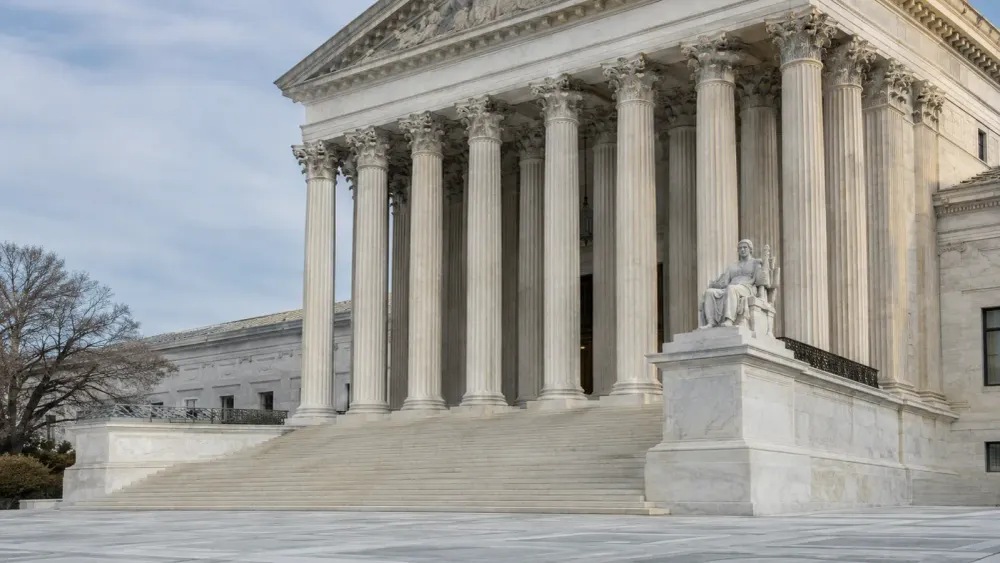
The House rejected a constitutional amendment fixing the Supreme Court at nine justices by a 212–206 vote on Wednesday, leaving the proposal 67 votes short of the two-thirds threshold among the 418 members voting. The official roll call showed 211 Republicans and one Democrat in favor, while 205 Democrats and one independent opposed it; 15 members did not vote.
The defeat changed no law and created no vacancy. Federal statute already provides for one chief justice and eight associate justices, the Court’s composition since 1869. But the near-party-line vote put members on record in an election season over a more enduring question: whether a future congressional majority should keep its existing power to alter the Court’s size through ordinary legislation. That distinction matters because statutory change is difficult but reversible, while constitutional change is designed to outlast electoral majorities.
Republicans presented the amendment as a barrier against partisan court expansion. Democrats described it as an attempt to entrench a 6–3 conservative majority created after President Donald Trump appointed three justices. As Reuters reported, leaders understood that the measure had virtually no path to ratification; the immediate audience was voters deciding control of Congress on November 3.
Why the Amendment Failed
House leaders brought H.J.Res. 1 to the floor under suspension of the rules, a procedure that limits debate and requires a two-thirds vote. With 418 representatives voting, passage required 279 yeas. The result therefore was not a narrow six-vote loss despite the 212–206 split. It was a decisive failure under the constitutional and procedural standard the sponsors chose. The method also avoided a lengthy amendment process on the floor, reinforcing the measure’s role as a clean recorded choice rather than a negotiation over details.
The proposal itself was spare. The reported resolution would have added a constitutional article stating that the Supreme Court consists of one chief justice and eight associate justices. It also required ratification by three-fourths of state legislatures within seven years. That language would have converted today’s statutory arrangement into a rule that ordinary majorities could not later revise.
Even a successful House vote would only have opened a much longer process. Article V requires approval by two-thirds of both chambers before Congress may send an amendment to the states, followed by ratification from three-fourths of them—currently 38. The president has no formal role in approving a constitutional amendment. No plausible coalition for those supermajorities existed in this Congress. Republicans would have needed scores of Democratic votes in both chambers and approval from legislatures across states controlled by both parties.
Nine Seats Are Statutory
The Constitution establishes “one supreme Court” but does not specify its membership. Congress supplied the original design in 1789, creating a chief justice and five associates. The National Archives records that early lawmakers also built the district and circuit systems, illustrating how much institutional detail the founding document left to legislation.
Congress changed the Court’s size several times as the nation, circuit system and political balance shifted. It reached ten seats during the Civil War, fell by attrition under an 1866 law intended to deny President Andrew Johnson appointments, and returned to nine under the Judiciary Act of 1869. Those changes were not purely administrative; appointments and partisan control repeatedly shaped the timing. That history makes both parties’ arguments more complicated: stability has lasted 157 years, but congressional power over size is equally longstanding.
Today, federal law says the Court “shall consist” of a chief justice and eight associate justices and sets six as a quorum. Changing nine to another number would require a bill to pass the House and Senate and become law, ordinarily through presidential signature or a veto override. H.J.Res. 1 sought to remove that option from the normal legislative process.
Two Competing Claims About Legitimacy
The Judiciary Committee’s Republican majority argued that a fixed nine would protect judicial independence by preventing a governing party from adding seats to obtain preferred rulings. Its July committee report invoked Franklin Roosevelt’s failed 1937 expansion plan and described predictable membership as a safeguard against political pressure on the justices.
The same report includes Democratic dissent, which argued that constitutionalizing nine would freeze Congress’s historical authority precisely when reform is contested. The dissent did not establish that Democrats possess the votes to expand the Court. It instead objected to permanently closing that avenue while the current majority reflects a sequence of confirmation fights that each party views through sharply different institutional narratives. Because the report prints both cases together, it also shows that the disagreement concerns the allocation of future power, not the current head count.
Those views track a deep public divide. A July Pew survey found overall opinion of the Court close to evenly split but strongly polarized by party, with Republicans far more favorable than Democrats. That does not translate automatically into support for enlargement, yet it explains why “protect the Court” and “reform the Court” can each mobilize a partisan audience.
Reform Extends Beyond Adding Seats
Court expansion is only one item in a broader reform argument. Proposals have included enforceable ethics requirements, tighter recusal rules, greater financial disclosure and 18-year active-service terms for future justices. Some could be attempted by statute; others raise constitutional disputes because Article III protects judicial tenure during “good Behaviour.” The failed amendment addressed none of those questions. Nor would it have changed the Senate’s confirmation power, the justices’ life tenure, the Court’s jurisdiction or Congress’s authority over lower federal courts.
Expansion legislation has nevertheless kept the numerical issue alive. Democratic lawmakers previously proposed a 13-member Court, linking one justice to each federal circuit and arguing that enlargement would restore balance. The sponsors’ case treats nine as a historical choice rather than a constitutional principle. That bill has not attracted the bipartisan support needed to become law, much less the consensus required for an amendment.
Supporters of H.J.Res. 1 therefore were legislating against a possibility, not an imminent governing plan. Their concern is prospective: if one party expands the Court, the other could respond when power changes hands, producing repeated enlargement and diminishing public acceptance of rulings. Opponents answer that surrendering the power in advance would reduce leverage for institutional reform and ratify the advantage of the current majority. Both positions treat institutional legitimacy as the goal, but they diagnose opposite threats—retaliatory expansion on one side and uncorrectable entrenchment on the other.
What the Vote Establishes
Legally, the answer is straightforward. The Supreme Court remains at nine members under Title 28, and a future Congress retains authority to change that number by statute. H.J.Res. 1 does not go to the Senate or the states after failing in the House. No justice’s tenure, jurisdiction or pending case was affected by Wednesday’s vote.
Politically, the record is more useful to both parties. Republicans can say nearly their entire conference voted to prohibit court expansion, while Democrats can say nearly theirs preserved Congress’s traditional power to restructure the judiciary. The lone Democratic yes vote, from Representative Don Davis of North Carolina, also demonstrates how a constitutional proposal can become a district-level campaign test even when national passage is impossible. For vulnerable members, the vote supplies a simple campaign position on an institution whose public standing has become unusually partisan.
The most important fact is the distance between symbolism and institutional change. A 212-vote coalition is enough to frame advertisements and force an opponent’s explanation; it is nowhere near enough to amend the Constitution. Unless the election produces a historically large realignment and a matching state-level consensus, the next phase of the Court debate will remain where it has been for decades: ordinary bills, oversight, nominations and public trust.