
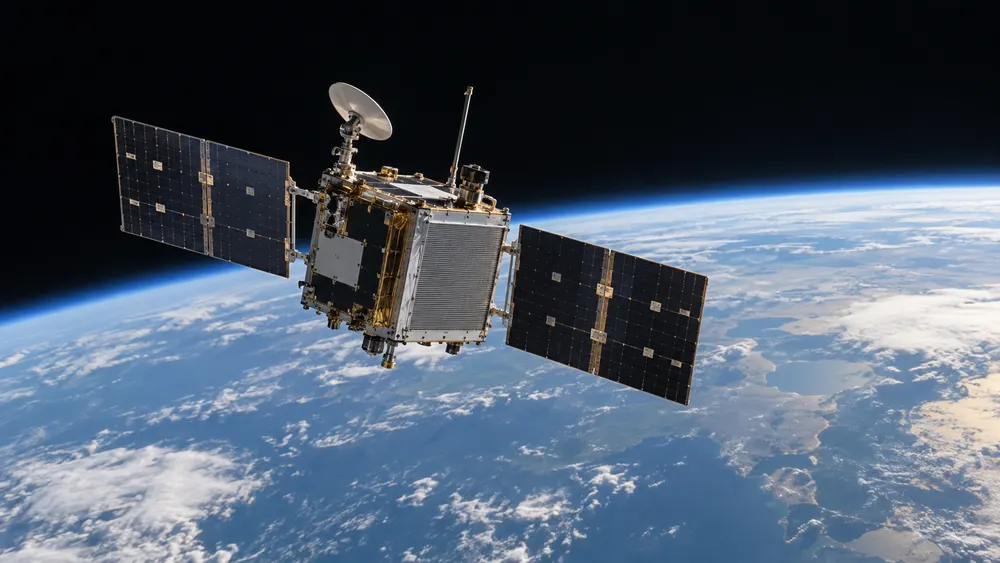
Google will put its Tensor Processing Units into orbit next week for the first time, turning Project Suncatcher from a paper design into a hardware test of whether artificial-intelligence chips can survive launch, radiation and cooling in space. The prototype satellite is scheduled to fly on SpaceX’s Transporter-18 rideshare mission and was developed with Earth-imaging company Planet, according to a new Google account and independent reporting by Reuters.
The mission is consequential because it replaces assumptions with orbital data at the point where AI’s demand for electricity and computing hardware is colliding with limits on Earth. It is not an operational data center, and Google has not shown that space-based computing can compete commercially with terrestrial facilities. The immediate goal is narrower: learn where ordinary high-performance AI hardware fails in low Earth orbit and use those results to shape a more complex two-satellite test planned for 2027.
From moonshot to flight hardware
Project Suncatcher envisions clusters of solar-powered satellites carrying Google accelerators and exchanging data through optical links. Google’s original research outline argued that solar panels in a favorable orbit could produce as much as eight times the power of comparable panels on Earth and operate with less battery storage because sunlight would be nearly continuous. That energy advantage is the project’s central attraction: machine-learning systems could, in theory, tap solar power without adding the same local load to terrestrial grids.
Next week’s flight is deliberately smaller than that vision. It will carry prototype hardware rather than a useful computing cluster, and it is designed to measure vibration, radiation exposure and thermal behavior. The Next Web reported that the satellite has already undergone three-axis vibration tests intended to mimic the punishing acceleration and shaking of launch, but ground simulations cannot reproduce the full orbital environment.
Radiation is the first reliability test
Commercial AI accelerators are optimized for data centers, not for charged particles that can corrupt memory or flip bits in orbit. Google previously exposed its Trillium TPU to a 67-megaelectron-volt proton beam while the chip was running AI workloads. The company’s technical preprint says the hardware survived a total ionizing dose equivalent to a five-year mission without permanent failure, although high-bandwidth memory was the most sensitive component and transient errors still required characterization.
That result is encouraging but not conclusive. Beam testing controls the dose and environment; orbit adds thermal cycling, vibration history, power fluctuations and a changing radiation field. Google says the satellite will record how its chips behave under those combined conditions. A successful flight would demonstrate hardware resilience, not that a constellation can deliver reliable cloud service or match the uptime expected from terrestrial infrastructure.
Cooling without air
Heat may prove as difficult as radiation. Data-center chips normally move heat into air or liquid systems, but a vacuum eliminates convection. The prototype therefore combines heat pipes, which move thermal energy away from the processor, with external radiators that release it as infrared energy. Google says that design worked in a thermal-vacuum chamber; the orbit test will show how it performs through real temperature cycles while the processor is operating.
The challenge becomes harder at scale. A future satellite would carry dozens of TPUs, concentrating far more heat than the current experiment. More radiators add area and mass, while additional mass raises launch costs. The engineering problem is therefore coupled: computing density, power collection, cooling capacity and launch economics have to improve together rather than one at a time.
Lasers and formation flying come next
Large AI models do not run efficiently on isolated processors. They divide work across accelerators connected by high-bandwidth, low-latency networks. Google’s concept would place satellites only hundreds of meters apart and link them with lasers capable of carrying tens of terabits per second. Its researchers reported a laboratory demonstration of 800 gigabits per second in each direction with one transceiver pair, but that setup did not have to point between fast-moving spacecraft.
The 2027 mission is expected to put two satellites in orbit to test those optical links. It will also begin measuring whether close formation flying can remain stable without excessive propellant or collision risk. Google’s earlier discussions with SpaceX marked a step toward launch capacity, Reuters reported in May, but a scalable network would require a manufacturing and launch cadence far beyond a two-satellite experiment.
The economics remain speculative
Google’s paper estimated that launch prices would need to fall below roughly $200 per kilogram in the mid-2030s for an orbital system’s annualized cost to approach the energy cost of an equivalent data center on Earth. That is a modeled threshold, not a quoted price or a demonstrated business case. It also excludes uncertainty around replacement satellites, insurance, ground stations, debris avoidance and the cost of transmitting results back to users.
Orbit is already crowded, particularly in sun-synchronous bands attractive to Earth-observation and near-continuous-sunlight missions. A Space.com analysis noted that tight clusters would have to detect and maneuver around debris that cannot always be tracked from the ground. Large constellations could also complicate astronomy and increase the environmental burden of repeated launches and reentries.
What next week can actually prove
The first Suncatcher flight can answer a limited but essential question: whether Google’s existing AI hardware can keep operating after a real launch and in the combined radiation and thermal conditions of low Earth orbit. It cannot validate the economics, networking or environmental case for orbital data centers, and Google has not announced a commercial deployment timetable.
That distinction matters. The experiment is more substantive than a concept presentation because it places working hardware at risk and will return measurements unavailable on Earth. Yet its value lies as much in revealing failure modes as in confirming the design. If the TPU, memory or cooling system behaves poorly, Google will have learned early; if it performs well, the harder tests—laser networking, formation control and system cost—will still remain.