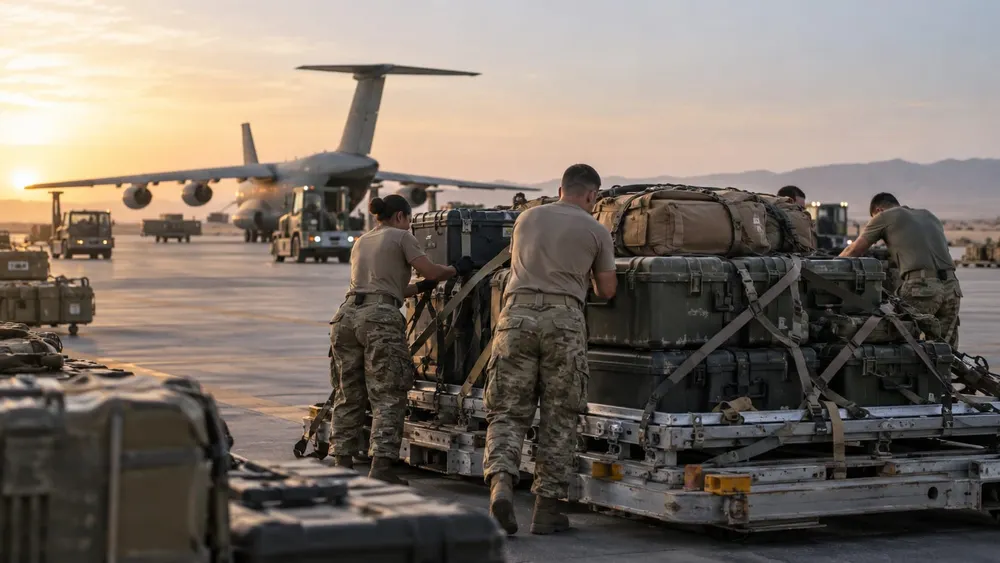
The final several hundred U.S. troops stationed at Iraq’s remaining bases are scheduled to leave by Wednesday, September 30, completing a withdrawal that Baghdad and Washington reaffirmed this summer. The departure closes the current American military mission in a country first invaded by U.S.-led forces in 2003, although that 23-year span included a nearly three-year absence before troops returned to fight the Islamic State group.
Iraq’s commander-in-chief spokesperson, Sabah al-Nauman, said Monday that American and coalition forces would finish withdrawing on the agreed timetable and that no foreign military bases would remain. He told an Iraqi news agency that Iraqi forces controlled the country’s territory and that future cooperation would move to bilateral partnerships. Reuters separately reported Tuesday that U.S. personnel were preparing to leave their final bases by Wednesday.
A mission that changed twice
The United States invaded Iraq in March 2003, removed Saddam Hussein’s government and remained through years of occupation and counterinsurgency. American forces withdrew at the end of 2011, then returned in 2014 at Iraq’s request after Islamic State seized Mosul and large areas of northern and western Iraq. The renewed mission trained, advised and supported Iraqi forces while coalition aircraft and intelligence assets helped dismantle the group’s territorial control.
By 2021, the coalition had formally ended its combat role and shifted toward advising and enabling Iraqi units. A September 2024 joint statement established a two-stage transition: the coalition mission in federal Iraq would conclude first, while support for counter-Islamic State operations in Syria could continue from Iraqi territory through September 2026. The Pentagon said at the time that the change was a transition to bilateral security relationships, not an immediate break in U.S.-Iraqi defense cooperation.
President Donald Trump and Iraqi Prime Minister Ali al-Zaidi later set September 30 as the date for all remaining U.S. military personnel to depart Iraq. The Associated Press reported in July that roughly 2,500 Americans had served in Iraq in recent years, mainly advising and training local forces, after troop strength reached more than 170,000 during the 2007 surge.
Iraq assumes the counter-ISIS burden
The operational question is what capabilities leave with the final contingent. Iraqi forces now conduct most ground operations against Islamic State, but U.S. support has included intelligence collection, surveillance, logistics, planning and access to aircraft and drones. Those functions can be harder to replace than troop numbers suggest, particularly across disputed or sparsely governed areas where militants can move between provinces.
The latest U.S. government oversight report, covering April through June, continued to define Operation Inherent Resolve as an effort to advise, assist and enable partner forces until they could independently defeat Islamic State in designated areas of Iraq and Syria. The report also described a broader campaign involving diplomacy, stabilization and humanitarian assistance. Withdrawal from Iraqi bases ends one military platform for that mission, but it does not eliminate U.S. interests in counterterrorism or regional stability.
Iraqi officials argue that their security forces are prepared. Al-Nauman said Monday that units were deployed nationwide and the security situation was under control. That is an official assessment rather than proof that every support gap has been closed. Reuters reported that Iraqi and Kurdish security officials had observed activity by suspected Islamic State cells and worried that reduced access to U.S. intelligence, logistics and unmanned aircraft could create opportunities for the group to reorganize.
Iran-backed militias gain political space
The withdrawal also changes the balance between Iraq’s state institutions and armed factions aligned with Iran. Some of those groups have attacked U.S. facilities and personnel, while also holding formal political influence and positions within Iraq’s broader security system. Their leaders have presented the American departure as a victory and have resisted demands to surrender weapons outside direct state control.
That does not mean Iran will automatically control Iraqi security decisions. Baghdad has tried to maintain working relationships with both Washington and Tehran, and Iraqi governments face domestic pressure to protect sovereignty from both foreign troops and autonomous militias. Still, removing the U.S. military presence eliminates one counterweight and transfers more responsibility to Iraqi leaders to integrate or restrain armed groups without external forces on the ground.
The 2024 transition framework anticipated continuing bilateral cooperation in training, intelligence and equipment. A Defense Department account emphasized that the coalition’s military mission and the broader U.S.-Iraq security relationship were distinct. The practical test after September 30 will be whether those bilateral channels provide useful support without recreating a standing foreign deployment that Baghdad has declared finished.
What the withdrawal establishes
The departure marks the end of a military cycle rather than the end of Iraq’s security risks. The United States left once before in 2011 and returned after Islamic State’s rapid advance exposed weaknesses in Iraqi command, readiness and territorial control. Today’s Iraqi forces are more experienced and the extremist group no longer holds cities, but sleeper cells, militia power and regional conflict still complicate the transition.
The evidence establishes that the final withdrawal is proceeding under an agreed timetable and that Iraq is assuming formal responsibility for the remaining coalition mission. What remains uncertain is whether Iraqi forces can replace specialized support quickly enough and whether political institutions can keep armed factions subordinate to the state. The next meaningful measures will be the pace of Islamic State attacks, the performance of Iraqi intelligence and air-support systems, and the scope of any bilateral defense cooperation that follows without permanent U.S. bases.