
Advanced Micro Devices agreed Monday to acquire World Labs in an all-stock transaction valued at approximately $8.2 billion, placing one of the semiconductor industry’s largest artificial-intelligence bets on models that understand and simulate three-dimensional environments. The definitive agreement is expected to close by the end of 2026, subject to regulatory approvals and customary conditions, according to AMD’s announcement.
The deal would bring World Labs co-founder and chief executive Fei-Fei Li to AMD as executive vice president and chief scientist, reporting to AMD Chief Executive Lisa Su. World Labs will continue its model-research work after the transaction closes, the companies said. Reuters reported that World Labs raised $1 billion earlier this year in a financing round that included AMD, creating an existing commercial and investment relationship before the acquisition.
A chipmaker moves closer to the models
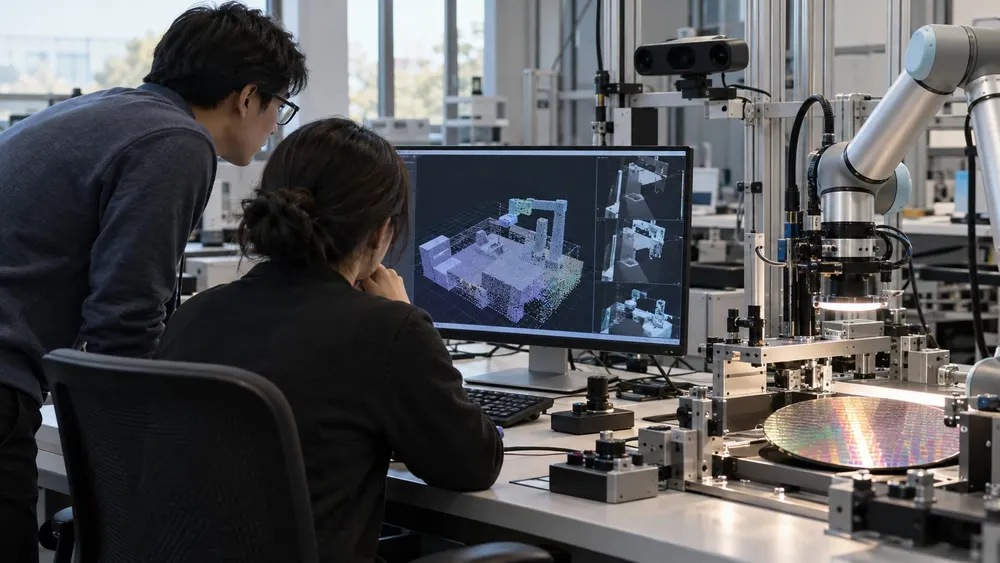
World Labs develops what it calls spatial-intelligence models: systems designed to generate, reconstruct and simulate interactive environments from text, images and video. The technology differs from large language models, which are optimized primarily to predict and produce sequences of text. Spatial models instead attempt to preserve geometry, perspective, movement and relationships among objects, capabilities that could support robotics, industrial simulation, design and immersive media.
For AMD, the strategic value is not limited to owning another AI application. Model developers can reveal how emerging workloads use memory, processors, networking and software, giving a chip designer earlier insight into future computing requirements. AMD said that understanding those workloads could guide its hardware, software and systems road maps. The Financial Times described the transaction as a move beyond chips into advanced model development, reflecting a broader push by semiconductor companies to control more of the AI technology stack.
The companies already had a technical partnership focused on training and inference optimization on AMD graphics processors. In its own statement, World Labs said closer coordination with hardware was necessary to scale its research and that the combined operation would pursue an open ecosystem spanning chips, software, platforms and models. Those are forward-looking plans, not demonstrated outcomes; the acquisition has not closed, and neither company disclosed revenue, customer or profitability figures for World Labs.
What World Labs has actually built
World Labs was founded in 2024 and has concentrated on systems that represent physical space rather than language alone. Its Atlas model, introduced on Sept. 1, accepts text, images, video and three-dimensional inputs within a shared spatial context. The company says Atlas can generate new camera views, reconstruct scenes and simulate changes over time, but the model remains in early access with selected partners.
The company’s technical description says Atlas was pretrained from scratch and combines autoregressive modeling with diffusion methods. World Labs reports that the system outperformed specialized open-source models on reconstruction benchmarks under a common evaluation protocol. Those results are company-reported rather than independently audited, and benchmark performance does not by itself establish reliability in factories, robots or other safety-sensitive settings.
That distinction limits how much can yet be inferred from the acquisition price. World models could eventually help robots learn in simulated environments before acting in the physical world, reducing the cost and risk of collecting real-world training data. They could also support design, gaming and digital-twin applications. But commercial adoption will depend on accuracy, consistency, computing cost, access to suitable training data and the ability to transfer simulated behavior into unpredictable real environments.
The strategic contest with Nvidia
AMD competes with Nvidia in accelerators used to train and run advanced AI models, but the contest increasingly extends beyond silicon. Chip performance depends on software libraries, developer tools, networking and the degree to which popular models are optimized for a hardware platform. By integrating a frontier research laboratory, AMD could shorten the feedback loop between model design and processor development while also creating high-profile workloads for its own systems.
The Wall Street Journal characterized the agreement as evidence that chipmakers want greater control over the AI stack. The purchase would also give AMD Li’s research leadership at a moment when the company is trying to differentiate its approach from Nvidia’s dominant hardware and software ecosystem. Even so, acquiring a model laboratory does not guarantee that outside developers will choose AMD hardware, and the companies’ commitment to open models will ultimately be judged by licensing, technical access and interoperability after closing.
An expensive bet with measurable tests ahead
The $8.2 billion valuation is notable because the consideration consists of AMD shares and because World Labs is a young company whose most advanced public model is still in limited release. The publicly disclosed terms provide no revenue, earnings or customer figures that would allow investors to assess the price through conventional operating multiples. Instead, the valuation appears to reflect the research team, technical assets and strategic option AMD believes the company can provide.
The transaction therefore rests heavily on research talent, intellectual property and AMD’s expectation that physical AI will become a major computing market. The principal near-term tests are whether regulators approve the deal, whether AMD retains World Labs’ researchers and whether the combined teams produce hardware and software improvements that outside developers can use. Longer term, the evidence will come from real deployments: robots that transfer skills from simulation, design tools that preserve physical consistency and models that run efficiently on AMD systems.
For now, the agreement establishes direction rather than results. AMD is proposing to spend $8.2 billion in stock to bring model research inside the company and make spatial intelligence part of its technology planning. The scale of that commitment signals that competition in AI is moving from supplying processors for today’s language models toward shaping the models, tools and physical systems that could determine the next generation of demand.