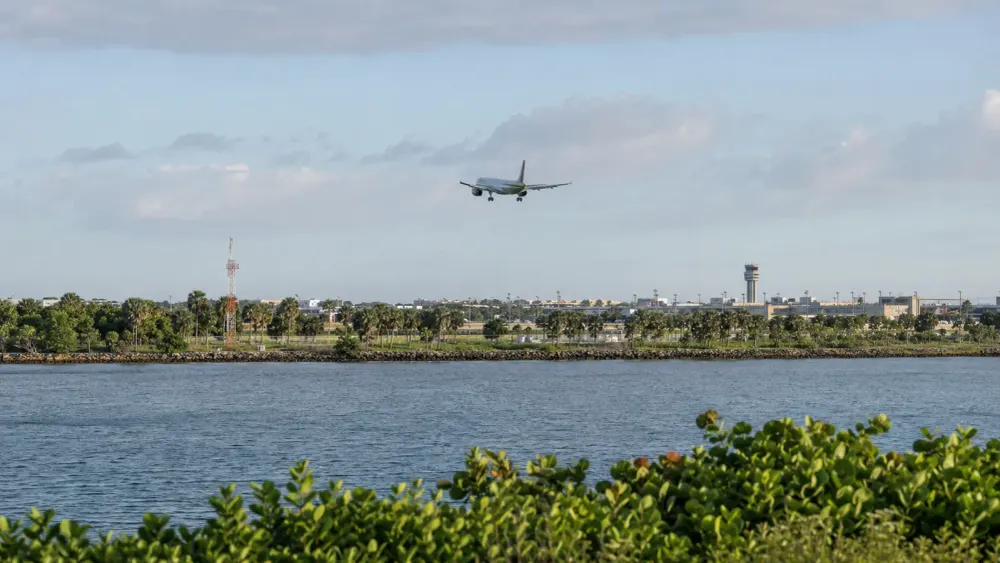
A one-nautical-mile ring of airspace around Mar-a-Lago would become a permanent federal flight-rules area under an FAA proposal scheduled for publication Wednesday. The zone would extend from the surface to 2,000 feet above mean sea level, replacing a temporary security restriction that is due to expire October 20. The change would preserve access to the main commercial runway at President Donald J. Trump International Airport while turning a presidential-protection measure into a standing part of the national airspace system.
The proposed rule, requested by the Secret Service and released for public inspection Tuesday, describes what the agency calls “adverse threat intelligence” and persistent risks from unauthorized aircraft and drones. It does not disclose the intelligence. The FAA instead lays out an operating compromise: aircraft could still cross the protected area if they follow specified routes, maintain radio contact with controllers, receive authorization and transmit an assigned transponder code.
That distinction matters. The proposal is not a blanket no-fly zone, and commercial service would not stop. But it would make permanent a security regime that has already changed flight paths, concentrated noise over some neighborhoods and produced a legal challenge by local governments. The central policy question is therefore not whether the president should be protected. It is whether the proposed rule adequately measures and distributes the costs of permanent protection around a private residence beside a busy airport.
A permanent framework replaces a temporary order
The FAA began imposing temporary presidential flight restrictions around Palm Beach in September 2025. A month later it established the current one-mile security zone under a special-security instruction. That restriction runs all year, whether Trump is at Mar-a-Lago or elsewhere, while larger temporary rings are added when he or another protected official visits. The permanent rule would codify the smaller, continuous zone in Part 93 of the federal aviation regulations.
As Reuters reported Tuesday, the Secret Service argues that a charted permanent area would make it easier to mitigate unauthorized flights and unmanned aircraft. The FAA also says publication on aviation charts should improve pilot awareness compared with a security instruction conveyed through notices. Congress gives the agency broad authority to assign airspace for safety and efficiency under federal law, while the Secret Service’s protective authority covers the president and designated residences.
The zone would be centered on Mar-a-Lago, not the airport terminal. Its top would be about 1,980 feet above ground because the airport sits roughly 20 feet above sea level. When a broader presidential temporary restriction is active, the more stringent requirements in its notice would control. The FAA’s current notice illustrates the layered approach: standing restrictions define the baseline, and travel-related orders can tighten it for particular dates and security conditions.
The runway explains the unusual design
Historically, the FAA has created prohibited areas over seven presidential or vice-presidential residences. Those rules largely bar flight unless a designated security agency grants an exception. The Palm Beach geography makes that model impractical. Mar-a-Lago lies close to the approach and departure path for Runway 28R/10L, the airport’s main commercial runway, which averaged about 86 airline operations a day in 2025.
The FAA concluded that commercial aircraft could not reliably make the turn and climb needed to avoid a prohibited one-mile circle. Closing that path would effectively eliminate the primary runway for airline use. The alternative Runway 14/32 is about 3,000 feet shorter and cannot handle the same heavy traffic. The proposed special-flight-rules area therefore permits routine arrivals and departures through the zone under controller supervision instead of making every crossing an exceptional security decision.
Arriving aircraft would need an active instrument or visual flight plan and an approved approach. Departures would need an assigned procedure or radar vector. Military flights supporting presidential protection, active law-enforcement missions, firefighting, air ambulances and narrowly defined safety flights could also enter. Every permitted aircraft would have to remain in two-way communication, obtain authorization and continuously broadcast a unique code so controllers and security officials can distinguish known traffic from a possible threat.
The agency’s cost finding has a narrow baseline
The FAA says the proposal would have “no incremental cost” to operators because the same basic procedures are already required under the temporary restriction. It predicts little or no additional effect on daily traffic, certifies no significant economic impact on a substantial number of small entities and treats the rule as non-significant under the White House regulatory-review framework. Those conclusions are internally consistent—but they depend on assuming the temporary regime would otherwise continue.
The agency acknowledges a different result if the comparison is unrestricted airspace after October 20. Against that baseline, pilots and operators would face continuing requirements for radio communication, assigned codes and controller approval. The FAA dismisses that scenario as less likely because officials could simply renew the temporary restriction. In policy terms, the analysis measures the cost of changing the legal container, not the full cost of keeping the security system in place indefinitely.
The same framing shapes the environmental review. The agency proposes a categorical exclusion, saying the rule should not significantly affect the human environment because it largely formalizes current operations. Yet Palm Beach County’s January airport notice said the restriction had already forced controllers to redirect departures and later prompted new precision routes intended to reduce the spread of noise. Making that baseline permanent may not add new effects, but it can lock in effects that began under the temporary order.
Local objections now move into rulemaking
West Palm Beach and the Town of Palm Beach filed a legal petition in December challenging the year-round restriction and the process used to establish it. Residents told local reporters that rerouted aircraft increased noise over neighborhoods that had not previously carried the same traffic. Municipal critics have generally accepted tighter protection when the president is present while disputing the need for identical routing burdens during his absences.
The proposed rule gives those objections a formal channel that the interim security instruction did not. After publication, the FAA will accept comments for 30 days in docket FAA-2026-10827 and says it wants data on economic, environmental, energy and federalism effects. The docket matters because generalized arguments about security or noise are unlikely to change a technical airspace rule. Flight-track evidence, measured sound exposure, operational-delay data and workable routing alternatives would carry more weight.
The airport itself has already adapted. New area-navigation departure procedures took effect in January, replacing broad radar-vector patterns with predefined routes. The aim was to concentrate flights more predictably and reduce the “fanning” of departures across multiple communities. Separately, the airport’s passenger-facing code changed from PBI to DJT in August, according to its official FAQ. Those administrative changes do not resolve the security dispute, but they show how quickly a temporary federal decision can reshape routine local operations.
What the final rule must demonstrate
The FAA chose a less restrictive instrument than a prohibited area, and that is a meaningful safeguard for commercial aviation and emergency access. The proposal also specifies who may enter, how controllers will identify them and which rules prevail during presidential visits. Compared with an indefinite series of hard-to-find security notices, a public regulation, charted boundary and comment record would improve transparency and compliance.
Still, permanence raises a higher evidentiary burden. The final rule should explain why the security risk exists continuously, why the one-mile radius and 2,000-foot ceiling remain necessary when Trump is absent, and how the agency evaluated noise and emissions displaced rather than newly created by the rule. It should also disclose enough unclassified information about violations or drone activity to let the public understand the policy without compromising protection.
The decision is a test of regulatory candor as much as aviation security. The FAA has identified a workable way to keep the airport’s principal runway open while protecting a designated presidential residence. Its remaining task is to show that the permanent public burden is proportionate, that alternatives were genuinely compared and that communities beneath the redirected paths were not written out of the baseline before the analysis began.