
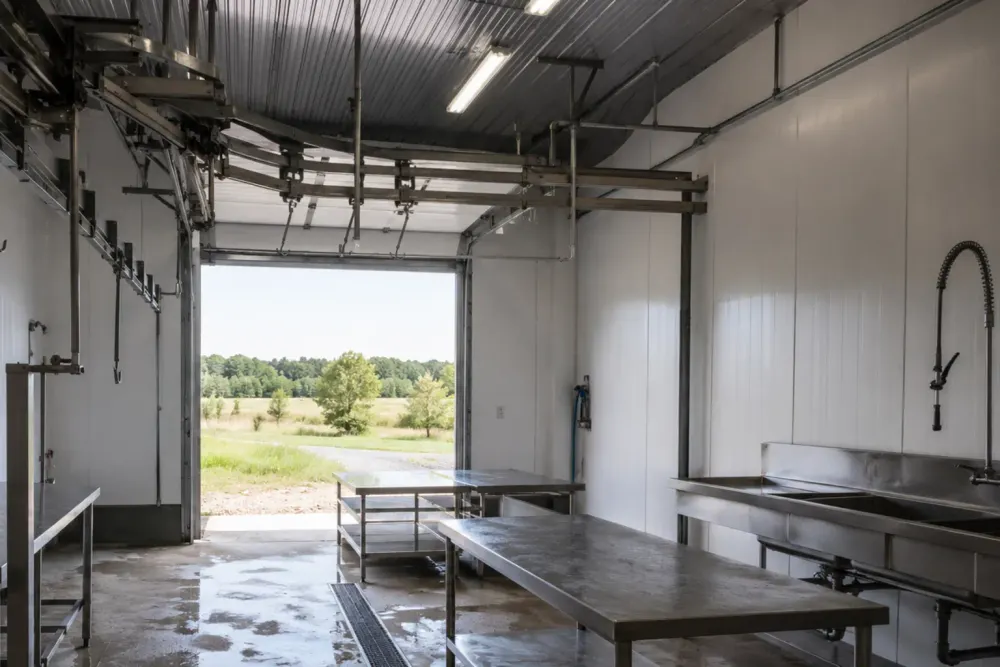
Four companies handle about 85% of U.S. steer and heifer purchases, and President Donald Trump said Friday that his administration is preparing legal documents intended to give farmers and ranchers more power to process and sell meat outside that concentrated system. Agriculture Secretary Brooke Rollins said the administration expects to announce steps Monday that would expand interstate sales, support smaller processors and rescind federal guidance. The promise is potentially significant, but the governing documents have not been released, leaving unanswered what legal authority the administration will use and how federal inspection safeguards would apply.
The announcement, reported by Reuters, joins antitrust scrutiny of large packers, subsidies for independent processing capacity and a temporary increase in low-tariff beef imports. Giving producers another place to slaughter animals can improve local options, but it does not create more cattle, inspectors or refrigerated transport by itself.
That distinction matters because the administration is presenting the initiative as both a competition measure and a response to household costs. Smaller plants could give some ranchers more bargaining power and shorten supply chains. Yet the national price effect is likely to be modest unless the policy adds a substantial volume of federally or equivalently inspected meat. The central test is whether Washington can expand lawful processing capacity without turning a food-safety exemption into a broad commercial channel.
The Policy Has Not Yet Been Written
Trump described the plan as an order and said lawyers were preparing documents, while Rollins offered three broad components: more access to interstate sales, help for small processors and the removal of guidance. None of those statements identifies a regulation to be changed, a funding total, an implementation date or the categories of plants and sales that would qualify. Until the text appears, claims that the policy will either dismantle inspection or break a packing monopoly go beyond the available evidence.
Existing law provides several possible routes. A plant operating under federal inspection may sell across state lines. State-inspected establishments generally sell only within their state, although qualifying plants with 25 or fewer employees can enter USDA’s interstate program and ship products bearing a federal mark of inspection. Washington could encourage more states and plants to use that channel, help establishments pay for upgrades or make administrative requirements easier to navigate.
A different route would involve the custom-slaughter exemption. Under federal inspection rules, livestock owners may have animals processed for their household and nonpaying guests, but the resulting packages must be marked “Not for Sale.” Broadly allowing that meat into commerce would raise legal and safety questions that a grant or guidance memo cannot necessarily resolve. Material changes to statutory inspection duties may require formal rulemaking or Congress rather than an executive announcement alone.
Concentration Is Real, but Its Effects Are Mixed
The market structure behind the proposal is not in dispute. USDA’s economic research says the four largest firms’ share of steer and heifer purchases climbed from 36% in 1980 to 81% in 1995 and now stands near 85%. Large plants gained share because high-throughput operations lowered per-animal processing costs, and those economies helped reshape cattle procurement, feedlots and boxed-beef distribution.
Concentration, however, is not the same as proof of unlawful conduct. USDA’s review found that earlier cost efficiencies sometimes offset the price effects of greater packer market power, benefiting consumers and cattle sellers. More recent research has found weaker competition in some cattle markets and wider margins between livestock and wholesale beef prices. That mixed record supports careful intervention: more viable buyers can improve ranchers’ options, but simply dividing production among smaller, higher-cost plants would not automatically make groceries cheaper.
New processing capacity can be most valuable where ranchers face long transportation distances, limited slaughter appointments or only one practical bidder. It can also support local beef businesses that receive premiums for traceability or production methods. Those gains are real even if they do not noticeably move national prices. A credible policy should therefore measure capacity, utilization, cattle bids and consumer prices separately.
Inspection Is the Central Constraint
Commercial access depends on inspection because slaughter and fabrication create biological hazards that cannot be managed by market competition alone. Federal inspectors verify sanitation systems, examine animals before and after slaughter and oversee plants’ hazard-control plans. States participating in cooperative inspection must maintain requirements at least equal to federal standards. Expanding sales while preserving those controls would require enough trained inspectors and veterinary personnel to serve additional plants.
Industry groups reflect that tension. The Meat Institute warned that allowing uninspected meat to be sold could expose consumers to unsafe products. The National Cattlemen’s Beef Association supports expanding small-processor access but has argued against weakening inspection. Those positions leave room for a middle path: help more small plants achieve inspected status, add inspection shifts and widen the cooperative interstate program, while keeping custom-exempt meat outside ordinary retail commerce.
That approach would cost money and time. A small slaughter facility needs wastewater handling, temperature control, testing, recordkeeping, trained labor and a steady flow of animals. Regulatory relief may remove avoidable paperwork, but it cannot responsibly eliminate contamination controls or the inspection workforce needed to verify them.
Small Plants Cannot Quickly Replace National Packers
USDA has already tried to lower those barriers. On August 8 it opened applications for $60 million in grants for independent meat and poultry processors. Expansion awards range from $50,000 to $2 million and generally require a 50% match; equipment-only awards range from $10,000 to $250,000 with a 25% match. The program can finance useful capacity, but its scale is small relative to a national packing industry built around plants that process thousands of cattle per day.
Texas A&M livestock economist David Anderson told Reuters that on-farm slaughter volumes would probably be too small to change broad competition significantly. Even a successful regional facility can take years to finance, permit, build, staff and reach steady production. Small plants also face disadvantages in purchasing packaging, selling byproducts, filling truckloads and negotiating with large retailers. Policy can improve their survival odds, but it cannot erase those economics by decree.
The cattle cycle is an even larger near-term constraint. The January inventory counted 86.2 million U.S. cattle and calves, the smallest herd in 75 years, including 27.6 million beef cows, down 1% from a year earlier. USDA’s August outlook forecasts 2026 beef production at about 25 billion pounds, 4% below 2025. Processing reforms may change where scarce cattle are slaughtered, but they cannot quickly reverse years of drought, high costs and herd liquidation.
The administration has pursued a separate short-term supply measure. A Wednesday proclamation temporarily increased the low-tariff quota for lean beef trimmings by 300,000 metric tons in three monthly tranches. Imported lean beef is commonly blended with fattier domestic trim for hamburger. That step could add supply sooner than new slaughter plants, although the proclamation conditions the quota on discounted sales and does not address ranchers’ concerns about domestic buyer concentration.
Monday’s Documents Will Reveal the Tradeoffs
The first question for Monday is whether the administration proposes more inspected capacity or a new exemption from inspection. The second is whether interstate access will flow through the established cooperative program, a regulatory amendment or a claimed executive power. Funding, eligibility rules, inspector staffing and measurable deadlines will show whether the initiative is a durable capacity policy or mainly a political response to food inflation.
Antitrust enforcement should also remain analytically separate. The Justice Department can challenge collusion, exclusionary conduct or unlawful information sharing when evidence supports a case. Its May settlement with Agri Stats, for example, would restrict the exchange of sensitive price, cost and output data among poultry and pork processors. That kind of enforcement targets conduct; opening more small plants targets market structure. Neither substitutes for cattle supply or inspection.
The administration has identified a genuine vulnerability: many ranchers depend on a highly concentrated group of buyers, while smaller processors struggle to enter and expand. But the legal order itself, not Friday’s description, will determine whether the response is workable. The strongest version would preserve inspection, add capacity where local bottlenecks are documented and measure results honestly. Beef prices will still depend heavily on the herd cycle, imports and consumer demand, even if producers gain another route to market.