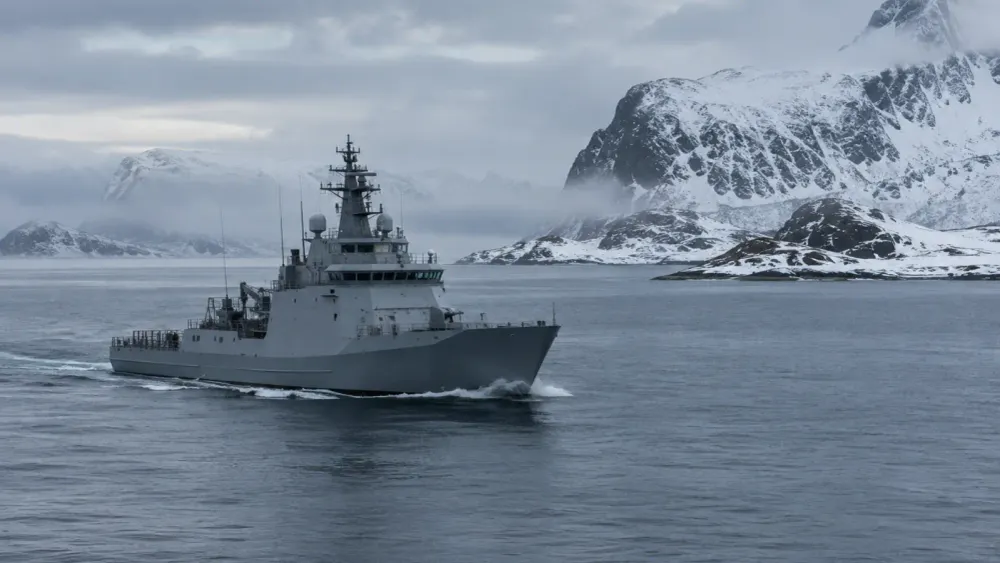
Three NATO allies disrupted a Russian undersea exercise near two roughly 1,400-kilometer fiber-optic cables linking Norway’s Svalbard archipelago to the mainland, according to a new Reuters investigation. Britain, Norway and the United States tracked and confronted Russian vessels during the spring operation, preventing them from completing a drill that Western officials said involved deep-sea submersibles and technology intended to disable cables without leaving obvious evidence.
The September 10 disclosure adds a specific location, an American role and an alleged sabotage mechanism to an operation that Britain and Norway had acknowledged in broader terms in April. The cables were not damaged, and the Russian vessels ultimately left the area. Norway’s defense minister, Tore Sandvik, said the joint response demonstrated that covert activity would be detected and that an attack on critical infrastructure would carry consequences.
The central allegation remains difficult to verify independently. Reuters based the new details on two unnamed Western officials, and the governments involved declined to describe the technology. Russia’s Defense Ministry did not respond to the news organization’s questions; Moscow has previously issued a categorical denial that it threatens British or allied undersea infrastructure. The evidence therefore establishes an allied interception and a serious official assessment, but not a publicly inspectable account of the equipment or Russia’s intent.
What the allied operation changed
The confrontation was unusual because the allies moved beyond observing Russian movements and acted at sea to interrupt the exercise. Western officials said ships from the three countries tracked the Russian vessels, confronted them and prevented completion of the simulated deployment. British and Norwegian officials then presented their findings to Moscow, apparently seeking deterrence through direct warning as well as public exposure.
Britain and Norway had already described a related monthlong operation north of Britain. An April AP report said a Royal Navy frigate, aircraft and hundreds of personnel tracked one Russian attack submarine and two intelligence vessels associated with the Main Directorate of Deep-Sea Research, known by its Russian acronym GUGI. British Defense Secretary John Healey said at the time that the vessels departed without damaging cables or pipelines.
The latest account places at least part of that contest farther north, near Svalbard, and identifies the United States as a participant. That matters operationally because a successful interception demonstrates that allies can combine maritime patrols, intelligence and underwater surveillance over long distances. It also raises the stakes: publicizing a secret capability may deter its use, but it can also prompt Russia to modify the technology or the way it deploys it.
Svalbard connects satellites to the mainland
The targeted geography is strategically important even though Svalbard is remote and lightly populated. Two fiber routes cross about 1,400 kilometers of seabed and reach depths of roughly 2,700 meters before connecting the archipelago with mainland Norway. They carry civilian communications and large volumes of data downloaded at SvalSat, a major ground station for polar-orbiting satellites and part of NASA’s Near Space Network.
That concentration creates both value and vulnerability. A cable can contain multiple fiber pairs and networks can reroute traffic when one path fails, so damage to a single segment would not automatically sever every service. Coordinated damage, however, can exhaust redundancy, slow satellite-data delivery and impose lengthy repairs in deep, harsh waters. NATO has said undersea cables support more than 95 percent of internet traffic and about $10 trillion in financial transactions each day, figures highlighted when the alliance launched Baltic Sentry.
The location also sits near a critical route between Russia’s Kola Peninsula and the North Atlantic. Russian nuclear-powered submarines leaving their northern bases must pass through constrained waters before reaching wider patrol areas. In a conflict, the same region would matter to NATO for tracking submarines, protecting reinforcement routes and preserving communications. That makes ordinary-looking oceanographic activity hard to separate from military preparation.
Undersea warfare thrives on ambiguity
GUGI is formally a deep-sea research organization within Russia’s Defense Ministry, but Western governments describe it as an undersea intelligence and warfare directorate. Its vessels can support submersibles, map seabed infrastructure and work at depths beyond the reach of most commercial or naval platforms. Surveying cables in international waters is not itself unlawful, and such dual-use capabilities give governments room to deny hostile purpose until damage occurs.
That ambiguity is a strategic advantage. A cut cable may result from an anchor, fishing gear, equipment failure or deliberate interference; investigators need vessel tracking, seabed imagery and forensic evidence before assigning responsibility. Even then, proving that a government ordered an act can be harder than showing which ship caused the damage. The Financial Times reported that three vessels damaged Baltic cables or pipelines with anchors in a 15-month period, illustrating how a common maritime hazard can also become a plausible method of coercion.
The threshold for a collective military response is equally uncertain. NATO’s Article 5 applies when allies determine that an armed attack has occurred; it does not automatically convert every damaged cable into an alliance-wide war. Scale, consequences, intent and attribution would all matter. A covert tool designed to leave little evidence could be especially useful below that threshold, creating economic disruption while forcing governments to debate whether they are confronting accident, sabotage or preparation for a larger conflict.
NATO is building a layered defense
NATO’s response combines ships, patrol aircraft, sensors and uncrewed systems rather than attempting to guard every kilometer of cable continuously. NATO said Baltic Sentry would integrate national surveillance, deploy frigates and maritime patrol aircraft, and add a small fleet of naval drones. The purpose is to build a shared operating picture, identify suspicious behavior early and position forces to investigate or deter it.
The British-led Joint Expeditionary Force has added a data-driven layer. Its Nordic Warden system uses information including ships’ Automatic Identification System broadcasts to assess risk in 22 maritime areas, then alerts participating governments and NATO when a vessel behaves suspiciously. The system can focus scarce aircraft and ships, but it also depends on data quality and cannot by itself reveal what a submersible is doing thousands of meters below the surface.
National authorities are also trying to close jurisdictional gaps. In January, Finland announced a regional surveillance center with neighboring states and the European Commission, emphasizing that agencies need both technical capability and legal authority to intervene in territorial waters and exclusive economic zones. Those authorities differ by location, leaving navies with more freedom to monitor than to board or seize vessels in international waters.
The new evidence is serious but incomplete
The Svalbard disclosure changes the public assessment in one important way. Earlier warnings focused heavily on ships mapping infrastructure, loitering above cables or dragging anchors across the seabed. The new account says allied forces observed a purpose-built deep-sea exercise and stopped its completion. If accurate, that is evidence of preparation for a more technically sophisticated form of disruption, not proof that Russia has decided to attack NATO infrastructure.
The gaps remain substantial. No government released imagery, acoustic records, intercepted communications or a technical description that outside specialists could test. Officials did not identify the Russian vessels, state exactly when the confrontation occurred or explain what rules governed the allied response. The current Guardian account reflects the same core reporting rather than offering separate verification.
Deterrence will therefore depend on more than exposing one operation. Allies need redundant routes, faster repair capacity, persistent seabed monitoring and agreed procedures for sharing evidence and responding to ambiguous damage. Norway plans another fiber connection linking Svalbard and Jan Mayen to the mainland by 2028, which would add resilience but also another asset to monitor.
The spring interception shows that Britain, Norway and the United States could detect and interrupt a sensitive Russian undersea operation before infrastructure was damaged. It does not resolve whether Moscow intended a rehearsal, a capability test or coercive signaling. The next measure of success will be whether NATO can preserve that warning advantage as Russia adapts, while maintaining enough public evidence to distinguish deterrence from escalation in the High North.