
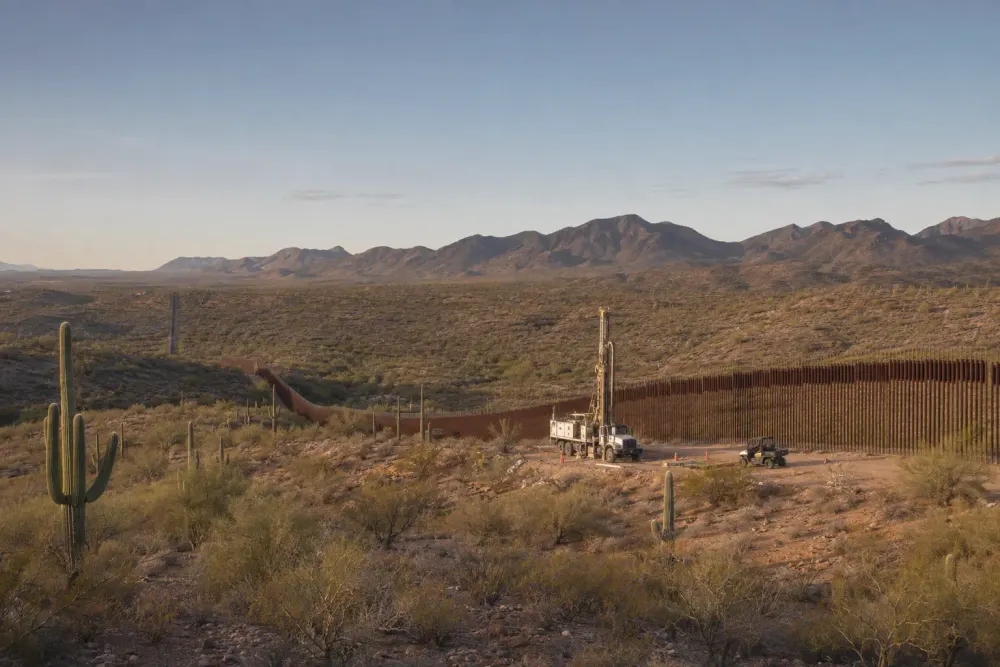
A 62-mile border-wall project moved from planning into field preparation this week along the Tohono O’odham Nation in southern Arizona, where tribal leaders said roughly 20 federal officers and contractors entered reservation land before dawn Tuesday to conduct soil tests. The latest account of the operation places an immediate sovereignty dispute inside a much larger federal push to expand physical barriers along the U.S.-Mexico border.
The Nation said vehicles reached three drilling locations and that Customs and Border Protection officers prevented tribal police from approaching the work areas. Drone footage reviewed by The Associated Press showed about 14 vehicles and a drill at one site. No physical confrontation was reported, but the Nation characterized the entry as unauthorized and said it was assessing further legal action.
The work follows an August 14 federal court decision allowing the Trump administration to proceed with construction inside a 60-foot federal strip known as the Roosevelt Reservation. That ruling did not erase the practical question now at the center of the dispute: whether the government may reach and service that narrow corridor by moving personnel and heavy equipment across land the Nation says it controls.
The confrontation also compressed a dispute that had been unfolding for months. The Nation sued in June, sought emergency relief the next day and then returned to court as federal officials prepared to mobilize. Earlier court coverage described the judge’s ruling as a significant victory for the administration, but the arrival of contractors exposed an implementation issue the preliminary decision had not settled in detail. The legal question is no longer only where bollards may stand; it is also which roads, entry points and work zones may be used to put them there.
A Narrow Corridor Drives a Broad Legal Fight
The Roosevelt Reservation dates to a 1907 presidential proclamation that set aside a strip of federal land along portions of the international boundary. The Tohono O’odham reservation was formally established later, creating overlapping histories that now produce sharply different readings of federal authority. In its June complaint, the Nation argued that the planned wall would alter the effective southern boundary of its reservation and that Congress has not approved such a change.
U.S. District Judge Richard Leon rejected the Nation’s request for a preliminary injunction, concluding that the government had shown strong border-security interests and that the Nation had not met the demanding standard for emergency relief. His court opinion focused on work within the Roosevelt Reservation and noted that the government had not announced plans to build outside it. The decision allows construction to continue while the larger case proceeds; it does not finally resolve every claim about title, access, religious exercise or environmental harm.
That distinction matters because a border wall is not built from the boundary line alone. Soil borings, staging areas, access roads, material deliveries and maintenance require a wider operational footprint. The Nation’s immediate allegation is therefore less about the nominal location of the steel barrier than about how federal agencies and their contractor use surrounding land to build it.
Security Cooperation Without Consent to a Wall
The Tohono O’odham Nation is not arguing for an unmonitored border. Its public position describes years of cooperation with federal law enforcement, including surveillance towers, vehicle barriers, patrol roads and joint task forces. The Nation says it spends about $3 million a year on border security and has permitted federal bases and integrated fixed towers on tribal land.
Tribal officials contend that those measures have reduced unauthorized vehicle traffic while preserving emergency access and avoiding a continuous wall. In its court filings, the Nation says apprehensions on the reservation fell about 90% over the prior 18 months compared with the preceding period. That figure is the Nation’s characterization of enforcement data, not a judicial finding, but it underpins its argument that security objectives can be met without a permanent barrier.
CBP presents the corridor differently. Commissioner Rodney Scott said the area has been used for drug smuggling, migrant crossings and other cartel activity, and that Congress funded the project to close a persistent gap. The agency’s project statement says the Tucson 5 contract is proceeding under federal authority after the court declined to stop it.
Construction Extends Beyond the Steel Bollards
The planned structure is a roughly 30-foot steel-bollard wall, part of an administration effort valued at about $46 billion nationwide. The Arizona work is being performed by SLSCO, a Texas-based contractor that has received more than $390 million in Department of Homeland Security awards since 2023, according to federal records. The company did not immediately provide a public response to the Nation’s account of Tuesday’s entry.
Soil sampling is an early but consequential step. Engineers use borings to determine subsurface conditions for foundations and to plan around washes, slopes and rock. The activity can look limited compared with trenching or installing bollards, yet it fixes construction locations and tests the routes that equipment will use. That is why the Nation treated the arrival of drills and vehicles as the beginning of construction rather than routine surveying.
The government’s wall waiver authority can accelerate work by setting aside environmental and preservation requirements that would otherwise require consultation or review. But a waiver does not necessarily answer separate questions about property access, tribal sovereignty or the government’s obligations to protect religious practice. Those questions are likely to become more concrete as crews move from test sites to roads, staging areas and foundations.
A Border That Runs Through Community Life
The Nation has about 37,000 enrolled members and a reservation covering approximately 2.8 million acres. Its lands meet the international boundary for about 62 miles, while several thousand O’odham people live in Mexico. Families, ceremonies and cultural relationships therefore extend across a modern national border that cuts through the people’s historic homeland.
Tribal leaders say a continuous wall would restrict movement to sacred sites, divide relatives and disturb burial grounds, cultural resources and desert habitat. The Nation’s request for emergency relief described blasting, grading and new roads as threats beyond the barrier’s physical footprint. Its injunction motion also argued that mitigation after construction could not restore access to places whose significance depends on an intact landscape.
The administration counters that the wall serves a national-security purpose and that the Roosevelt Reservation was created specifically for border control. That clash illustrates why the case reaches beyond one contract: it tests how far an old federal corridor can be used today when the surrounding land belongs to a sovereign tribal nation with its own police, government and protected cultural interests.
What the Next Phase Will Test
The Nation can continue pursuing its underlying lawsuit even though it lost the preliminary-injunction motion. It may also ask the court to address specific entries or construction methods if they differ from what the government described during the earlier hearing. The administration, meanwhile, can keep work moving unless a higher court or later order intervenes.
The most important near-term facts will be operational: where crews travel, whether access is negotiated, how much land is disturbed outside the 60-foot strip and whether tribal police can observe or enforce tribal rules away from the federal corridor. Clear documentation of those boundaries could determine whether Tuesday’s events remain a political grievance or become evidence in a narrower legal claim.
For now, the wall project is advancing, but the dispute has shifted from an abstract map to physical activity on the ground. The administration has a court ruling that permits work in the federal strip. The Tohono O’odham Nation has not accepted that ruling as permission to cross the rest of its reservation. How the project handles that difference will shape both the construction schedule and a consequential test of federal power on tribal land.