

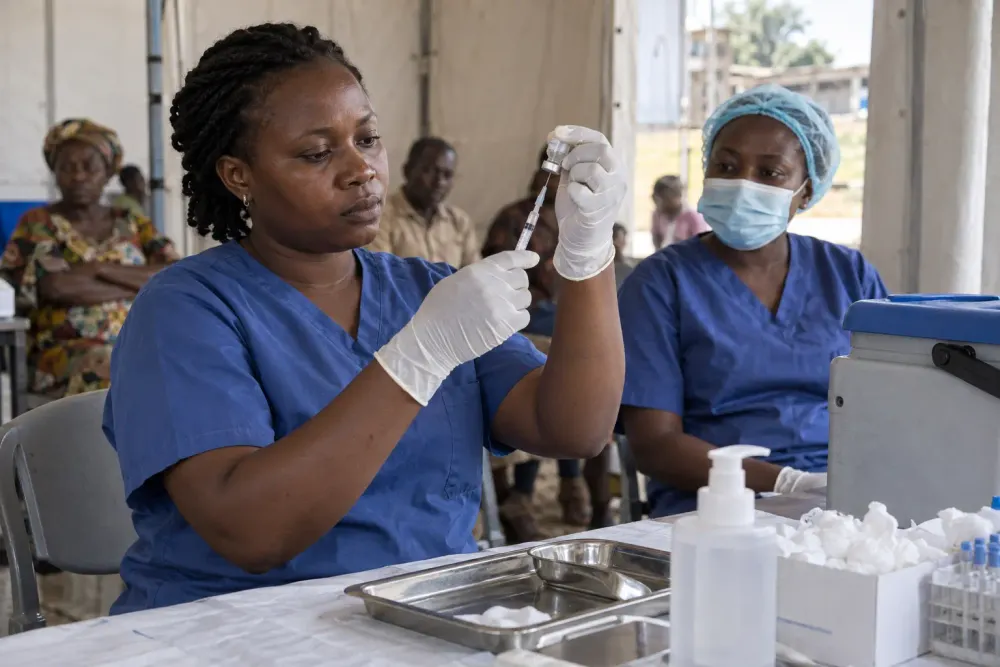
Congolese health authorities began vaccinating frontline workers in the Ebola outbreak’s epicenter Saturday, deploying a proven vaccine against a virus strain it was not designed to stop. The campaign opened in Bunia and Mongbwalu, two hard-hit health zones in Ituri province, as the country reported 7,541 confirmed cases, 3,639 deaths and 1,823 recoveries.
The immediate goal is to reduce risk for people most likely to encounter infected patients and bodies. The larger scientific question is whether Ervebo, a vaccine developed for Zaire ebolavirus, can also protect people from Bundibugyo virus, the species causing the current epidemic. There is no licensed vaccine or specific approved treatment for Bundibugyo virus disease.
The new campaign is expected to cover about 20,000 health and frontline workers in Ituri and North Kivu over six to nine months. It arrives during Congo’s deadliest recorded Ebola outbreak and under conditions that make both disease control and rigorous research unusually difficult: armed insecurity, displacement, a health-worker strike and constant movement across provincial and national borders.
A vaccine-strain mismatch
Ervebo is not an experimental product in the ordinary sense. It is a licensed, single-dose, live viral-vector vaccine with extensive evidence against Zaire ebolavirus. The CDC explains that the vaccine uses a weakened vesicular stomatitis virus carrying one gene from Zaire ebolavirus; it cannot cause Ebola. But the same guidance is explicit that Ervebo does not provide established protection against other orthoebolavirus species.
That boundary matters. Vaccines train the immune system to recognize particular antigens, and Ervebo presents the surface glycoprotein of Zaire ebolavirus. Bundibugyo virus is related, but it is not the same target. Laboratory and animal findings suggest cross-protection may be possible, yet those signals do not establish that vaccinated people will be less likely to develop disease, become severely ill or die.
The WHO assessment says there is insufficient human evidence to determine whether Ervebo protects against Bundibugyo disease or to quantify any benefit. Its updated emergency guidance therefore recommends use within research protocols, with clear disclosure of the benefits, risks and unknowns. That is a more precise description than calling the rollout simply an emergency vaccination drive: it is protection-oriented action paired with evidence generation.
What past success can—and cannot—show
Ervebo’s record against Zaire ebolavirus explains why authorities are willing to study it now. In the pivotal Guinea ring-vaccination trial, contacts and contacts of confirmed Ebola cases were grouped into “rings” and assigned to immediate or delayed vaccination. The final trial report found no Ebola cases 10 days or more after vaccination among immediately vaccinated eligible participants, compared with cases in delayed rings. The design provided strong evidence of protection against the Zaire species circulating in that epidemic.
Later operational use in Congo produced another encouraging estimate. A 2019 WHO analysis reported high effectiveness during a Zaire ebolavirus response conducted under field conditions. Those results strengthened confidence that ring vaccination could work amid an outbreak, not just in a conventional trial site.
Neither study answers the current question. Both involved a vaccine antigen matched to Zaire ebolavirus and outbreaks caused by that same species. Extrapolating their efficacy estimate to Bundibugyo would confuse biological plausibility with demonstrated clinical protection. The earlier studies support the platform and provide substantial safety experience; they do not establish cross-strain effectiveness.
The vaccine’s known risks also remain relevant. The FDA-approved prescribing information lists common reactions such as injection-site pain, headache, fever and muscle pain, and warns that vaccination may not protect everyone. Because it is a replication-competent live vaccine, clinicians must also consider particular precautions, including for some immunocompromised people. Those known safety considerations can be managed; the larger unknown is whether the product provides meaningful benefit against Bundibugyo virus.
How the evidence will be generated
Congo requested doses from the international Ebola vaccine stockpile as the outbreak accelerated. The allocation released 70,000 doses: 20,000 for a Phase 3 trial and 50,000 for health and frontline workers, according to the allocation notice from WHO and Africa CDC. More than 3,000 workers had already been vaccinated by mid-September, and the Bunia launch expands that effort.
WHO favors a randomized ring-vaccination trial because it can compare disease outcomes among people linked to confirmed cases while still offering vaccination within an outbreak response. A separate observational effectiveness study is expected to follow frontline workers. The randomized trial should provide the cleaner estimate if enrollment and follow-up are adequate; random assignment reduces the chance that vaccinated and comparison groups differ in exposure, health status or access to care.
The observational study may move faster and reflect real working conditions, but interpretation will be harder. Vaccinated workers may be more likely to receive protective equipment or training, while the people at highest risk may also be first in line for vaccination. Changes in transmission, case detection and infection-control practice over time can further distort a simple comparison. Researchers will need careful exposure histories, reliable vaccination records, laboratory-confirmed outcomes and enough cases after the immune-response window to estimate effectiveness.
The outcome is not foregone. A finding of fewer cases among vaccine recipients could support broader use, but confidence would depend on study design, precision and evidence that other protections did not explain the difference. A null result could mean the vaccine truly does not work against Bundibugyo, or that transmission fell too quickly for the study to produce a clear answer. Severe-disease and mortality estimates would require still more events and could remain uncertain even if infection prevention becomes measurable.
Why frontline workers come first
Health workers face repeated exposure through triage, treatment, cleaning and the handling of infectious materials. Safe-burial teams confront another high-risk setting because bodies remain infectious after death. Protecting those workers could preserve a strained care system even if the vaccine’s cross-strain benefit turns out to be partial.
But vaccination cannot substitute for the measures already known to interrupt Ebola transmission. WHO’s outbreak guidance prioritizes early detection, laboratory testing, isolation, supportive care, contact tracing, infection-control procedures and safe burials. It also advises against broad travel and trade restrictions, which can drive movement toward informal crossings and weaken surveillance.
Supportive care is especially important because no Bundibugyo-specific treatment is approved. Rapid fluid replacement, management of complications and timely referral can improve an individual patient’s chances, while stronger triage and personal protective equipment reduce exposure inside health facilities. The vaccine rollout should be judged as one layer in that system, not as a replacement for it.
A cautious opening, not a resolution
There are tentative signs of improvement in parts of Ituri, but the national picture remains unstable. WHO officials said transmission had declined in some of the hardest-hit areas while warning that the outbreak had spread to a seventh province and could produce more detected cases as surveillance improves. Falling counts can reflect real control, reporting delays or changing case finding; they should not be treated as proof that the epidemic is ending.
The rollout therefore carries two obligations at once. Authorities must offer exposed workers a scientifically plausible intervention under transparent consent, and researchers must resist presenting plausibility as established protection. Participants need to understand that Ervebo is licensed because it works against another Ebola species, not because it has already proved effective against Bundibugyo.
If the studies produce a reliable signal, Congo’s campaign could supply the evidence needed for future policy while helping the current response. If they do not, the effort can still clarify where Ervebo’s protection ends and sharpen the case for strain-specific or broadly protective vaccines. For now, the most accurate conclusion is narrower: frontline vaccination has begun, but the protection it offers against this outbreak remains an open clinical question.