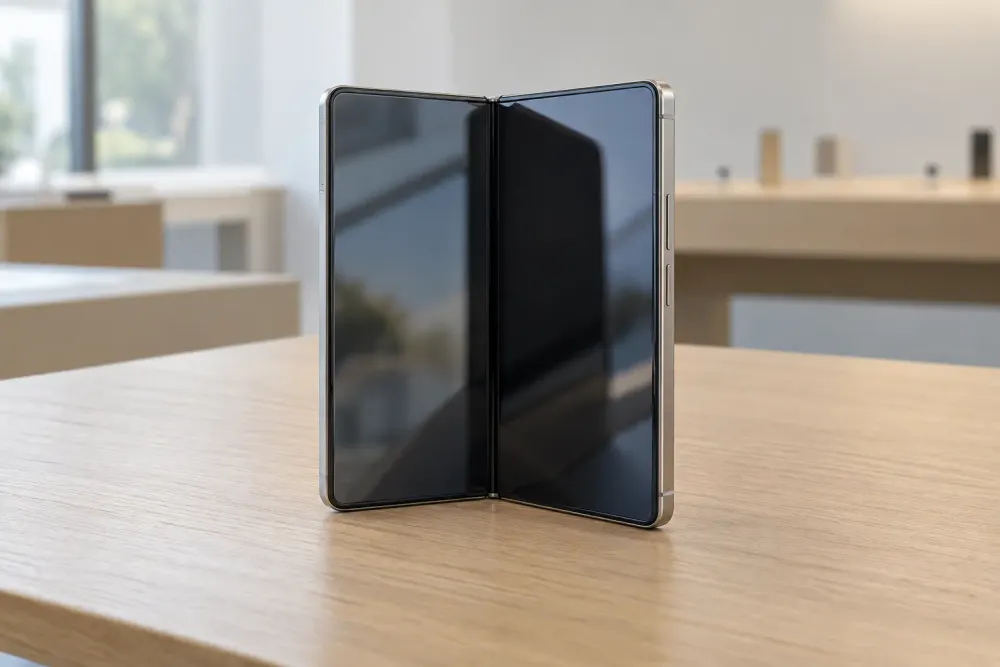
Apple's first foldable iPhone reached stores worldwide Friday with a $1,999 starting price, scarce launch inventory and a larger question hanging over it: Can the company turn a long-niche form factor into a mainstream smartphone category?
The iPhone Duo is the most consequential change to Apple's handset design in years. It opens like a book from a 5.4-inch outer screen into a 7.6-inch inner display, pairing an A20 Pro processor with a new hinge, two batteries and software built for partially folded and fully open positions. But early testing also exposes the limits that have kept foldables from wider adoption: high prices, added weight, camera compromises and inconsistent app support.
A premium launch with constrained supply
The Duo starts at $1,999 for 256 gigabytes of storage, with options up to 2 terabytes, according to Apple. Sales began October 23 in more than 70 countries and regions, with another 28 markets scheduled for October 30.
Initial availability appears tight. Reuters reported that delivery estimates slipped into late January within minutes of preorders opening and that Apple limited online purchases to two phones in several markets. Launch-day queues appeared in cities including New York, London, Shanghai and Hong Kong, though the crowds were smaller than those surrounding some earlier iPhone debuts.
Scarcity is not the same as mass-market demand. A limited first production run can sell through quickly even if the device remains an enthusiast product. The more useful signals will be sustained orders after early adopters are served, production growth and whether buyers accept a price comparable to a laptop.
Polished hardware still carries tradeoffs
Apple's specifications list a 254-gram device that is 11.3 millimeters thick when folded. Both OLED screens support adaptive refresh rates up to 120 hertz, while the inner display uses a matte nano-texture finish intended to reduce reflections and make the central crease less visible. The phone carries an IP68 water- and dust-resistance rating, an unusual strength for a folding design.
Independent reviewers largely agree that the hinge and inner display feel mature for a first-generation product. Wired praised the wide, passport-like shape and nearly hidden crease, while noting that the phone is 53 grams heavier than Samsung's Galaxy Z Fold8. The Verge likewise found the matte display impressive but said the small, wide outer screen makes many ordinary phone tasks awkward and encourages users to unfold the device frequently.
The camera system is another compromise. Apple includes two 48-megapixel rear cameras but no dedicated telephoto lens. Both reviews found it reliable for routine photography, yet below the flexibility of Apple's Pro line. Battery tests were mixed: Wired ended typical days with substantial charge remaining, while The Verge needed a midday charge under heavier use and encountered noticeable heat during some apps and camera features.
The app ecosystem is the harder test
The Duo's value depends less on whether it folds smoothly than on whether software makes use of the extra screen. Apple says standard SwiftUI and UIKit apps can adapt automatically, while new tools in the iOS 27.1 software kit let developers respond to hinge angle, move controls away from the fold and present content on both displays. The company says more than 2,000 developers attended over 50 workshops in 19 cities.
That preparation has not produced universal compatibility at launch. Wired found that optimized apps can offer effective multi-pane layouts but advised waiting for more developers to update their software. The Verge encountered unoptimized apps with black bars, cramped controls or large areas of unused space. It also criticized Apple's rigid multitasking rules, including a fixed 50-50 split for two apps and limited support for a floating third window.
Those shortcomings matter because a foldable is not merely a conventional phone with a larger screen. Its appeal depends on switching smoothly between quick interactions while closed and more expansive reading, editing or multitasking when open. If major apps remain awkward, the hardware premium becomes difficult to justify.
A large bet on a small category
Market researchers agree that Apple's arrival will expand foldables, but their forecasts underscore the category's uncertainty. IDC told Reuters that Apple could capture 31% of foldable units and 44% of the segment's value in 2026. TrendForce separately projected about 5 million Duo shipments this year, or 24.8% of global foldable volume. The estimates differ because they use separate models and definitions, but both anticipate a rapid premium-market impact rather than immediate dominance of smartphones overall.
The launch therefore tests more than one device. Apple must prove that its hardware polish can offset a $2,000 price, that developers will redesign widely used apps, and that production can expand without erasing the early sense of exclusivity. Strong first-week demand answers only the easiest of those questions.
For now, the iPhone Duo looks less like a finished replacement for conventional flagship phones than a credible first step toward one. Its hardware gives foldables a powerful new advocate; its cost and software gaps show why the category has not yet broken through.