With mail voting already underway and fewer than two months before the November 3 midterms, the Trump administration asked the Supreme Court on Sunday to let the Postal Service enforce new national conditions on ballot envelopes and voter data. The emergency request places a fast-moving dispute over postal authority, state election control and operational readiness before the justices at the point when election officials have the least room to change course.
The administration’s application asks the court to suspend a preliminary injunction that blocks mandatory portions of the Postal Service’s rule for the 2026 election. Justice Ketanji Brown Jackson gave challengers until Wednesday to respond, according to Reuters. That schedule signals urgency, but it does not predict whether the court will grant relief or ultimately uphold the rule.
The stakes are national even though the dispute concerns the mechanics of mail. Federal data show that mail ballots accounted for 30.3% of turnout in the 2024 general election, down from the pandemic-era peak but still a central voting method. The new rule could affect when election offices may present ballot mail, what must appear on envelopes and which recipient information states must provide to a federal portal.
A third emergency trip to the justices
The latest filing is the administration’s third request for Supreme Court intervention in the litigation, AP reported. Earlier proceedings challenged a March executive order before the Postal Service completed its rule. The justices lifted one preliminary block in August because the lower court had evaluated a rule that had not yet been finalized, leaving the legality of the finished policy unresolved.
That distinction matters. The Postal Service published its final rule on August 26, and Democratic-led states and voting-rights organizations returned to court against the concrete requirements. U.S. District Judge Indira Talwani first issued temporary relief and on Friday entered a preliminary injunction covering the November election. Her order preserves voluntary use of longstanding postal recommendations while preventing the agency from making the new provisions conditions of service.
The administration says that split creates uncertainty: election officials may prepare under existing practices while litigation continues, only to face mandatory standards later. The challengers answer that immediate enforcement would create the greater disruption because ballot materials, vendor contracts and computer systems were designed before the final requirements appeared. The justices are therefore considering a stay in an unusually compressed operational setting, not deciding a fully developed trial record.
What the postal rule would require
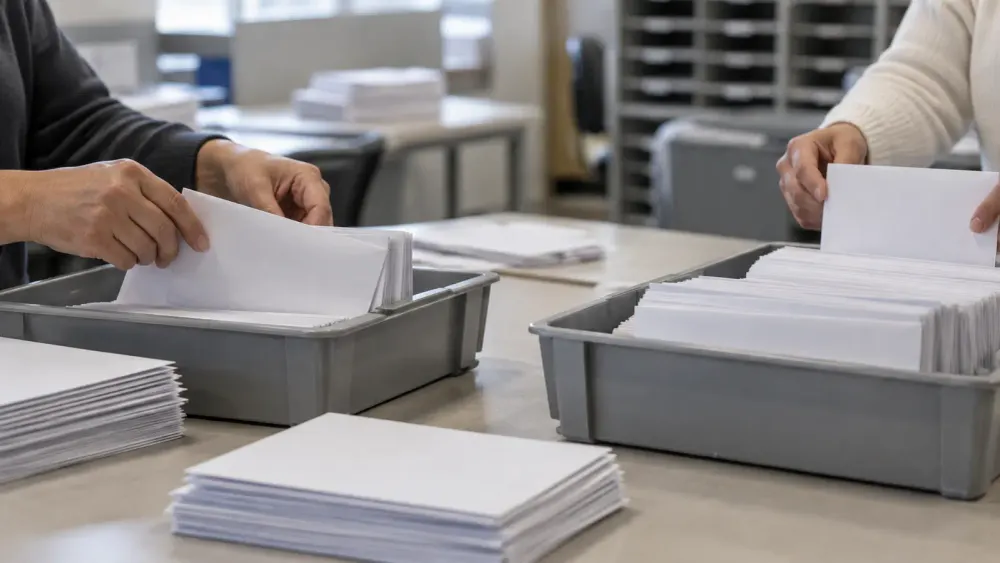
The final rule requires outbound and return envelopes for federal-election ballots to meet automation standards, carry the official Election Mail logo and use unique Intelligent Mail barcodes. Election offices must submit envelope designs for Postal Service review. For outbound mailings, states also must upload each recipient’s name, address, state and barcode information to a new Federal Ballot Mail Portal before presenting the mailing.
Postal workers would compare the physical mailing with the portal submission. A noncompliant outbound batch could be returned to the authorized election mailer for correction and resubmission. The rule says states may update recipient lists continuously and that the Postal Service will not decide who is eligible to vote, maintain voter rolls or count ballots. Returned ballots from voters face envelope-design rules but not the outbound recipient-list check.
The agency presents the system as a way to improve tracking, processing and law-enforcement visibility. Many individual design practices were already recommended, and some states use them. What changes is their mandatory combination with mailpiece-level data. The Postal Service acknowledged comments seeking pilots, delayed implementation, data minimization and safe harbors for minor errors, but concluded that immediate enforcement would maximize time to prepare and advance election-integrity goals.
The government and judge read postal power differently
The administration argues that Congress gave the Postal Service broad authority over the collection, handling and delivery of mail. Its filing characterizes the rule as a modest preparation standard comparable to special requirements for other sensitive mail. States remain free to set voter eligibility, deadlines and counting procedures, the government says, but cannot use the federal mail network while claiming exemption from reasonable conditions for that service.
Talwani reached the opposite preliminary conclusion. She found that the rule functions as an election regulation because it conditions whether ballots may enter the mail and therefore affects how states conduct federal elections. Her order says the Constitution assigns election administration primarily to states, subject to congressional action, and that Congress did not clearly delegate this kind of authority to the Postal Service. She also found a likely statutory problem in creating a new basis for refusing otherwise mailable material.
The policy began with a March executive order, numbered 14399, which directed postal rulemaking as part of a wider election-integrity program. The White House linked the project to federal mail and election crimes. Opponents say the executive branch cannot turn general postal powers into control over state-run ballot systems. Neither the district court’s preliminary ruling nor a Supreme Court stay decision would finally settle that constitutional boundary.
Operational costs collide with a uniformity claim
The district court credited evidence that some jurisdictions had already printed envelopes or could not add individualized barcodes to locally produced and electronically delivered ballots. It found that small offices might lack printing capacity and that states could not reliably redesign materials, secure postal approval, modify election-management systems, train staff and upload data on the new timetable. Because rejected mailings would need correction and resubmission, the court concluded that disruption could prevent eligible voters from receiving ballots.
The administration disputes that prediction and says many jurisdictions already follow much of the design guidance. It argues that an injunction makes compliance appear optional precisely when states need to begin, increasing the risk that eventual appellate relief arrives too late. The filing also stresses that the Postal Service checks state-supplied information rather than independently validating voters, an important limitation on what the portal does.
Yet scale magnifies even a low error rate. The EAC found that about 30% of 2024 ballots were cast by mail. Current state law also varies widely: 29 states allow any voter to request a mail ballot without an excuse, while eight states and Washington generally permit elections conducted entirely by mail. A single federal preparation rule therefore lands on thousands of election offices with different vendors, laws and technical capacity.
Ballot calendars limit every legal option
North Carolina began sending ballots Friday. Alabama is scheduled to follow this week, and more states will begin mail voting through September. A current state calendar shows why the dispute cannot be treated like ordinary regulation: many jurisdictions must transmit ballots 45 days or more before Election Day, including ballots for military and overseas voters governed by separate federal protections.
The Supreme Court’s immediate question is whether the administration has shown a likelihood of success, irreparable harm and a balance of equities favoring a stay. The challengers will argue that the district court preserved settled procedures and protected voters from a late change. The administration will argue that blocking a duly issued postal rule harms federal operations and prevents the promised tracking system from functioning during the election it was designed to cover.
Whatever the justices decide after Wednesday’s response, election officials still must communicate clearly that existing state rules govern voters unless a court order and official state guidance say otherwise. A stay could revive mandatory federal preparation standards almost immediately; a denial would leave the injunction in place while appeals proceed. The durable question—how far postal administration may reach into election administration—will remain after the November deadline has passed.