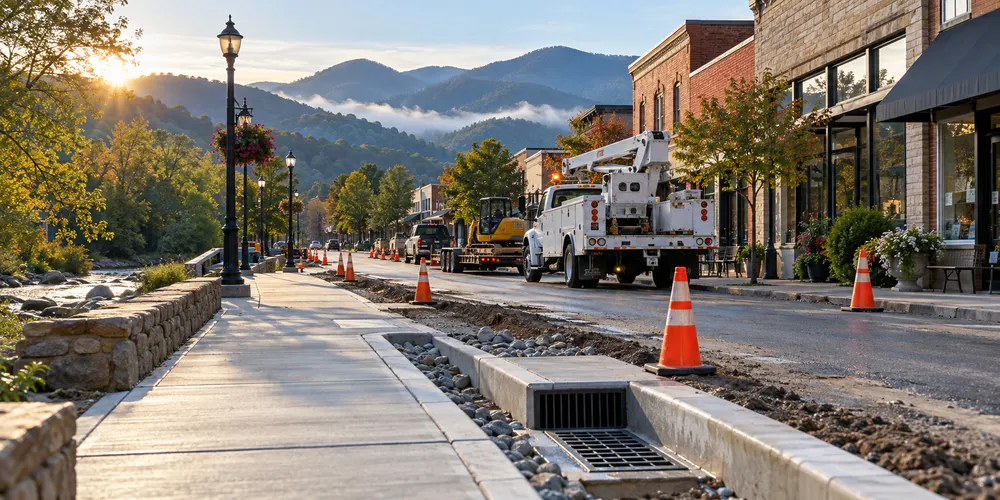
North Carolina has awarded about $5 million for seven public-infrastructure projects intended to help small businesses in western communities recover from Hurricane Helene, directing money to sidewalks, stormwater systems, a culvert and a public water system.
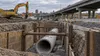
The fourth round of the state’s Small Business Infrastructure Grant Program, known as SmBIZ, includes three $1 million awards in Hayesville for a retaining wall, sidewalks and stormwater work. Bryson City will receive $965,968 for its public water system south of the Tuckasegee River, while Buncombe County will receive $786,291 for sidewalk work in Beacon Village. West Jefferson will get $233,191 for downtown infrastructure, and Elk Park will receive $100,000 to replace a failing Main Street culvert, according to the state announcement.
The awards are consequential because they target public systems that individual businesses generally cannot repair themselves. Under the program rules, local governments apply on behalf of projects tied to small businesses, while the infrastructure must remain publicly owned or maintained. Eligible work can include water, sewer, utilities, broadband, sidewalks and curbs.
SmBIZ was created with a $55 million state appropriation after Helene. The state says it has now awarded more than $36 million across 51 projects since 2025. Grants are generally capped at $1 million per project and $5.5 million per county, and qualifying projects must support businesses with fewer than 150 employees.
One of the new awards illustrates how the program reaches commercial corridors rather than individual storefronts. Buncombe County said its $786,291 grant will repair and extend sidewalks along Railroad Street, Alexander Place and South Avenue in Swannanoa, covering roughly 1,000 square yards. The county’s project notice says the North Carolina Department of Transportation will manage construction and that commissioners are expected to review grant agreements on Oct. 6.
The broader state recovery site describes SmBIZ as a way to restore infrastructure that small businesses rely on to operate and receive customers. Its program overview lists water, sewer, gas, telecommunications, broadband, electrical utilities and pedestrian infrastructure among eligible uses.
Gov. Josh Stein announced the latest grants Thursday in Lansing, nearly two years after Helene struck the mountains. State officials say 99% of damaged drinking-water systems and more than 99% of storm-affected roads have been restored, but they estimate more than $758 million in unmet federal water-system needs remains. Those figures frame the new grants as targeted repairs within a much larger rebuilding effort.
Local governments in eligible counties may keep applying while money remains available. For businesses and residents, the immediate impact will depend on procurement and construction schedules, but the awards establish which communities can now move specific public works from planning toward execution. The work also has practical implications beyond storm recovery: reliable water, safer walkways and drainage capacity can determine whether downtown businesses remain accessible during construction and resilient during the next severe-weather event.