
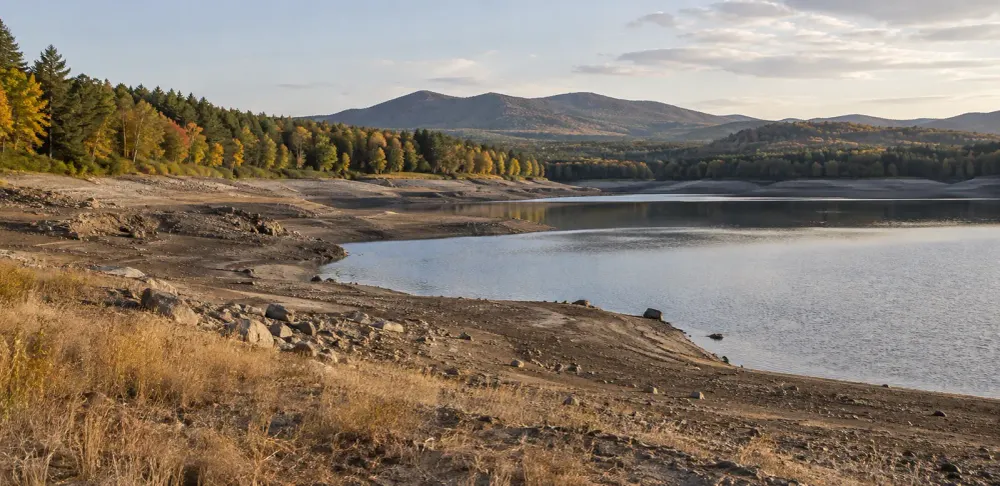
Moderate drought now covers 54.6% of New Hampshire, exposing about 755,400 residents to drought conditions as dry weather returns across central and eastern parts of the state. The federal Drought.gov dashboard says the affected population rose 39.7% in one week, while another 41.3% of the state is classified as abnormally dry.
The latest conditions do not reach the severe or extreme categories recorded during last year’s drought, but the statewide footprint is broad. The U.S. Drought Monitor uses five classifications, with moderate drought as the first formal drought level and “abnormally dry” describing areas entering or emerging from drought. Its weekly assessments combine precipitation, soil moisture, streamflow and local observations.
Water systems are already responding. New Hampshire Bulletin reported that 88 public water systems and two municipalities have outdoor-water restrictions in effect, citing the state Department of Environmental Services. Residents should check the NHDES drought page before watering lawns, filling pools or undertaking other high-volume outdoor uses because restrictions are adopted locally and can vary by system.
The strain is especially relevant for households with private wells. About 250 dry wells have been reported to NHDES over the past year, according to the Bulletin. The hardest-hit areas have accumulated a precipitation deficit of roughly 10 inches, while low water tables in southern New Hampshire also reflect longer-term shortages. Once the ground freezes, late-season rain is less able to recharge groundwater, making autumn conservation consequential even if surface conditions appear to improve.
State officials recommend reducing discretionary water use rather than waiting for a well or local supply to fail. NHDES’s water-conservation guidance advises residents to follow their supplier’s restrictions, shorten showers, run dishwashers and washing machines only with full loads, repair leaks and limit lawn watering. Municipalities and public water systems have authority to impose mandatory limits when supplies require them.
The renewed drought follows a winter that produced near-normal snowfall totals but less water content than usual. State climatologist Mary Stampone and Plymouth State University researcher Eric Kelsey told the Bulletin that snow-water equivalent reached only about 50% to 75% of historical benchmarks in much of the state. Spring rain eased conditions in several regions, but drought persisted in portions of southeastern New Hampshire before expanding again.
A September 10 regional update from the NOAA-supported Northeast Regional Climate Center likewise found deterioration across northern New England, including expanding moderate drought or abnormal dryness in central New Hampshire. That broader pattern means short bursts of rain may not erase accumulated groundwater deficits. Residents on private wells should watch for falling pressure, sediment or air in plumbing and contact a licensed well professional before a complete loss of water.
NHDES also accepts reports of dry wells, giving state planners a clearer picture of household impacts that may not appear immediately in broad regional maps or precipitation totals.