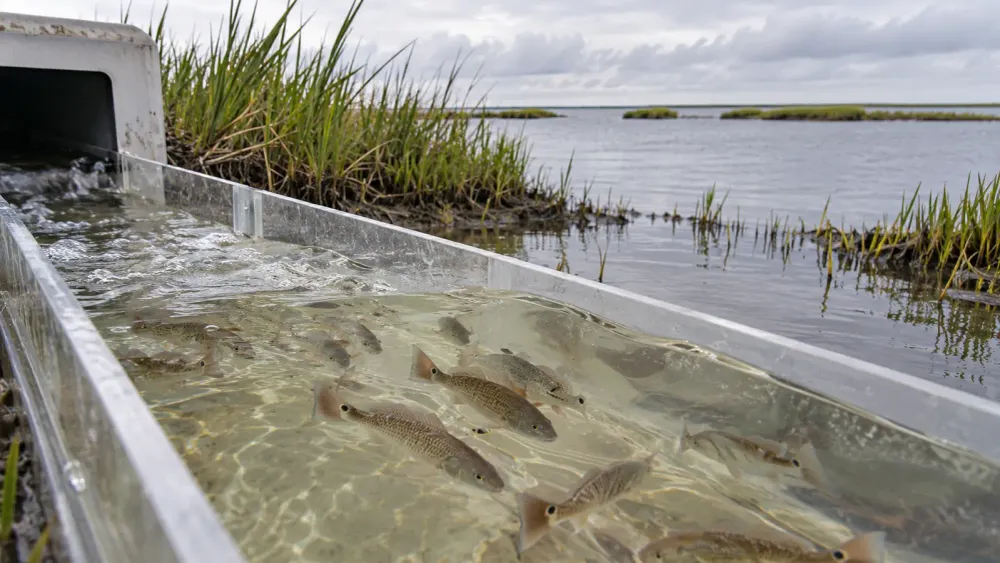
Louisiana has released more than 150,000 hatchery-raised red drum into three coastal areas in the state’s first redfish restocking effort, a new test of whether carefully tracked juvenile fish can supplement the wild population. The Louisiana Department of Wildlife and Fisheries announced that fish were placed in Calcasieu Lake, the Rigolets and waters near Grand Isle.
The largest publicized release took place September 11 at the West Cove Boat Ramp on Sabine National Wildlife Refuge, where more than 50,000 juveniles entered Calcasieu Lake. American Press reported that event as part of the broader program, while the remaining fish were distributed at the Rigolets and Grand Isle rather than concentrated in one estuary. LDWF posted the statewide announcement on September 16, five days after the Calcasieu release.
The fish were raised at the University of Southern Mississippi’s Gulf Coast Research Laboratory from Louisiana broodstock. Before release, crews gradually adjusted the fingerlings to local water temperature and salinity, according to a Houma Times account of the operation. The project brings together Coastal Conservation Association Louisiana, the Recreational Fisheries Research Institute and LDWF, with Southeastern Louisiana University participating in the research. Cameron LNG and Sempra Infrastructure funded the work.
The releases are designed as a monitored fisheries experiment, not a claim that anglers will immediately see more legal-size redfish. LDWF plans to provide fin clips from its independent red-drum sampling for genetic testing, allowing researchers to identify hatchery-origin fish and estimate their survival, movement and contribution over time. Using Louisiana broodstock and several release sites should also help the partners compare results across different coastal habitats.
That distinction matters because fingerlings face normal mortality before reaching harvestable size. The practical measure of success will be how many genetically identified fish appear later in scientific sampling—not simply the number placed in the water this month. Juvenile red drum depend on shallow estuarine nursery habitat, which is why the West Cove location and the other coastal release areas were selected for the pilot.
For anglers, existing harvest rules remain unchanged. Under LDWF regulations in force since June 20, 2024, the daily limit is four red drum per angler, with an 18-inch minimum and 27-inch maximum total length. Retaining fish longer than 27 inches is prohibited, and captains and crews may not keep red drum while working charter or head-boat trips.
The immediate state-level consequence is scientific capacity: Louisiana now has a marked, genetically traceable group of hatchery fish spread across southwest and southeast coastal waters. Results will take time, and the agencies have not presented restocking as a substitute for harvest limits or habitat management. But the first release gives managers a measurable way to test whether hatchery supplementation can become a useful addition to Louisiana’s red-drum program.