
A Johnson County judge has reversed Iowa’s decision to close the State Historical Society of Iowa research center in Iowa City, ruling that state law requires the Department of Administrative Services to maintain a functioning research facility in the city.
District Court Judge David M. Cox’s Sept. 17 order rejected the department’s interpretation of Iowa Code section 8A.707. The ruling resolved three consolidated judicial-review cases. That statute says the department “shall” maintain research centers in Des Moines and Iowa City. Cox concluded the language is unambiguous and that an arrangement with the University of Iowa did not satisfy the state’s obligation.
The ruling does not set an immediate reopening date. Instead, it gives the parties 30 days to confer and propose language carrying out the reversal. If they cannot agree, each side must submit a proposed order and the court will decide the implementation terms. Cox declined, for now, to appoint a special master.
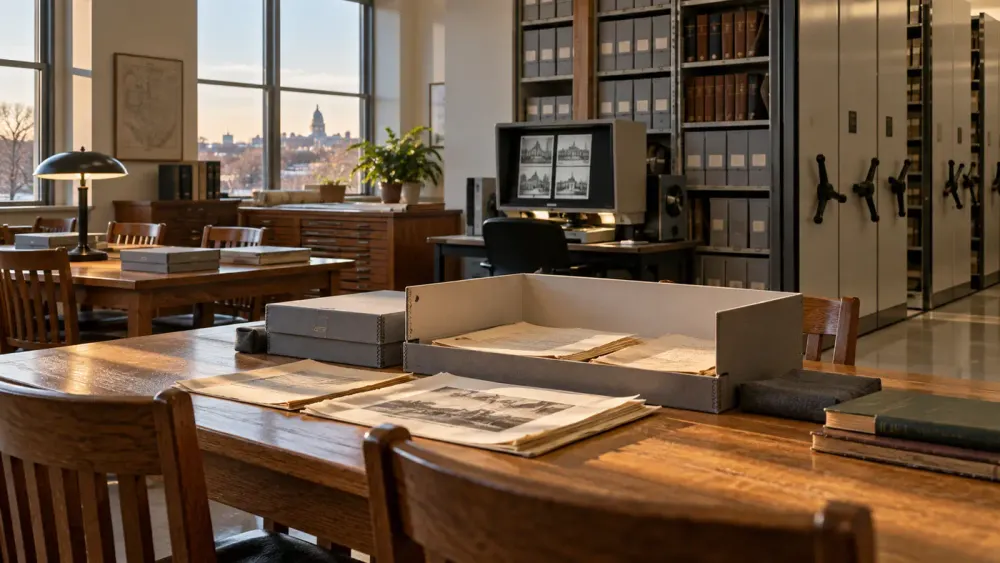
The dispute centers on the Centennial Building at 402 Iowa Avenue, which opened in 1960 and holds print material, special collections, photographs, audiovisual recordings and fine art. The court said the department violated the statute by closing that building without offering a replacement Iowa City research facility. It also found that the agency lacked a proper basis to refuse a declaratory ruling on whether moving donated materials would violate donor restrictions.
The state closed the building in December after officials cited budget and maintenance concerns. Iowa Public Radio reported that former DAS director Adam Steen had described the decision as a response to the facility’s costs. The department told Radio Iowa that it is reviewing the order.
The controversy began well before the final closure. In 2025, the society shifted public access to appointments as it faced a projected $800,000 shortfall, while historians and former employees warned that consolidation could weaken access to unique records. The Iowa City center had served researchers for nearly 70 years, according to Axios reporting from that period.
Cox also preserved the practical concern behind an earlier injunction that stopped additional removals. His order said moving materials could damage or destroy them and found that closure would negatively affect the public interest. However, the ruling does not resolve every operational question, including what repairs are needed, which records must be returned or how quickly public services can resume.
For researchers, donors and the state, the next milestone is the court-directed implementation process. KCRG reported that the agency and the historical society have 30 days from the order to agree on how the decision will be carried out. The legal result is clear: Iowa must maintain a research center in Iowa City. The timetable and operating plan now depend on negotiations under the court’s supervision.