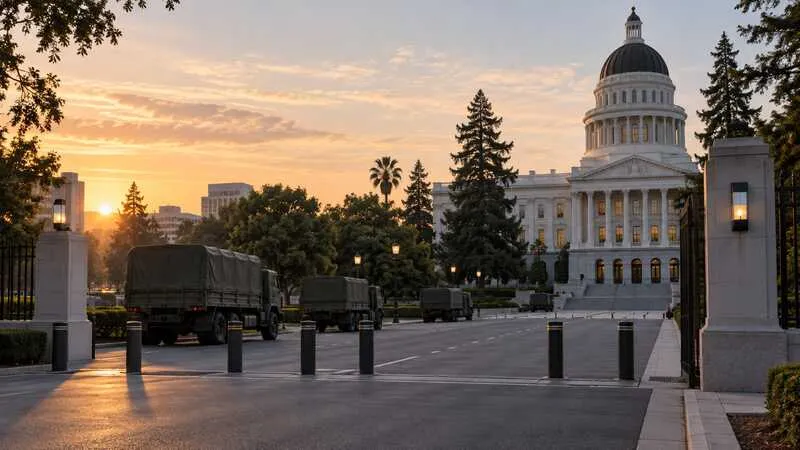
California has enacted a law requiring the governor's permission before military personnel controlled by another state, territory or the District of Columbia may enter California for military duty or law-enforcement functions, while preserving exceptions for federalized troops, existing interstate compacts and training.
Governor Gavin Newsom signed Senate Bill 1354 on September 19. The enrolled bill text adds a new section to the Military and Veterans Code and allows the governor to delegate approval authority to California's adjutant general. The measure was authored by Democratic Sen. Bob Archuleta of Pico Rivera and passed the Assembly on August 19 and the Senate on August 24.
The law is specifically aimed at state-controlled deployments. It does not cover troops called into active federal service under Title 10 and acting under the president or defense secretary. It also exempts interstate military compacts entered before January 1, 2027, and educational courses or training exercises involving personnel from outside California.
That distinction limits the law's reach. Under Title 10, Guard members operate as part of the federal armed forces. Under Title 32, they remain under a state's command even when the federal government funds the mission. The governor's signing announcement says SB 1354 is intended to prevent another governor from sending state-controlled forces into California without consent.
What changes — and what does not
The practical effect is to create a clear state-law approval requirement for interstate deployments that remain under another governor's authority. Newsom framed the legislation as a state-sovereignty safeguard. Archuleta said it would ensure outside forces enter California only for appropriate missions and training.
The law would not have blocked the 2025 federalization and deployment of California National Guard personnel to Los Angeles, because those troops were placed under federal Title 10 command. That episode nevertheless shaped the political context. The administration says the deployment cost at least $111.2 million and diverted Guard personnel from wildfire and counterdrug work; California challenged the federal action in court.
The San Francisco Chronicle reported that the enacted version was narrowed from an earlier proposal that contemplated criminal penalties. The final statute instead places the decision with the governor and defines categorical exceptions, reducing the risk that ordinary training or established emergency-assistance arrangements would be swept in.
The unresolved question is how the restriction would operate if another state asserted federal encouragement or funding while retaining state command. Any confrontation could raise constitutional questions about federal authority, interstate relations and preemption. SB 1354 states California's position clearly, but courts would have the final word if a disputed deployment reached the state.
For Californians, the immediate consequence is institutional rather than operational: out-of-state military forces on a nonfederal mission now need affirmative state approval. The measure does not change federal mobilization powers, authorize California to obstruct active-duty forces or disturb pre-2027 mutual-aid compacts.