
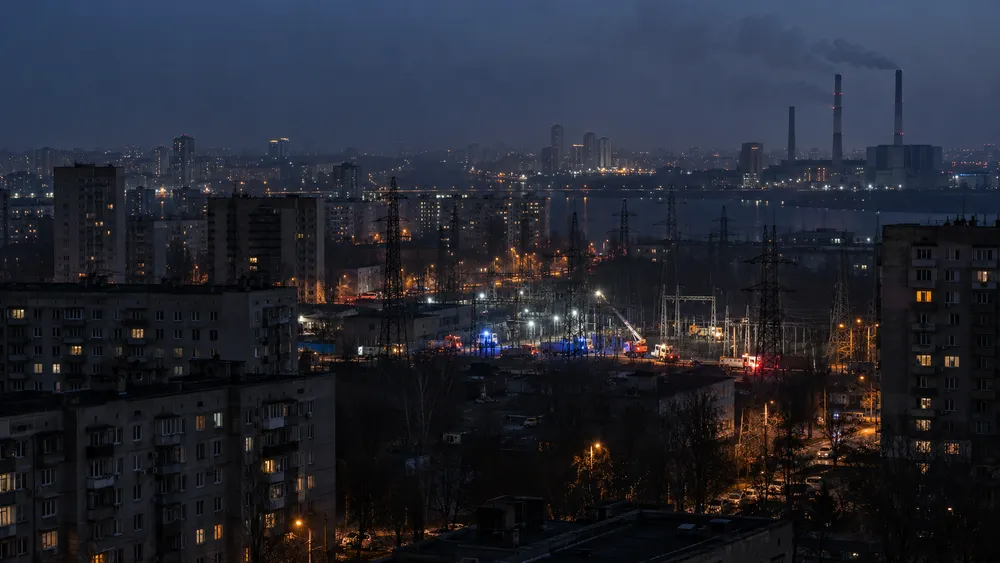
Russian strikes hit at least two Ukrainian power plants on Sunday after President Donald Trump said an energy ceasefire between Russia and Ukraine was “effective immediately,” according to Ukrainian officials and independent reporting. The attacks on facilities in Kyiv and Kharkiv produced outages in the capital and a fire at Kharkiv’s CHP-5 plant, raising an immediate question about whether the announced truce existed beyond the president’s social-media post.
Ukrainian President Volodymyr Zelenskyy said a drone struck a Kyiv power plant shortly before one of his diplomatic calls, then energy facilities in the Kharkiv region were hit after Trump’s announcement. His office said the Kyiv strike left several districts without electricity, while AFP reported that the Kharkiv target was CHP-5, a combined heat-and-power facility.
The strikes are a material change from the uncertainty described in TAQ’s report earlier Sunday, when Kyiv was waiting for terms and Moscow had not responded. Russia still had not publicly confirmed an agreement by Sunday evening, while Ukraine said it was prepared to stop striking Russian energy infrastructure only if Moscow reciprocated.
An announcement without published terms
Trump declared that both countries had agreed to an energy ceasefire but did not publish a start time beyond “effective immediately,” a list of protected facilities, a monitoring mechanism or consequences for violations. Reuters reported that Zelenskyy welcomed the idea while saying Ukraine was still awaiting details from Washington and needed Russia to support the same restraint.
That gap matters because an energy ceasefire is narrower than a general halt in fighting. It could cover power plants, transmission networks, oil refineries and gas installations while leaving battlefield operations and attacks on other military or civilian targets outside its scope. Without a shared written definition and an agreed effective time, even a confirmed strike may not establish which side violated what rule.
The absence of terms also echoes an unresolved U.S. announcement in September. AP reported that Trump then said both countries had agreed not to attack energy infrastructure, but neither side confirmed a durable arrangement. That history makes matching statements and observable compliance especially important now.
Power plants hit after the declaration
Zelenskyy said in his evening address that Russian drones and glide bombs remained active and that Ukraine’s energy system was still under attack. The presidential office said strikes on energy facilities in Kyiv and Kharkiv occurred after Trump’s statement. It also said Ukraine had recorded more than 200 attacks on electricity-generation and transmission facilities and 17 attacks on oil and gas sites during the preceding week.
At Kharkiv’s CHP-5 plant, a local official told ABC News that the facility was hit at least twice and caught fire. The Associated Press separately reported that Ukraine’s presidential office confirmed the Kharkiv attack followed Trump’s post and that Kyiv also reported a strike on an energy site. AP noted that Moscow had not commented on the ceasefire claim.
The reports establish that attacks continued after the U.S. announcement, but important details remain unresolved. Russia had not acknowledged responsibility for the power-plant strikes or provided its account of the targets by the reporting cutoff. The scale of the outages, the duration of the fire and the plants’ operating status were also not fully established.
A ceasefire now requires reciprocal confirmation
Ukraine’s position is conditional but explicit: Kyiv says it will refrain from striking Russian energy infrastructure if Russia does the same. Zelenskyy’s evening address framed the U.S. announcement as potentially positive while emphasizing that it had to become reality. Trump’s statement asserted that both parties had agreed; the public record available Sunday evening showed Ukrainian readiness, Russian silence and continued strikes.
That distinction prevents the latest attacks from being labeled a proven breach of a mutually accepted accord. They do, however, undercut the claim that an operative ceasefire was already in place. A durable arrangement would require direct confirmation from Moscow and Kyiv, a common list of protected energy assets, a verifiable start time and a process for investigating incidents.
What comes next
The immediate test is whether Russia confirms the proposal and whether attacks on energy infrastructure stop overnight. Ukraine’s grid operators and local authorities will also provide the first measurable indication of damage and restoration needs in Kyiv and Kharkiv. Further strikes would make the gap between the announced ceasefire and battlefield reality harder to explain as a timing or communication problem.
For now, the new fact is not that diplomacy has ended, but that the claimed ceasefire did not produce an observable halt when announced. The proposal remains possible; its implementation is unverified. Until both governments state matching terms and attacks stop, the energy ceasefire is best understood as a U.S. assertion that Ukraine supports in principle, not a functioning agreement.