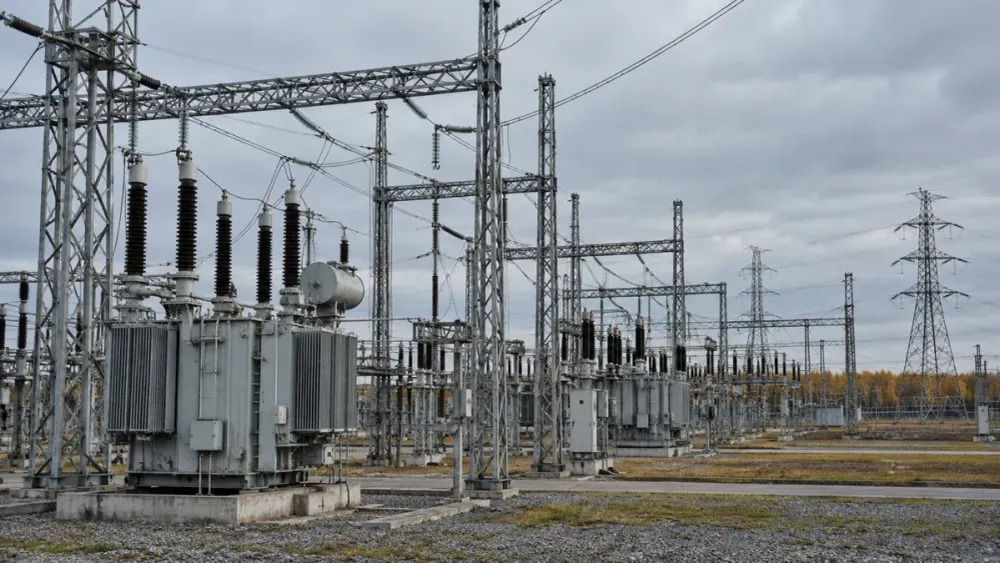
Russian missile and drone strikes left at least 550,000 Ukrainian households without electricity overnight, President Volodymyr Zelenskyy said Monday, as another assault on the country’s energy network sharpened a dispute with Washington over advance warnings. The figure was an initial account of outages, rather than a verified count of households still disconnected after repairs began.
Zelenskyy said Russia launched 16 ballistic missiles against Kyiv and the surrounding region and more than 200 drones across Ukraine. His official account initially reported damage to more than 10 energy facilities; a later update identified 28 substations and other important energy sites that had been hit. He said restoration work was underway and electricity was gradually returning.
The attacks during the night of October 18–19 are distinct from the separate political question of why warnings did not reach Ukraine as expected. Kyiv says critical information was missing or late. U.S. officials deny a pause in intelligence sharing. The public evidence does not establish that Washington deliberately withheld a warning for these strikes.
Damage extends beyond electricity facilities
Ukraine’s Interior Ministry reported damage to energy and civilian infrastructure in 11 regions, with the capital also affected. It listed a medical clinic, a school, a metro station and residential buildings among damaged sites. Warehouses holding medicines, railway stations and commercial premises were also hit, according to the ministry’s account.
The ministry cited Prime Minister Sergii Koretskyi as reporting one death and eight injuries in Kyiv, six people wounded in the Kharkiv region, including two children, and two injured in Rivne. Separately, Reuters reported officials’ accounts of two deaths in Kryvyi Rih as well as the Kyiv fatality. Those figures describe reports available during the response, not a final national casualty total. The ministry said emergency services were assisting injured people while specialists carried out restoration work and replaced equipment. Its statement did not give a definitive nationwide timetable for completion, leaving the duration of local disruption uncertain.
Russia’s Defense Ministry said its forces struck facilities supporting Ukraine’s military, including a data center and sites associated with drones and missiles. That is Moscow’s account of its targets, reported by the Associated Press; it does not independently resolve the purpose or use of every damaged location. Civilian damage and military targeting claims require separate verification.
The warning accounts remain unresolved
Zelenskyy said Ukraine again received no early warning from partners. Air force spokesperson Yurii Ihnat gave a more specific sequence: information was missing before the first ballistic-missile attack but was received before a second, according to Reuters. AP reported that information concerning the second wave arrived too late to activate air-raid sirens in time. The accounts indicate a dispute about both availability and usefulness, rather than proving that every intelligence channel stopped operating.
Secretary of State Marco Rubio denied an interruption while speaking to reporters in Uzbekistan on Monday. His response contradicted Zelenskyy’s Sunday statement that intelligence cooperation had briefly been blocked and then restored. Rubio said there had been no pause and argued that attention should remain on ending the war. Ukraine has relied on U.S. intelligence to detect fast-moving Russian ballistic missiles.
No public technical record reviewed for this article establishes why particular warnings failed to arrive when Ukrainian officials expected them. A late alert, a technical failure and a deliberate policy restriction are different explanations. The available statements do not justify choosing among them as an established fact. Nor does confirmation that some information was shared establish that it arrived early enough to protect civilians.
Repairs face a repeated cycle of damage
The assault struck a system already undergoing emergency repairs. At an October 16 crisis meeting, Ukraine’s government reviewed repairs, protective engineering and reserves of gas, coal, fuel and replacement equipment. Its account said facilities restored by energy workers were being damaged again. Koretskyi called for faster construction and connection of distributed generation, with particular attention to delays in Kyiv.
That record helps explain why restoring power after one attack does not settle the winter-supply problem. Repairing a damaged installation restores a capability; protecting it, maintaining spare equipment and adding alternative generation address different vulnerabilities. The government’s instructions describe intended actions, not proof that new capacity is already operating. Monday’s outages add another repair burden while those preparations continue.
What the figures can establish
The scale of reported outages and damage shows a substantial disruption, but household counts are not interchangeable with numbers of individual people. Likewise, an installation described as hit is not necessarily destroyed, and electricity restored to customers does not mean all equipment has been permanently repaired. The changing official totals should be read as successive assessments during an active emergency.
The immediate tests are how quickly utilities reconnect affected customers, how much capacity remains available and whether advance warnings become reliable. For diplomacy, the unresolved issue is whether Kyiv and Washington can reconcile their conflicting accounts with a functioning warning process. For households facing another interruption, that process and the supply of defensive equipment matter alongside the repair crews already working on the ground.